Department of Molecular Genetics, Weizmann Institute of Science, Rehovot, Israel.
Department of Chemical and Biological Physics, Weizmann Institute of Science, Rehovot, Israel..
Sci Adv. 2021 Jun 2;7(23). doi: 10.1126/sciadv.abf6251. Print 2021 Jun.
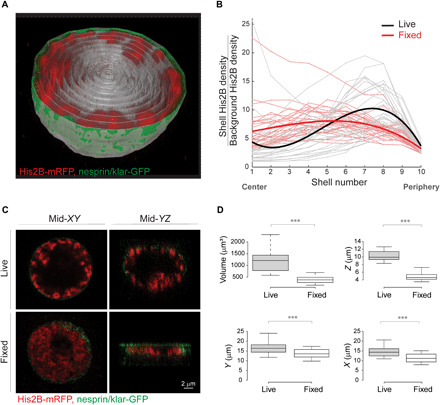
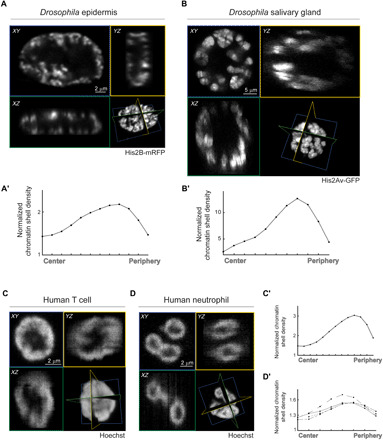
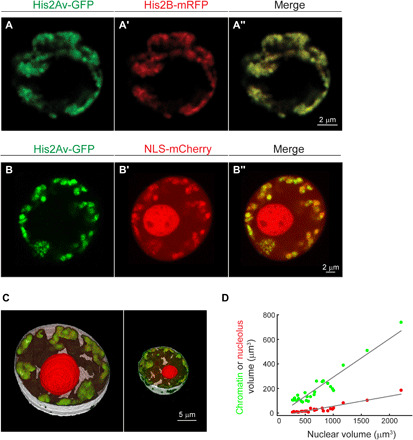
The three-dimensional organization of chromatin contributes to transcriptional control, but information about native chromatin distribution is limited. Imaging chromatin in live larvae, with preserved nuclear volume, revealed that active and repressed chromatin separates from the nuclear interior and forms a peripheral layer underneath the nuclear lamina. This is in contrast to the current view that chromatin distributes throughout the nucleus. Furthermore, peripheral chromatin organization was observed in distinct tissues, as well as in live human effector T lymphocytes and neutrophils. Lamin A/C up-regulation resulted in chromatin collapse toward the nuclear center and correlated with a significant reduction in the levels of active chromatin. Physical modeling suggests that binding of lamina-associated domains combined with chromatin self-attractive interactions recapitulate the experimental chromatin distribution profiles. Together, our findings reveal a novel mode of mesoscale organization of peripheral chromatin sensitive to lamina composition, which is evolutionary conserved.
染色质的三维组织有助于转录控制,但有关天然染色质分布的信息有限。对保持核体积的活体幼虫中的染色质进行成像显示,活跃和抑制的染色质从核内部分离出来,并在核纤层下形成一个外围层。这与当前认为染色质分布在整个核内的观点形成对比。此外,在外周组织中观察到了外周染色质的组织,以及在活的人类效应 T 淋巴细胞和中性粒细胞中。核纤层 A/C 的上调导致染色质向核中心坍塌,并与活跃染色质水平的显著降低相关。物理建模表明,与核纤层相关的结构域的结合以及染色质的自吸引相互作用可以再现实验染色质分布模式。总之,我们的研究结果揭示了一种对核纤层组成敏感的外周染色质的新的介观组织模式,这种模式在进化上是保守的。