Kandpal Renu, Arora Sandeep, Arora Divya
Department of Dermatology, Military Hospital, Meerut, Uttar Pradesh, India.
Department of Dermatology, Command Hospital Air Force, Bangalore, Karnataka, India.
J Cutan Aesthet Surg. 2021 Jan-Mar;14(1):93-100. doi: 10.4103/JCAS.JCAS_29_20.
Onychomycosis (OM) accounts for 20%-40% of all nail disorders. Slow growth of nails, resistance to antifungal drugs, their side effects, and drug interactions limit treatment options. Q-switched neodymium-doped yttrium aluminum garnet (Nd:YAG) laser is approved for nail clearance of OM, however conflicting reports exist in literature about its efficacy. This study was conducted to compare the efficacy of Q-switched Nd:YAG laser.
The aim of this study was to find the efficacy of Q-switched Nd:YAG laser (1064 nm) management of OM as monotherapy in comparison to itraconazole.
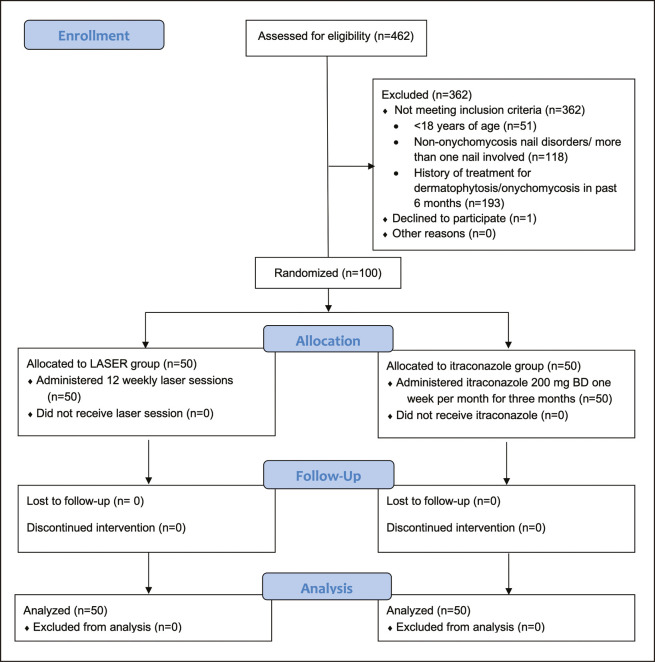
A randomized parallel group, outcome assessor trial was conducted over 18 months from July 1, 2015 to December 31, 2016, at skin center of a tertiary care hospital.
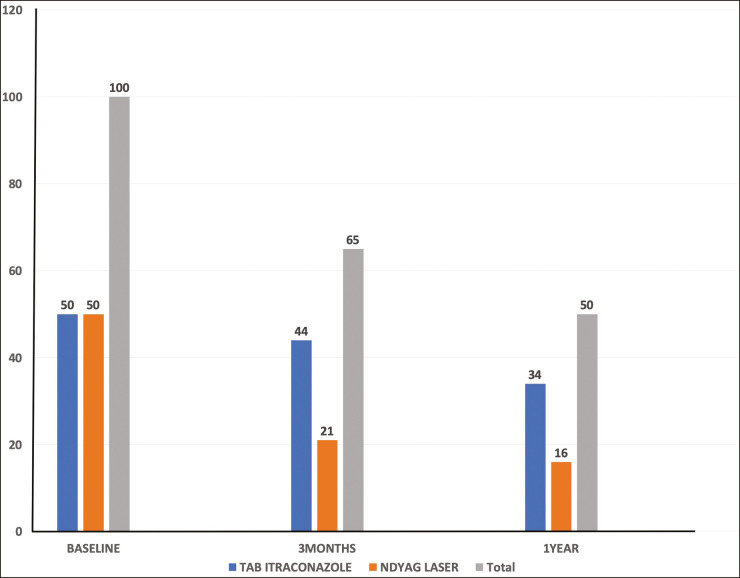
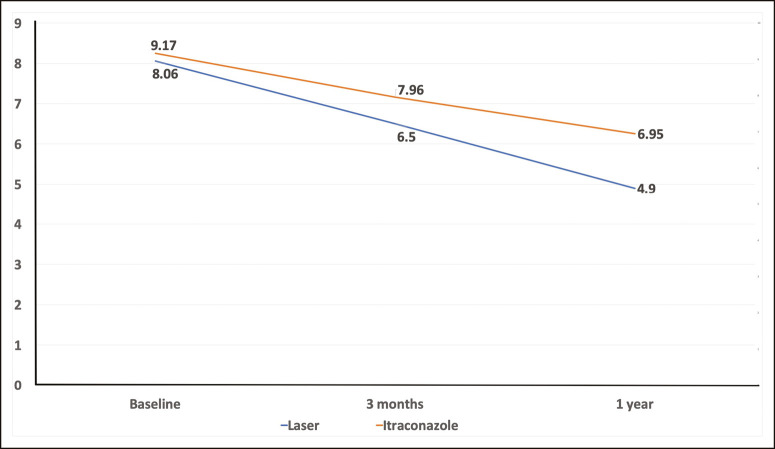
In the first group, patients of OM were administered 12 weekly sessions of the laser. Second group was administered itraconazole 200 mg twice a day for 1 week per month for the 3 months. Confirmed cases of OM, who had not received treatment 6 months before presentation, were selected and randomly allocated to two groups of 50 each. Onychomycosis severity index (OSI) and visual analog scale (VAS) score were used to assess nail involvement at the start of study, 3 months and 1 year after enrollment.
Clinical profile of patients was analyzed by chi-square test for qualitative variables. For comparison of quantitative variables, Student test was performed. A 5% probability level was considered as statistically significant ( < 0.05).
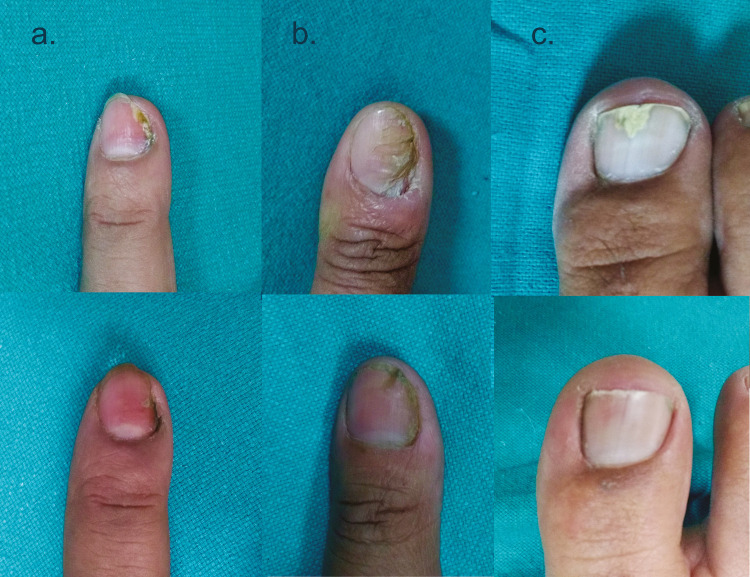
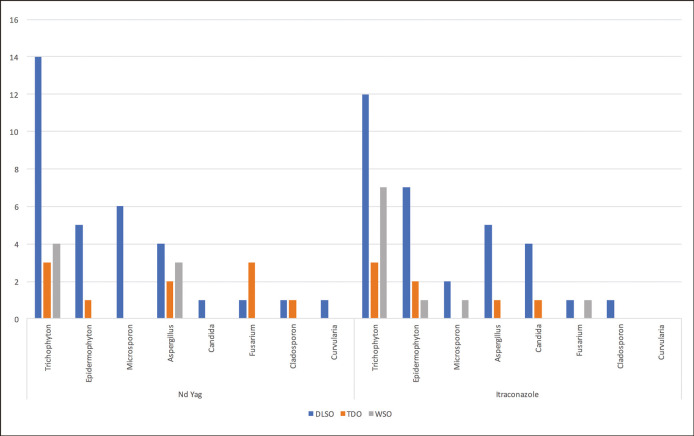
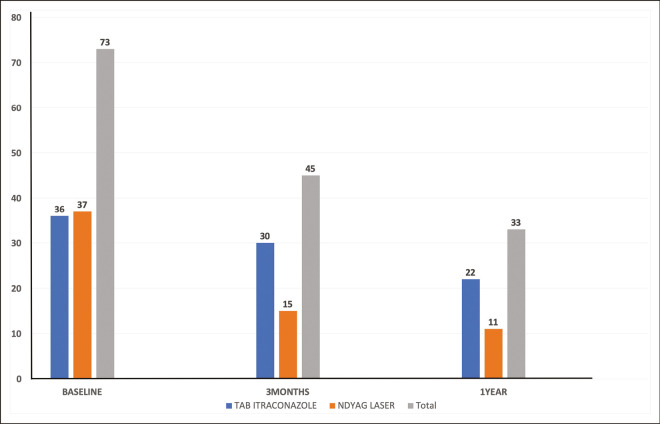
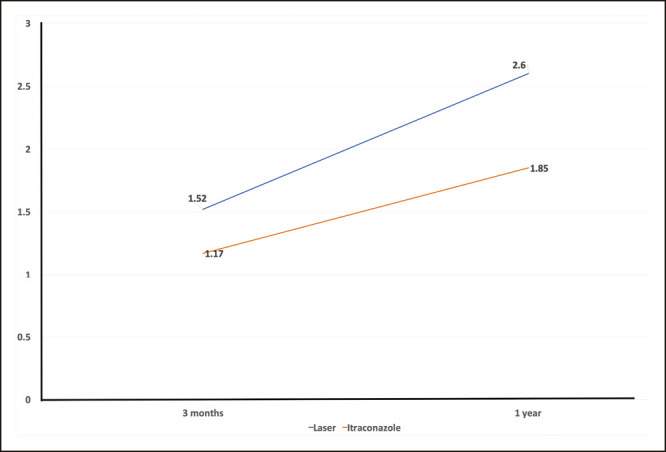
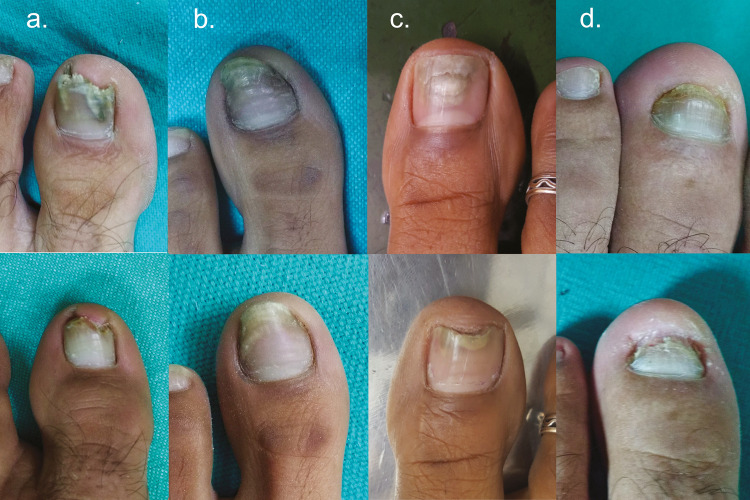
VAS and OSI showed statistically significant improvement at 3 and 12 months in Group I, while resulting in faster clearance with laser; OSI was comparable in both groups at 12 months. Mycological cure was significantly higher in Group I. Both dermatophytes as well as non-dermatophytes responded well to laser treatment, whereas non-dermatophytes responded better to laser.
Q-switched Nd:YAG laser is effective in inducing nail clearance in OM and is better than itraconazole in managing non-dermatophyte OM.
甲真菌病(OM)占所有指甲疾病的20%-40%。指甲生长缓慢、对抗真菌药物的耐药性、药物副作用以及药物相互作用限制了治疗选择。调Q掺钕钇铝石榴石(Nd:YAG)激光已被批准用于清除甲真菌病的病甲,然而文献中关于其疗效的报道相互矛盾。本研究旨在比较调Q Nd:YAG激光的疗效。
本研究的目的是比较调Q Nd:YAG激光(1064nm)作为单一疗法治疗甲真菌病与伊曲康唑的疗效。
2015年7月1日至2016年12月31日,在一家三级护理医院的皮肤中心进行了一项为期18个月的随机平行组、结果评估者试验。
第一组,甲真菌病患者接受12次每周一次的激光治疗。第二组,每月服用伊曲康唑200mg,每天两次,共3个月,每月服用1周。选择确诊为甲真菌病且在就诊前6个月未接受过治疗的患者,并随机分为两组,每组50人。在研究开始时、入组后3个月和1年,使用甲真菌病严重程度指数(OSI)和视觉模拟量表(VAS)评分来评估指甲受累情况。
通过卡方检验分析患者的临床特征以评估定性变量。对于定量变量的比较,进行学生t检验。5%的概率水平被认为具有统计学意义(P<0.05)。
第一组在3个月和12个月时,VAS和OSI显示出统计学上的显著改善,激光治疗导致病甲清除更快;12个月时两组的OSI相当。第一组的真菌学治愈率显著更高。皮肤癣菌和非皮肤癣菌对激光治疗均反应良好,而非皮肤癣菌对激光的反应更好。
调Q Nd:YAG激光在诱导清除甲真菌病的病甲方面有效,并且在治疗非皮肤癣菌性甲真菌病方面优于伊曲康唑。