Parbie Prince Kofi, Mizutani Taketoshi, Ishizaka Aya, Kawana-Tachikawa Ai, Runtuwene Lucky Ronald, Seki Sayuri, Abana Christopher Zaab-Yen, Kushitor Dennis, Bonney Evelyn Yayra, Ofori Sampson Badu, Uematsu Satoshi, Imoto Seiya, Kimura Yasumasa, Kiyono Hiroshi, Ishikawa Koichi, Ampofo William Kwabena, Matano Tetsuro
AIDS Research Center, National Institute of Infectious Diseases, Tokyo, Japan.
Noguchi Memorial Institute for Medical Research, University of Ghana, Accra, Ghana.
Front Cell Infect Microbiol. 2021 May 18;11:646467. doi: 10.3389/fcimb.2021.646467. eCollection 2021.
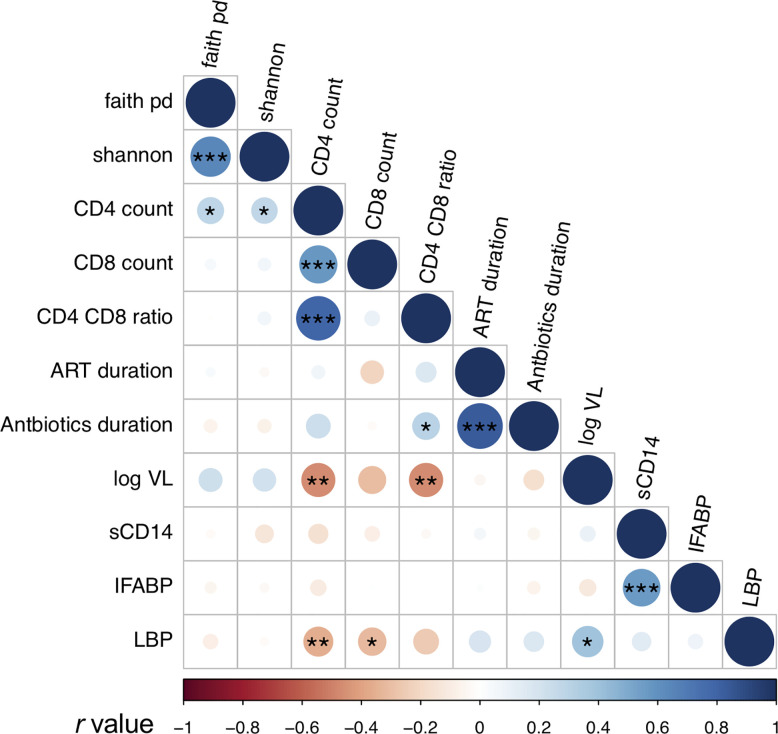
HIV-1 infected individuals under antiretroviral therapy can control viremia but often develop non-AIDS diseases such as cardiovascular and metabolic disorders. Gut microbiome dysbiosis has been indicated to be associated with progression of these diseases. Analyses of gut/fecal microbiome in individual regions are important for our understanding of pathogenesis in HIV-1 infections. However, data on gut/fecal microbiome has not yet been accumulated in West Africa. In the present study, we examined fecal microbiome compositions in HIV-1 infected adults in Ghana, where approximately two-thirds of infected adults are females. In a cross-sectional case-control study, age- and gender-matched HIV-1 infected adults (HIV+; n = 55) and seronegative controls (HIV-; n = 55) were enrolled. Alpha diversity of fecal microbiome in HIV+ was significantly reduced compared to HIV- and associated with CD4 counts. HIV+ showed reduction in varieties of bacteria including , the most abundant in seronegative controls, but enrichment of . Ghanaian HIV+ exhibited enrichment of and ; bacteria groups whose depletion has been reported in HIV-1 infected individuals in several other cohorts. Furthermore, HIV+ in our cohort exhibited a depletion of , a genus whose enrichment has recently been shown in men having sex with men (MSM) regardless of HIV-1 status. The present study revealed the characteristics of dysbiotic fecal microbiome in HIV-1 infected adults in Ghana, a representative of West African populations.
接受抗逆转录病毒治疗的HIV-1感染者能够控制病毒血症,但往往会患上非艾滋病相关疾病,如心血管和代谢紊乱。肠道微生物群失调已被证明与这些疾病的进展有关。对各个地区的肠道/粪便微生物群进行分析,对于我们理解HIV-1感染的发病机制很重要。然而,西非尚未积累关于肠道/粪便微生物群的数据。在本研究中,我们调查了加纳HIV-1感染成年人的粪便微生物群组成,该国约三分之二的感染成年人是女性。在一项横断面病例对照研究中,纳入了年龄和性别匹配的HIV-1感染成年人(HIV+;n = 55)和血清阴性对照者(HIV-;n = 55)。与HIV-相比,HIV+粪便微生物群的α多样性显著降低,且与CD4细胞计数相关。HIV+显示包括血清阴性对照者中最丰富的[细菌名称未给出]在内的多种细菌减少,但[细菌名称未给出]富集。加纳的HIV+人群表现出[细菌名称未给出]和[细菌名称未给出]的富集;在其他几个队列中,HIV-1感染个体中曾报告过这些菌群的减少。此外,我们队列中的HIV+人群表现出[细菌名称未给出]属的减少,最近的研究表明,无论HIV-1感染状态如何,男男性行为者(MSM)中该属都会富集。本研究揭示了加纳HIV-1感染成年人(代表西非人群)中失调粪便微生物群的特征。