Department of Chronic Diseases and Ageing, Norwegian Institute of Public Health, Oslo, Norway.
Steno Diabetes Center Copenhagen, Gentofte, Denmark.
J Clin Endocrinol Metab. 2021 Sep 27;106(10):e4062-e4071. doi: 10.1210/clinem/dgab400.
Genetic markers are established as predictive of type 1 diabetes, but unknown early life environment is believed to be involved. Umbilical cord blood may reflect perinatal metabolism and exposures. We studied whether selected polar metabolites in cord blood contribute to prediction of type 1 diabetes.
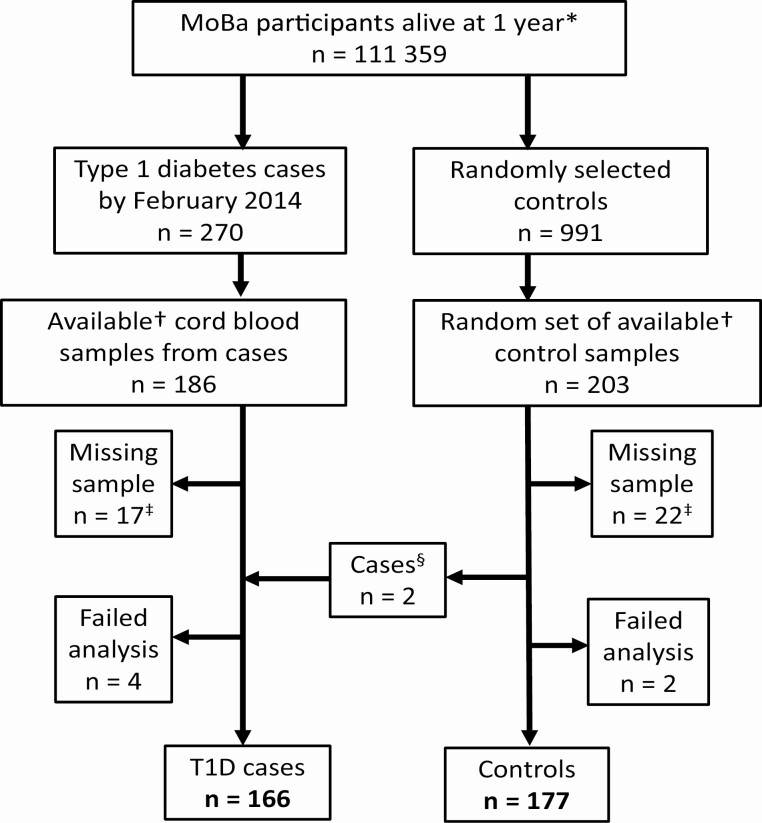
Using a targeted UHPLC-QQQ-MS platform, we quantified 27 low-molecular-weight metabolites (including amino acids, small organic acids, and bile acids) in 166 children, who later developed type 1 diabetes, and 177 random control children in the Norwegian Mother, Father, and Child cohort. We analyzed the data using logistic regression (estimating odds ratios per SD [adjusted odds ratio (aOR)]), area under the receiver operating characteristic curve (AUC), and k-means clustering. Metabolites were compared to a genetic risk score based on 51 established non-HLA single-nucleotide polymorphisms, and a 4-category HLA risk group.
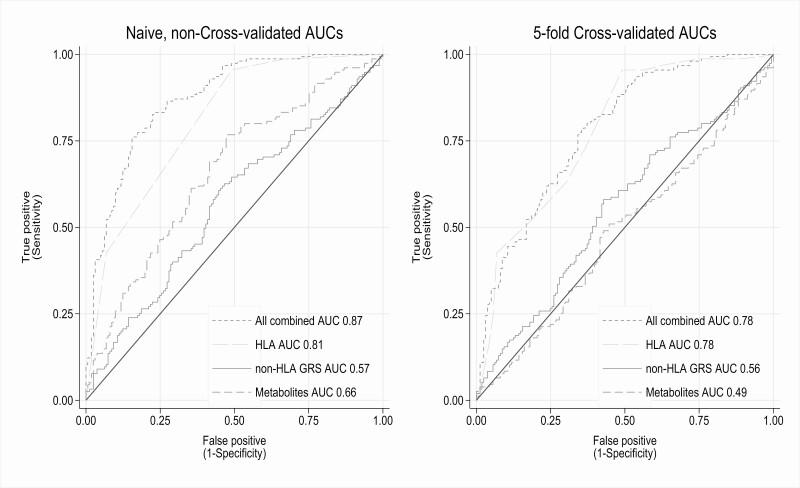
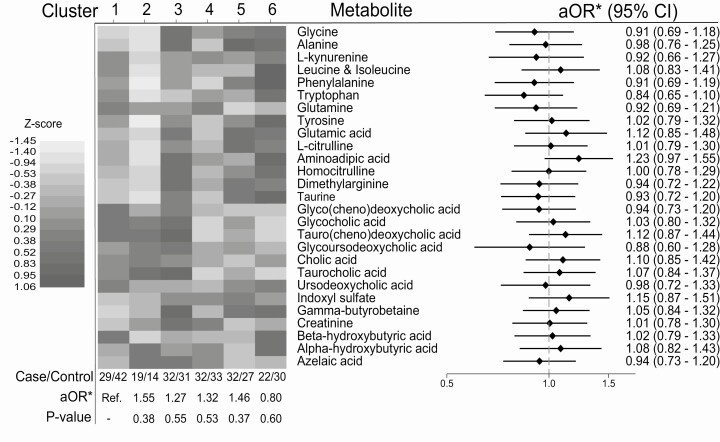
The strongest associations for metabolites were aminoadipic acid (aOR = 1.23; 95% CI, 0.97-1.55), indoxyl sulfate (aOR = 1.15; 95% CI, 0.87-1.51), and tryptophan (aOR = 0.84; 95% CI, 0.65-1.10), with other aORs close to 1.0, and none significantly associated with type 1 diabetes. K-means clustering identified 6 clusters, none of which were associated with type 1 diabetes. Cross-validated AUC showed no predictive value of metabolites (AUC 0.49), whereas the non-HLA genetic risk score AUC was 0.56 and the HLA risk group AUC was 0.78.
In this large study, we found no support of a predictive role of cord blood concentrations of selected bile acids and other small polar metabolites in the development of type 1 diabetes.
遗传标志物已被确定可预测 1 型糖尿病,但据信未知的早期生活环境也与之相关。脐带血可能反映围产期的代谢和暴露情况。我们研究了脐带血中选定的极性代谢物是否有助于预测 1 型糖尿病。
使用靶向 UHPLC-QQQ-MS 平台,我们在挪威母婴儿童队列中,对 166 名后来发生 1 型糖尿病的儿童和 177 名随机对照儿童的脐带血中,定量分析了 27 种低分子量代谢物(包括氨基酸、小分子有机酸和胆汁酸)。我们使用逻辑回归(估计每个 SD 的优势比 [调整后的优势比 (aOR)])、受试者工作特征曲线下面积 (AUC) 和 k-均值聚类分析数据。将代谢物与基于 51 个已建立的非 HLA 单核苷酸多态性和 4 个 HLA 风险组的遗传风险评分进行比较。
代谢物中与疾病相关性最强的是氨基己二酸 (aOR=1.23;95%CI,0.97-1.55)、吲哚硫酸 (aOR=1.15;95%CI,0.87-1.51) 和色氨酸 (aOR=0.84;95%CI,0.65-1.10),其他 aOR 值接近 1.0,且均与 1 型糖尿病无显著相关性。k-均值聚类未鉴定出与 1 型糖尿病相关的 6 个聚类。经交叉验证的 AUC 显示代谢物无预测价值 (AUC 0.49),而非 HLA 遗传风险评分 AUC 为 0.56,HLA 风险组 AUC 为 0.78。
在这项大型研究中,我们未发现脐带血中选定的胆汁酸和其他极性小代谢物浓度在 1 型糖尿病发展中的预测作用。