Wang Xue, Ou Pengfei, Wicks Joshua, Xie Yi, Wang Ying, Li Jun, Tam Jason, Ren Dan, Howe Jane Y, Wang Ziyun, Ozden Adnan, Finfrock Y Zou, Xu Yi, Li Yuhang, Rasouli Armin Sedighian, Bertens Koen, Ip Alexander H, Graetzel Michael, Sinton David, Sargent Edward H
Department of Electrical and Computer Engineering, University of Toronto, Toronto, ON, Canada.
Department of Chemistry, The Chinese University of Hong Kong, Hong Kong, S.A.R., China.
Nat Commun. 2021 Jun 7;12(1):3387. doi: 10.1038/s41467-021-23699-4.
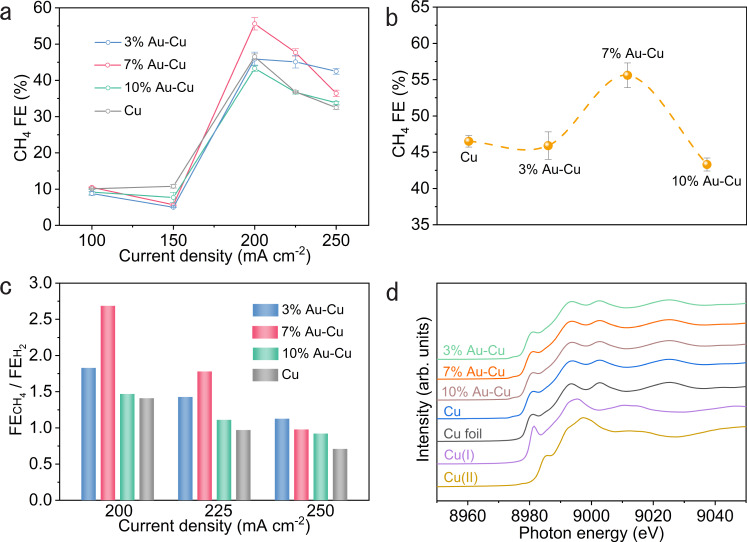
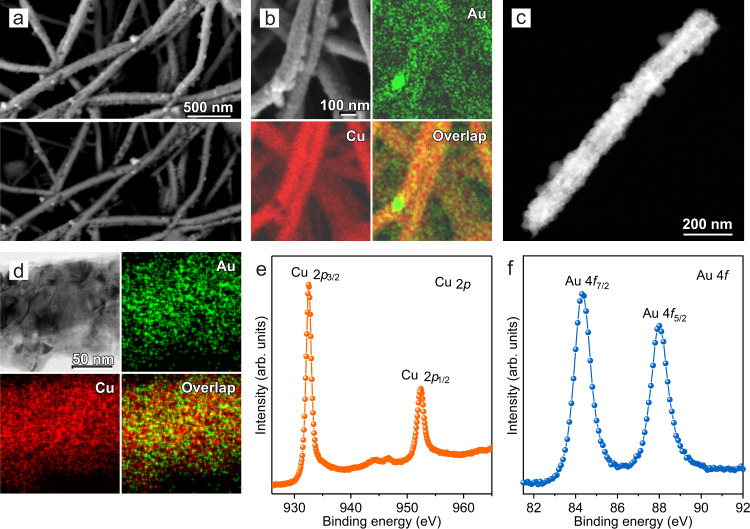
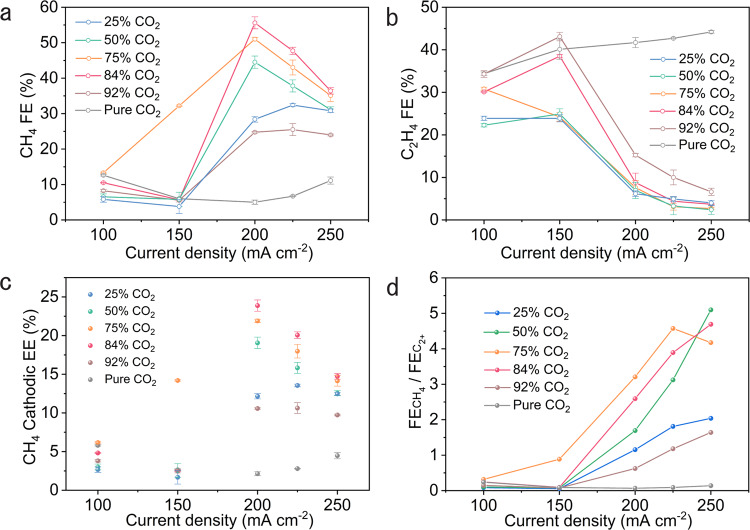
The renewable-electricity-powered CO electroreduction reaction provides a promising means to store intermittent renewable energy in the form of valuable chemicals and dispatchable fuels. Renewable methane produced using CO electroreduction attracts interest due to the established global distribution network; however, present-day efficiencies and activities remain below those required for practical application. Here we exploit the fact that the suppression of *CO dimerization and hydrogen evolution promotes methane selectivity: we reason that the introduction of Au in Cu favors *CO protonation vs. C-C coupling under low *CO coverage and weakens the *H adsorption energy of the surface, leading to a reduction in hydrogen evolution. We construct experimentally a suite of Au-Cu catalysts and control *CO availability by regulating CO concentration and reaction rate. This strategy leads to a 1.6× improvement in the methane:H selectivity ratio compared to the best prior reports operating above 100 mA cm. We as a result achieve a CO-to-methane Faradaic efficiency (FE) of (56 ± 2)% at a production rate of (112 ± 4) mA cm.
可再生电力驱动的CO电还原反应为以有价值的化学品和可调度燃料的形式存储间歇性可再生能源提供了一种很有前景的方法。利用CO电还原生产可再生甲烷因已有的全球配送网络而备受关注;然而,目前的效率和活性仍低于实际应用所需水平。在此,我们利用这样一个事实:抑制CO二聚化和析氢可提高甲烷选择性:我们推断,在低CO覆盖度下,在Cu中引入Au有利于CO质子化而非C-C偶联,并削弱了表面的H吸附能,从而减少析氢。我们通过实验构建了一系列Au-Cu催化剂,并通过调节CO浓度和反应速率来控制*CO的可用性。与之前在高于100 mA cm下运行的最佳报道相比,该策略使甲烷:氢选择性比提高了1.6倍。因此,我们在(112±4) mA cm的产率下实现了(56±2)%的CO到甲烷的法拉第效率(FE)。