Department of Orthopedics, Diakonessenhuis, Utrecht, Zeist, The Netherlands.
Clinical Orthopedic Research Center m-N, Zeist, The Netherlands.
Arch Orthop Trauma Surg. 2022 Jun;142(6):1253-1264. doi: 10.1007/s00402-021-03982-1. Epub 2021 Jun 8.
Dislocation remains a major complication in total hip arthroplasty (THA), in which femoral component orientation is considered a key parameter. New imaging modalities and definitions on femoral component orientation have been introduced, describing orientation in different planes. This study aims to systematically review the relevance of the different orientation parameters on implant stability.
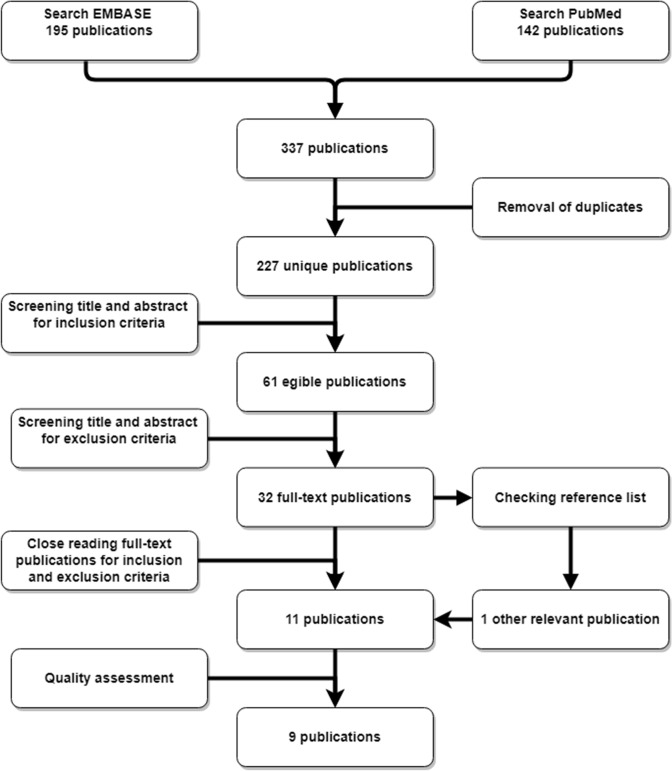
A systematic review was performed according to the PRISMA guidelines to identify articles in the PubMed and EMBASE databases that study the relation between any femoral component orientation parameters and implant stability in primary THA.
After screening for inclusion and exclusion criteria and quality assessment, nine articles were included. Definitions to describe the femoral component orientation and methodologies to assess its relevance for implant stability differed greatly, with lack of consensus. Seven retrospective case-control studies reported on the relevance of the transversal plane orientation: Low femoral- or low combined femoral and acetabular anteversion was statistical significantly related with more posterior dislocations, and high femoral- or combined femoral and acetabular anteversion with anterior dislocations in two studies. There were insufficient data on sagittal and coronal component orientation in relation to implant stability.
Because of incomparable definitions, limited quality and heterogeneity in methodology of the included studies, there is only weak evidence that the degree of transverse component version is related with implant stability in primary THA. Recommendations about the optimal orientation of the femoral component in all three anatomical planes cannot be provided. Future studies should uniformly define the three-dimensional orientation of the femoral component and systematically describe implant stability.
在全髋关节置换术(THA)中,脱位仍然是一个主要的并发症,其中股骨部件的方向被认为是一个关键参数。已经引入了新的成像方式和股骨部件方向的定义,描述了在不同平面上的方向。本研究旨在系统地回顾不同的方向参数对植入物稳定性的相关性。
根据 PRISMA 指南进行了系统综述,以确定在 PubMed 和 EMBASE 数据库中研究任何股骨部件方向参数与初次 THA 中植入物稳定性之间关系的文章。
经过纳入和排除标准以及质量评估的筛选,共纳入 9 篇文章。描述股骨部件方向的定义和评估其与植入物稳定性相关性的方法差异很大,缺乏共识。七项回顾性病例对照研究报告了横断平面方向的相关性:低股骨或低联合股骨和髋臼前倾角与更多的后脱位统计学上显著相关,而高股骨或联合股骨和髋臼前倾角与前脱位在两项研究中相关。关于矢状面和冠状面组件方向与植入物稳定性的关系,数据不足。
由于定义不可比,纳入研究的质量有限且方法学存在异质性,只有微弱的证据表明横向组件版本的程度与初次 THA 中的植入物稳定性有关。不能提供关于股骨组件在所有三个解剖平面上的最佳方向的建议。未来的研究应统一定义股骨组件的三维方向,并系统地描述植入物的稳定性。