Academy of National Food and Strategic Reserves Administration, Beijing, 100037, P. R. China.
China National Tranditional Chinese Medicine Co., Ltd, Beijing, 100077, P. R. China.
BMC Complement Med Ther. 2021 Jun 10;21(1):169. doi: 10.1186/s12906-021-03346-7.
Non-small-cell lung cancer (NSCLC) accounts more than 80% of the lung cancer cases. Polysaccharides in rice bran and its fermentation products have been proven to suppress many cancers. However, the report on inhibiting NSCLC is few. In this paper, the polysaccharides with suppression activity to H1299 NSCLC in the fermentation products of full-fat rice bran and defatted rice bran were studied in vitro and in vivo.
Polysaccharides (GSRBPs) were extracted from Ganoderma sinense - full-fat rice bran (GS-FRB) and Ganoderma sinense - defatted rice bran (GS-DRB) fermentation products. The structure information of the GSRBPs was studied using HPLC analysis. The anti-tumor activities on H1299 NSCLC of GSRBPs in vitro study was performed using MTT method. The in vivo studies use BALB/c-nu nude mice as H1299 NSCLC bearing mice.
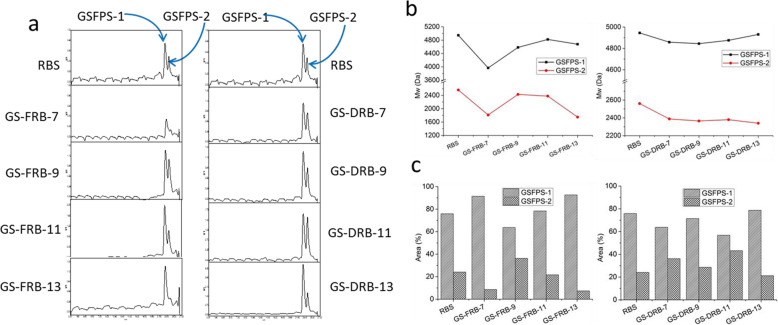
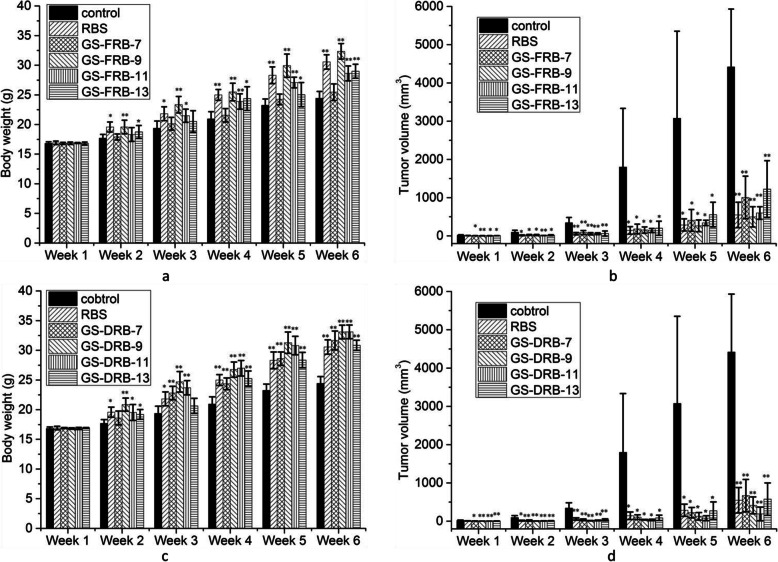
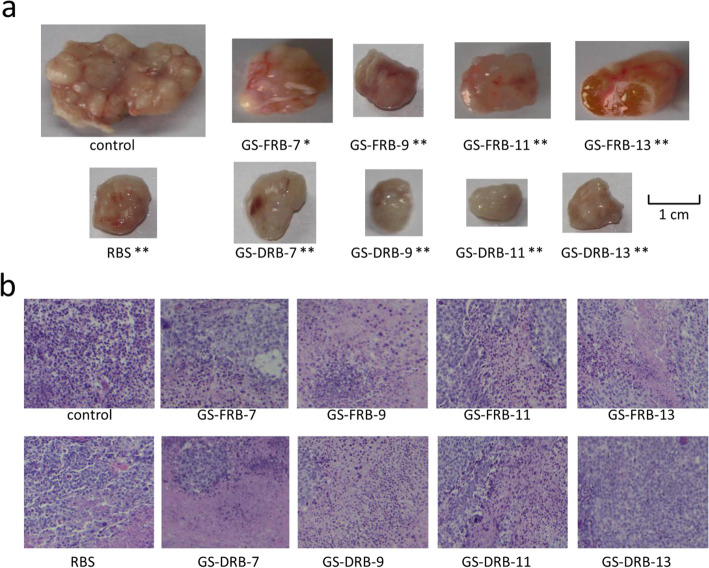
All the polysaccharides contained two fractions, GSFPS-1 and GSFPS-2. The molecular weight and the ratio of GSFPS-1 and GSFPS-2 were different in GS-FRB and GS-DRB. At the earlier state of fermentation, all polysaccharides were composed of D-glu, D-man, D-xyl and L-ara with certain molar ratios. But at the latter stage, polysaccharides in GS-FRB were composed of D-glu, D-man, D-xyl, L-ara and D-fru, while these in GS-DRB only composed of D-glu and D-man. In the in vitro study, the IC50 of RBS and GSRBPs was as GS-DRB-11 (40.62 μg/mL), GS-FRB-9 (43.82 μg/mL), GS-DRB-7 (48.08 μg/mL), RBS (49.56 μg/mL), GS-DRB-9 (49.91 μg/mL), GS-DRB-13 (51.89 μg/mL), GS-FRB-11 (53.75 μg/mL), GS-FRB-7 (56.84 μg/mL), GS-DRB-13 (60.63 μg/mL) from small to large. In the in vivo study, the H1299 NSCLC inhibition rate (InRa) of RBS and GSRBPs were GS-DRB-11 (86.81%) > GS-DRB-9 (86.01%) > GS-FRB-9 (84.88%) > GS-DRB-7 (82.21%) > GS-DRB-13 (78.04%) > RBS (76.06%) > GS-FRB-13 (65.44%) > GS-FRB-11 (64.70%) > GS-FRB-7 (27.87%). The GSFPS-2 area percent was negatively correlated to the IC50 and was positively correlated to the InRa. This means the GSFPS-2 had much higher anti-tumor activity than GSFPS-1.
GSFPS-2 had higher anti-tumor activities, and the lipid in the rice bran has a decisive effect on the structures of polysaccharides produced by fermentation. Therefore, GSRBPs could be considered as potential novel agents to suppress H1299 non-small-cell lung cancer.
非小细胞肺癌(NSCLC)占肺癌病例的 80%以上。米糠及其发酵产物中的多糖已被证明能抑制多种癌症。然而,关于抑制 NSCLC 的报道却很少。本文研究了全脂米糠和脱脂米糠发酵产物中具有抑制 H1299 NSCLC 活性的多糖。
从灵芝-全脂米糠(GS-FRB)和灵芝-脱脂米糠(GS-DRB)发酵产物中提取多糖(GSRBPs)。采用 HPLC 分析研究 GSRBPs 的结构信息。采用 MTT 法研究 GSRBPs 对 H1299 NSCLC 的体外抗肿瘤活性。体内研究采用 BALB/c-nu 裸鼠作为 H1299 NSCLC 荷瘤小鼠。
所有多糖均含有两个馏分,GSFPS-1 和 GSFPS-2。GS-FRB 和 GS-DRB 中的分子量和 GSFPS-1 与 GSFPS-2 的比例不同。在发酵的早期阶段,所有多糖均由一定摩尔比的 D-葡萄糖、D-甘露糖、D-木糖和 L-阿拉伯糖组成。但在后期,GS-FRB 中的多糖由 D-葡萄糖、D-甘露糖、D-木糖、L-阿拉伯糖和 D-果糖组成,而 GS-DRB 中的多糖仅由 D-葡萄糖和 D-甘露糖组成。在体外研究中,RBS 和 GSRBPs 的 IC50 为 GS-DRB-11(40.62μg/mL)、GS-FRB-9(43.82μg/mL)、GS-DRB-7(48.08μg/mL)、RBS(49.56μg/mL)、GS-DRB-9(49.91μg/mL)、GS-DRB-13(51.89μg/mL)、GS-FRB-11(53.75μg/mL)、GS-FRB-7(56.84μg/mL)、GS-DRB-13(60.63μg/mL),从低到高。在体内研究中,RBS 和 GSRBPs 的 H1299 NSCLC 抑制率(InRa)为 GS-DRB-11(86.81%)>GS-DRB-9(86.01%)>GS-FRB-9(84.88%)>GS-DRB-7(82.21%)>GS-DRB-13(78.04%)>RBS(76.06%)>GS-FRB-13(65.44%)>GS-FRB-11(64.70%)>GS-FRB-7(27.87%)。GSFPS-2 面积百分比与 IC50 呈负相关,与 InRa 呈正相关。这意味着 GSFPS-2 比 GSFPS-1 具有更高的抗肿瘤活性。
GSFPS-2 具有更高的抗肿瘤活性,米糠中的脂质对发酵产生的多糖结构有决定性影响。因此,GSRBPs 可以被认为是抑制 H1299 非小细胞肺癌的潜在新型药物。