Department of Veterinary Diagnostics (DDV), Veterinary Services National Laboratories (LANASEVE), Animal Health National Service (SENASA), Ministry of Livestock and Agriculture (MAG), Heredia, Costa Rica.
Department of Population Health Sciences, University of Utrecht, Utrecht, The Netherlands.
BMC Vet Res. 2021 Jun 12;17(1):217. doi: 10.1186/s12917-021-02925-7.
Worldwide, Porcine Reproductive and Respiratory Syndrome (PRRS) is among the diseases that cause the highest economic impact in modern pig production. PRRS was first detected in Costa Rica in 1996 and has since then severely affected the local swine industry. Studies of the molecular characterization of circulating strains, correlation with clinical records, and associations with pathogens associated with Porcine Respiratory Disease Complex (PRDC) have not been done in Costa Rica.
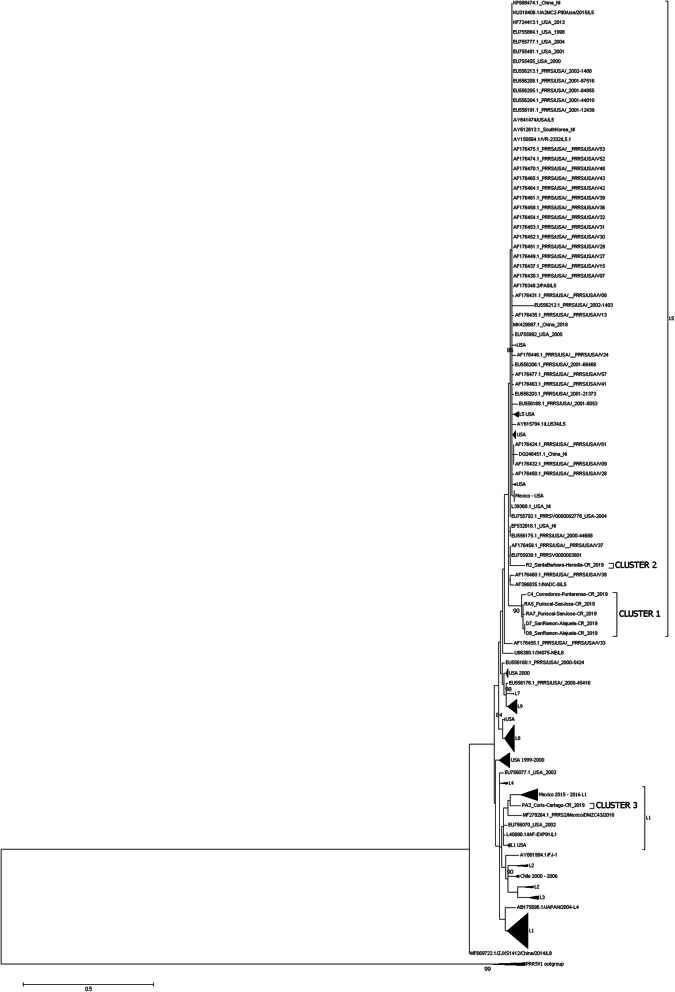
Sequencing and phylogenetic analysis of ORF5 proved that PRRSV-2 was the only species detected in all locations analyzed. These sequences were grouped into three clusters. When comparing samples from San Jose, Alejuela, and Puntarenas to historical isolates of the previously described lineages (1 to 9), it has been shown that these were closely related to each other and belonged to Lineage 5, along with the samples from Heredia. Intriguingly, samples from Cartago clustered in a separate clade, phylogenetically related to Lineage 1. Epitope analysis conducted on the GP5 sequence of field isolates from Costa Rica revealed seven peptides with at least 80% amino acid sequence identity with previously described and experimentally validated immunogenic regions. Previously described epitopes A, B, and C, were detected in the Santa Barbara-Heredia isolate.
Our data suggest that the virus has three distinct origins or introductions to the country. Future studies will elucidate how recently introduced vaccines will shape the evolutionary change of circulating field strains.
在全球范围内,猪繁殖与呼吸综合征(PRRS)是导致现代养猪业经济损失最大的疾病之一。PRRS 于 1996 年在哥斯达黎加首次被发现,此后严重影响了当地的养猪业。对循环毒株的分子特征、与临床记录的相关性以及与猪呼吸道疾病复合症(PRDC)相关病原体的相关性进行研究尚未在哥斯达黎加进行。
对 ORF5 的测序和系统发育分析证明,所有分析地点均只检测到 PRRSV-2 一种病毒。这些序列分为三个聚类。将圣何塞、阿雷瓦洛和蓬塔雷纳斯的样本与之前描述的谱系(1 到 9)的历史分离株进行比较,结果表明它们彼此密切相关,属于谱系 5,与赫雷迪亚的样本相同。有趣的是,来自卡塔戈的样本聚类在一个单独的分支中,与谱系 1 在系统发育上相关。对哥斯达黎加田间分离株 GP5 序列进行的表位分析显示,有 7 个肽段与先前描述和实验验证的免疫原性区域具有至少 80%的氨基酸序列同一性。在圣巴巴拉-赫雷迪亚分离株中检测到了先前描述的表位 A、B 和 C。
我们的数据表明,该病毒有三个不同的起源或引入该国的途径。未来的研究将阐明最近引入的疫苗将如何影响循环田间毒株的进化变化。