Department of Preventive Medicine and Public Health, School of Medicine, University of Navarra, Pamplona, Spain.
Biomedical Research Centre Network on Physiopathology of Obesity and Nutrition (CIBERobn), Institute of Health Carlos III, Madrid, Spain.
Int J Behav Nutr Phys Act. 2021 Jun 14;18(1):78. doi: 10.1186/s12966-021-01149-0.
Food retail environments have an influential role in shaping purchasing behavior and could contribute to improving dietary patterns at a population level. However, little is known about the level of public support for different types of initiatives to encourage healthy food choices in supermarkets, and whether this varies across countries or context. The current study aimed to explore the level of support for three potential supermarket initiatives focused on product placement across five countries, and factors that may influence this support.
A total of 22,264 adults from Australia, Canada, Mexico, the United Kingdom and the United States (US) provided information on support for three supermarket initiatives related to product placement (targeting product positioning: 'checkouts with only healthy products', 'fewer end-of-aisle displays containing unhealthy foods or soft drinks' or availability: 'more shelf space for fresh and healthier foods') as part of the online 2018 International Food Policy Study. The proportion of respondents that supported each initiative was assessed across countries, and multivariable logistic regression analyses were conducted to evaluate the influence of sociodemographic factors on support.
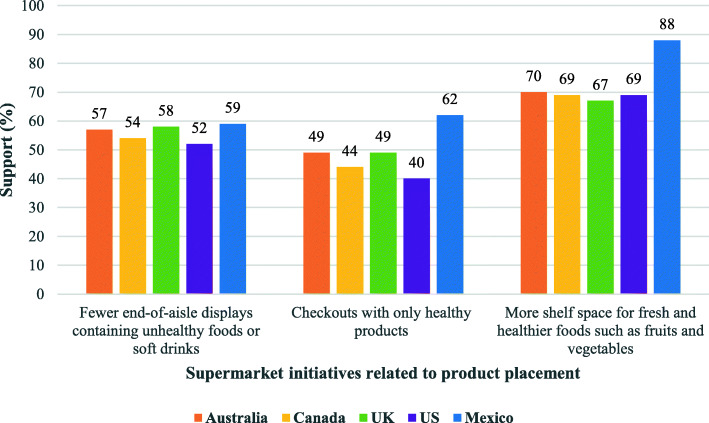
The initiative that received the highest support was 'more shelf space for fresh and healthier foods': 72.0% [95% CI 71.3-72.7], whereas 'checkouts with only healthy products' received the lowest support: 48.6% [95% CI 47.8-49.4]. The level of support differed between countries (p < 0.001 for all initiatives), with the US generally showing the lowest support and Mexico the highest. Noteworthy, in the overall sample, there was not much opposition to any of the initiatives (2.5-14.2%), whereas there was a large proportion of neutral responses (25.5-37.2%). Respondents who were older, female, highly educated, and those who reported having more nutrition knowledge tended to be more supportive, with several differences between countries and initiatives.
Most people in the assessed five countries showed a generally high level of support for three placement initiatives in supermarkets to encourage healthy food choices. Support varied by type of initiative (i.e., product positioning or availability) and was influenced by several factors related to country context and sociodemographic characteristics. This evidence could prompt and guide retailers and policy makers to take stronger action to promote healthy food choices in stores.
食品零售环境在塑造购买行为方面具有重要作用,并有助于改善人群的饮食模式。然而,对于支持超市鼓励健康食品选择的不同类型举措的公众支持程度,以及这种支持在不同国家或背景下是否存在差异,人们知之甚少。本研究旨在探讨五个国家对三种潜在超市举措的支持程度,以及影响这种支持的因素。
澳大利亚、加拿大、墨西哥、英国和美国(美国)的 22264 名成年人参与了此次在线 2018 年国际食品政策研究,他们提供了有关三种与产品定位相关的超市举措(定位目标:“仅健康产品结账处”、“减少末端过道展示的不健康食品或软饮料”或供应情况:“更多新鲜和更健康食品的货架空间”)的支持信息。评估了各国对每项举措的支持比例,并进行了多变量逻辑回归分析,以评估社会人口因素对支持的影响。
最受欢迎的举措是“为新鲜和更健康的食品提供更多货架空间”:72.0%[95%CI71.3-72.7%],而“仅健康产品结账处”的支持率最低:48.6%[95%CI47.8-49.4%]。支持率在国家之间存在差异(所有举措均为 p<0.001),美国的支持率普遍较低,墨西哥的支持率较高。值得注意的是,在总体样本中,对于任何一项举措都没有太多反对意见(2.5-14.2%),而中立意见的比例较大(25.5-37.2%)。年龄较大、女性、受教育程度较高、营养知识较多的受访者往往更支持这些举措,而且在不同国家和举措之间存在一些差异。
在评估的五个国家中,大多数人对超市中鼓励健康食品选择的三种定位举措表示普遍支持。支持程度因举措类型(即产品定位或供应情况)而异,受到与国家背景和社会人口特征相关的几个因素的影响。这些证据可以促使零售商和政策制定者采取更强有力的行动,以促进商店中的健康食品选择。