School of Management, Hunan University of Technology and Business, Changsha 410205, China.
Business School of Sichuan University, No. 24 South Section 1, Yihuan Road, Chengdu, China.
J Healthc Eng. 2021 May 27;2021:5555029. doi: 10.1155/2021/5555029. eCollection 2021.
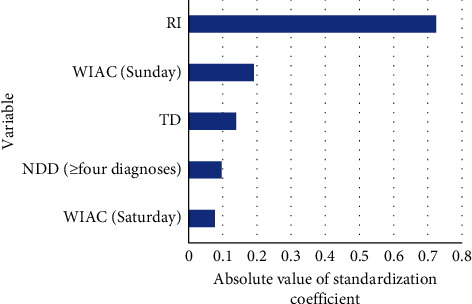
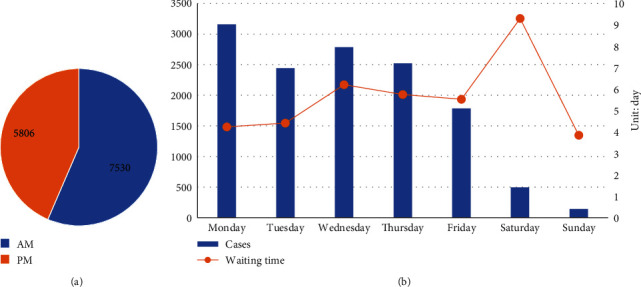
The length of waiting time has become an important indicator of the efficiency of medical services and the quality of medical care. Lengthy waiting times for patients will inevitably affect their mood and reduce satisfaction. For patients who are in urgent need of hospitalization, delayed admission often leads to exacerbation of the patient's condition and may threaten the patient's life. We gathered patients' information about outpatient visits and hospital admissions in the Nephrology Department of a large tertiary hospital in western China from January 1st, 2014, to December 31st, 2016, and we used big data-enabled analysis methods, including univariate analysis and multivariate linear regression models, to explore the factors affecting waiting time. We found that gender (=0.048), the day of issuing the admission card (Saturday, =0.028), the applied period for admission ( < 0.001), and the registration interval ( < 0.001) were positive influencing factors of patients' waiting time. Disease type (after kidney transplantation, < 0.001), number of diagnoses (=0.037), and the day of issuing the admission card (Sunday, =0.001) were negative factors. A linear regression model built using these data performed well in the identification of factors affecting the waiting time of patients in the Nephrology Department. These results can be extended to other departments and could be valuable for improving patient satisfaction and hospital service quality by identifying the factors affecting waiting time.
等待时间的长短已成为医疗服务效率和医疗质量的重要指标。患者长时间等待不可避免地会影响他们的情绪,降低他们的满意度。对于急需住院的患者来说,延迟入院往往会导致病情恶化,甚至可能威胁到患者的生命。我们收集了中国西部一家大型三甲医院肾病科 2014 年 1 月 1 日至 2016 年 12 月 31 日期间门诊就诊和住院患者的信息,采用大数据分析方法,包括单因素分析和多元线性回归模型,探讨影响等待时间的因素。我们发现,性别(=0.048)、入院通知单发放日(周六,=0.028)、申请入院时段(<0.001)和登记间隔(<0.001)是影响患者等待时间的正向影响因素。疾病类型(肾移植后,<0.001)、诊断数量(=0.037)和入院通知单发放日(周日,=0.001)是负向影响因素。使用这些数据构建的线性回归模型在识别肾病科患者等待时间的影响因素方面表现良好。这些结果可以推广到其他科室,通过识别影响等待时间的因素,可以提高患者满意度和医院服务质量。