Clinical and Translational Epidemiology Unit, Massachusetts General Hospital and Harvard Medical School, Boston, MA, USA.
Division of Gastroenterology, Massachusetts General Hospital and Harvard Medical School, Boston, MA, USA.
Nat Commun. 2021 Jun 18;12(1):3737. doi: 10.1038/s41467-021-24115-7.
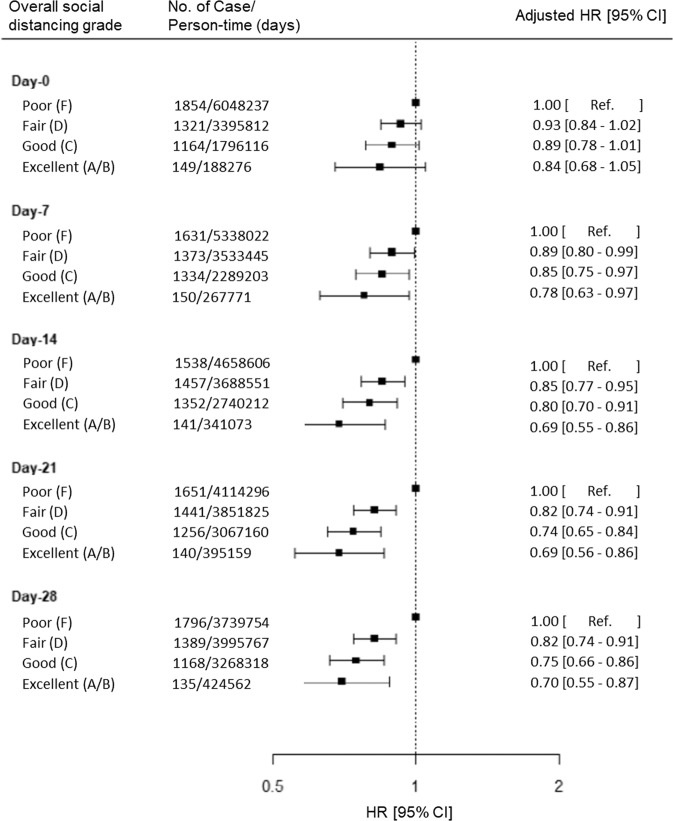
Given the continued burden of COVID-19 worldwide, there is a high unmet need for data on the effect of social distancing and face mask use to mitigate the risk of COVID-19. We examined the association of community-level social distancing measures and individual face mask use with risk of predicted COVID-19 in a large prospective U.S. cohort study of 198,077 participants. Individuals living in communities with the greatest social distancing had a 31% lower risk of predicted COVID-19 compared with those living in communities with poor social distancing. Self-reported 'always' use of face mask was associated with a 62% reduced risk of predicted COVID-19 even among individuals living in a community with poor social distancing. These findings provide support for the efficacy of mask-wearing even in settings of poor social distancing in reducing COVID-19 transmission. Despite mass vaccination campaigns in many parts of the world, continued efforts at social distancing and face mask use remain critically important in reducing the spread of COVID-19.
鉴于全球范围内 COVID-19 的持续负担,我们非常需要有关社交距离和戴口罩措施对降低 COVID-19 风险影响的数据。我们在美国一项针对 198077 名参与者的大型前瞻性队列研究中,研究了社区层面的社交距离措施和个人戴口罩与预测 COVID-19 风险之间的关联。与社交距离不佳的社区相比,生活在社交距离最大的社区的个人患预测 COVID-19 的风险降低了 31%。即使在社交距离不佳的社区中,自我报告的“始终”戴口罩与预测 COVID-19 风险降低 62%有关。这些发现为戴口罩即使在社交距离不佳的情况下也能有效减少 COVID-19 传播提供了支持。尽管世界许多地区都开展了大规模疫苗接种运动,但在减少 COVID-19 传播方面,继续努力保持社交距离和戴口罩仍然至关重要。