Department: Julius Center for Health Sciences and Primary Care, University Medical Center Utrecht, Utrecht University, Utrecht, The Netherlands.
Department: Medical Oncology, University Medical Center Utrecht, Utrecht University, Utrecht, The Netherlands.
Psychooncology. 2021 Oct;30(10):1663-1679. doi: 10.1002/pon.5750. Epub 2021 Jun 28.
Patient involvement in decision making is conditional for personalised treatment decisions. We aim to provide an up-to-date overview of patients' preferred and perceived level of involvement in decision making for cancer treatment.
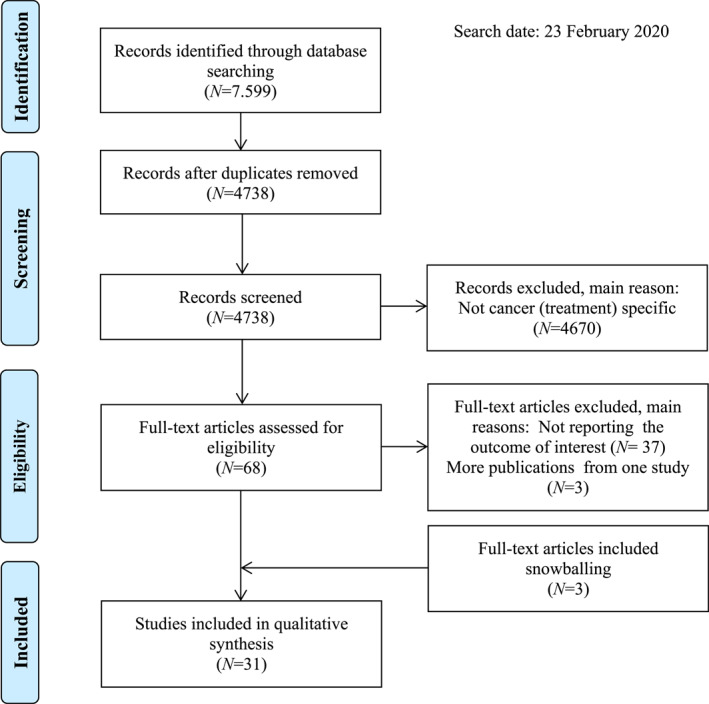
A systematic search was performed in PubMed, EMBASE, PsycINFO and CINAHL for articles published between January 2009 and January 2020. Search terms were 'decision making', 'patient participation', 'oncology', 'perception' and 'treatment'. Inclusion criteria were: written in English, peer-reviewed, reporting patients' preferred and perceived level of involvement, including adult cancer patients and concerning decision making for cancer treatment. The percentages of patients preferring and perceiving an active, shared or passive decision role and the (dis)concordance are presented. Quality assessment was performed with a modified version of the New-Castle Ottawa Scale.
31 studies were included. The median percentage of patients preferring an active, shared or passive role in decision making was respectively 25%, 46%, and 27%. The median percentage of patients perceiving an active, shared or passive role was respectively 27%, 39%, and 34%. The median concordance in preferred and perceived role of all studies was 70%. Disconcordance was highest for a shared role; 42%.
Patients' preferences for involvement in cancer treatment decision vary widely. A significant number of patients perceived a decisional role other than preferred. Improvements in patient involvement have been observed in the last decade. However, there is still room for improvement and physicians should explore patients' preferences for involvement in decision making in order to truly deliver personalised cancer care.
患者参与决策是制定个体化治疗决策的前提条件。本研究旨在提供最新的关于患者在癌症治疗决策中偏好和感知的参与程度的概述。
系统检索了 2009 年 1 月至 2020 年 1 月期间在 PubMed、EMBASE、PsycINFO 和 CINAHL 上发表的文章,检索词包括“决策”、“患者参与”、“肿瘤学”、“认知”和“治疗”。纳入标准为:以英文撰写、同行评议、报告患者偏好和感知的参与程度、包括成年癌症患者以及涉及癌症治疗决策的研究。呈现患者偏好和感知积极、共享或被动决策角色的百分比以及(不)一致性。使用纽卡斯尔-渥太华量表的改良版本进行质量评估。
纳入了 31 项研究。患者偏好积极、共享或被动决策角色的中位数百分比分别为 25%、46%和 27%。患者感知积极、共享或被动决策角色的中位数百分比分别为 27%、39%和 34%。所有研究中偏好和感知角色的中位数一致性为 70%。共享角色的不一致性最高,为 42%。
患者对参与癌症治疗决策的偏好差异很大。相当数量的患者感知到的决策角色与偏好不同。在过去十年中,患者参与度有所提高。然而,仍有改进的空间,医生应探讨患者对参与决策的偏好,以真正提供个体化的癌症护理。