• 文献检索
  • 文档翻译
  • 深度研究
  • 学术资讯
  • Suppr Zotero 插件Zotero 插件
  • 邀请有礼
  • 套餐&价格
  • 历史记录
应用&插件
Suppr Zotero 插件Zotero 插件浏览器插件Mac 客户端Windows 客户端微信小程序
定价
高级版会员购买积分包购买API积分包
服务
文献检索文档翻译深度研究API 文档MCP 服务
关于我们
关于 Suppr公司介绍联系我们用户协议隐私条款
关注我们

Suppr 超能文献

核心技术专利:CN118964589B侵权必究
粤ICP备2023148730 号-1Suppr @ 2026

文献检索

告别复杂PubMed语法,用中文像聊天一样搜索,搜遍4000万医学文献。AI智能推荐,让科研检索更轻松。

立即免费搜索

文件翻译

保留排版,准确专业,支持PDF/Word/PPT等文件格式,支持 12+语言互译。

免费翻译文档

深度研究

AI帮你快速写综述,25分钟生成高质量综述,智能提取关键信息,辅助科研写作。

立即免费体验

新冠疫情:对美国高层写字楼能源效率的影响

COVID-19: The impact in US high-rise office buildings energy efficiency.

作者信息

Cortiços Nuno D, Duarte Carlos C

机构信息

Building Science, Technology and Sustainability Lab, Research Centre for Architecture, Urbanism and Design, Lisbon School of Architecture, University of Lisbon, Rua Sá Nogueira, Pólo Universitário, Alto da Ajuda, 1349-063 Lisboa, Portugal.

出版信息

Energy Build. 2021 Oct 15;249:111180. doi: 10.1016/j.enbuild.2021.111180. Epub 2021 Jun 15.

DOI:10.1016/j.enbuild.2021.111180
PMID:34149152
原文链接:https://pmc.ncbi.nlm.nih.gov/articles/PMC8205289/
Abstract

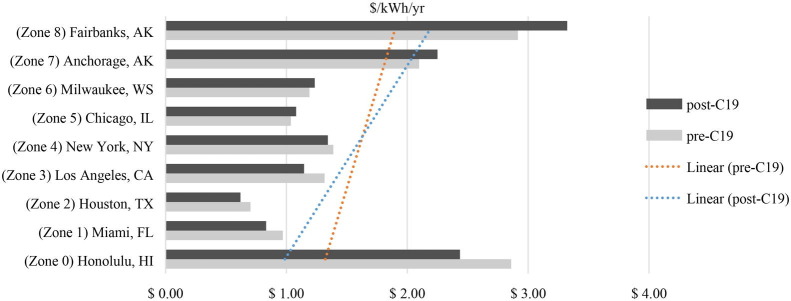
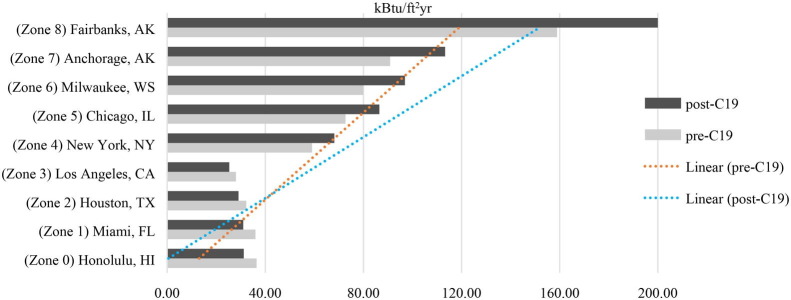
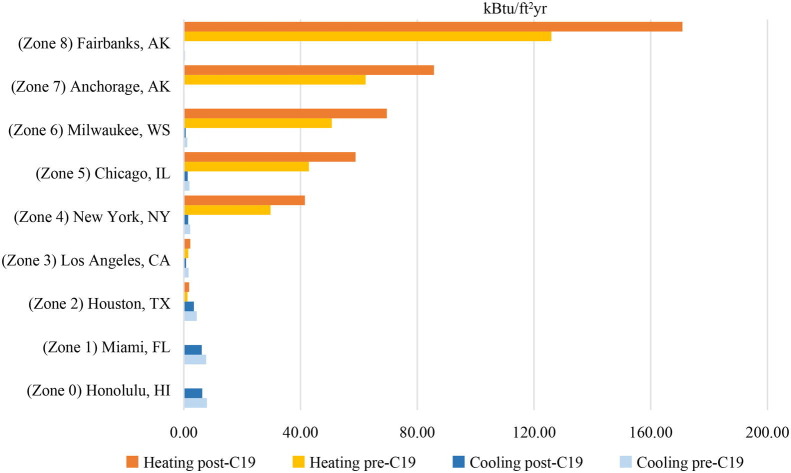
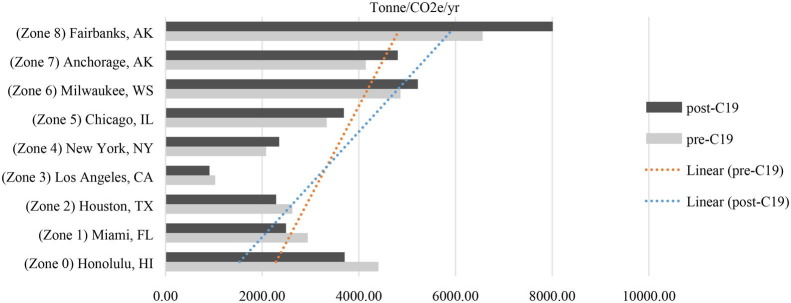
The COVID-19 pandemic, through stay-at-home orders, forced rapid changes to social human behavior and interrelations, targeting the work environments to protect workers and users. Rapidly, global organizations, US associations, and professionals stepped in to mitigate the virus's spread in buildings' living and work environments. The institutions proposed new HVAC settings without efficiency concerns, as improved flow rates and filtering for irradiation, humidity, and temperature. Current literature consensually predicted an increase in energy consumption due to new measures to control the SARS-CoV-2 spread. The research team assumed the effort of validating the prior published outcomes, applied to US standardized high-rise office buildings, as defined and set by the key entities in the field, by resorting to a methodology based on software energy analysis. The study compares a standard high-rise office building energy consumption, CO emissions and operations costs in nine US climate zones - from 0 to 8, south to north latitudes, respectively -, assessed in the most populated cities, between the previous and post COVID-19 scenarios. The outcomes clarify the gathered knowledge, explaining that climate zones above mixed-humid type tend to increase relative energy use intensity by 21.72%, but below that threshold the zones decrease relative energy use intensity by 11.92%.

摘要

新冠疫情通过居家令,迫使社会人类行为和相互关系迅速改变,目标是工作环境以保护工人和使用者。全球组织、美国协会和专业人士迅速介入,以减轻病毒在建筑物生活和工作环境中的传播。这些机构提出了新的暖通空调设置,而不考虑效率问题,如提高流速以及对辐射、湿度和温度进行过滤。当前文献一致预测,由于控制新冠病毒传播的新措施,能源消耗将会增加。该研究团队假定要努力验证先前发表的成果,这些成果适用于美国标准化的高层办公楼,这些办公楼是由该领域的关键实体所定义和设定的,研究团队采用了基于软件能源分析的方法。该研究比较了美国九个气候区(分别从0到8,即从南到北的纬度)中最人口密集城市里,新冠疫情之前和之后的情景下,一座标准高层办公楼的能源消耗、碳排放和运营成本。研究结果澄清了已收集的知识,解释说混合湿润型以上的气候区相对能源使用强度往往会增加21.72%,但低于该阈值的气候区相对能源使用强度会降低11.92%。
https://cdn.ncbi.nlm.nih.gov/pmc/blobs/c448/8205289/ed981e1dea2e/gr9_lrg.jpg
https://cdn.ncbi.nlm.nih.gov/pmc/blobs/c448/8205289/abb66ae6aab3/gr2_lrg.jpg
https://cdn.ncbi.nlm.nih.gov/pmc/blobs/c448/8205289/bb02d9e76506/gr3_lrg.jpg
https://cdn.ncbi.nlm.nih.gov/pmc/blobs/c448/8205289/67edba89b9cb/gr4_lrg.jpg
https://cdn.ncbi.nlm.nih.gov/pmc/blobs/c448/8205289/60480173e9a3/gr1_lrg.jpg
https://cdn.ncbi.nlm.nih.gov/pmc/blobs/c448/8205289/59a7878c33f5/gr5_lrg.jpg
https://cdn.ncbi.nlm.nih.gov/pmc/blobs/c448/8205289/a19bb67e3728/gr6_lrg.jpg
https://cdn.ncbi.nlm.nih.gov/pmc/blobs/c448/8205289/e40f276dc264/gr7_lrg.jpg
https://cdn.ncbi.nlm.nih.gov/pmc/blobs/c448/8205289/855e33e9f040/gr8_lrg.jpg
https://cdn.ncbi.nlm.nih.gov/pmc/blobs/c448/8205289/ed981e1dea2e/gr9_lrg.jpg
https://cdn.ncbi.nlm.nih.gov/pmc/blobs/c448/8205289/abb66ae6aab3/gr2_lrg.jpg
https://cdn.ncbi.nlm.nih.gov/pmc/blobs/c448/8205289/bb02d9e76506/gr3_lrg.jpg
https://cdn.ncbi.nlm.nih.gov/pmc/blobs/c448/8205289/67edba89b9cb/gr4_lrg.jpg
https://cdn.ncbi.nlm.nih.gov/pmc/blobs/c448/8205289/60480173e9a3/gr1_lrg.jpg
https://cdn.ncbi.nlm.nih.gov/pmc/blobs/c448/8205289/59a7878c33f5/gr5_lrg.jpg
https://cdn.ncbi.nlm.nih.gov/pmc/blobs/c448/8205289/a19bb67e3728/gr6_lrg.jpg
https://cdn.ncbi.nlm.nih.gov/pmc/blobs/c448/8205289/e40f276dc264/gr7_lrg.jpg
https://cdn.ncbi.nlm.nih.gov/pmc/blobs/c448/8205289/855e33e9f040/gr8_lrg.jpg
https://cdn.ncbi.nlm.nih.gov/pmc/blobs/c448/8205289/ed981e1dea2e/gr9_lrg.jpg

相似文献

1
COVID-19: The impact in US high-rise office buildings energy efficiency.新冠疫情:对美国高层写字楼能源效率的影响
Energy Build. 2021 Oct 15;249:111180. doi: 10.1016/j.enbuild.2021.111180. Epub 2021 Jun 15.
2
Investigation of HVAC operation strategies for office buildings during COVID-19 pandemic.新冠疫情期间办公建筑暖通空调运行策略研究
Build Environ. 2022 Jan;207:108519. doi: 10.1016/j.buildenv.2021.108519. Epub 2021 Nov 12.
3
Energy efficiency in large office buildings post-COVID-19 in Europe's top five economies.欧洲五大经济体新冠疫情后大型办公楼的能源效率
Energy Sustain Dev. 2022 Jun;68:410-424. doi: 10.1016/j.esd.2022.04.006. Epub 2022 Apr 26.
4
Mitigation of CO2 emissions from the EU-15 building stock: beyond the EU Directive on the Energy Performance of Buildings.欧盟15国建筑存量二氧化碳排放的减排:超越欧盟建筑能源性能指令
Environ Sci Pollut Res Int. 2006 Sep;13(5):350-8. doi: 10.1065/espr2005.12.289.
5
Tradeoffs among indoor air quality, financial costs, and CO emissions for HVAC operation strategies to mitigate indoor virus in U.S. office buildings.美国办公楼暖通空调运行策略在缓解室内病毒方面,室内空气质量、财务成本和一氧化碳排放之间的权衡。
Build Environ. 2022 Aug 1;221:109282. doi: 10.1016/j.buildenv.2022.109282. Epub 2022 Jun 16.
6
The office of the future: Operational energy consumption in the post-pandemic era.未来的办公室:疫情后时代的运营能耗
Energy Res Soc Sci. 2022 May;87:102472. doi: 10.1016/j.erss.2021.102472. Epub 2022 Jan 13.
7
Increasing water and energy efficiency in university buildings: a case study.提高大学建筑的水和能源效率:案例研究。
Environ Sci Pollut Res Int. 2020 Feb;27(5):4571-4581. doi: 10.1007/s11356-019-04990-w. Epub 2019 Apr 15.
8
Quantification of how mechanical ventilation influences the airborne infection risk of COVID-19 and HVAC energy consumption in office buildings.量化机械通风如何影响办公建筑中新型冠状病毒肺炎的空气传播感染风险和暖通空调能耗。
Build Simul. 2023;16(5):713-732. doi: 10.1007/s12273-022-0937-5. Epub 2022 Oct 3.
9
A fresh (air) look at ventilation for COVID-19: Estimating the global energy savings potential of coupling natural ventilation with novel radiant cooling strategies.对新冠疫情通风的全新(视角)审视:估算将自然通风与新型辐射制冷策略相结合的全球节能潜力。
Appl Energy. 2021 Jun 15;292:116848. doi: 10.1016/j.apenergy.2021.116848. Epub 2021 Mar 22.
10
An overview of solutions for airborne viral transmission reduction related to HVAC systems including liquid desiccant air-scrubbing.与暖通空调系统相关的减少空气传播病毒传播的解决方案概述,包括液体干燥剂空气洗涤。
Energy (Oxf). 2022 Apr 1;244:122709. doi: 10.1016/j.energy.2021.122709. Epub 2021 Nov 20.

引用本文的文献

1
Energy efficient ventilation and indoor air quality in the context of COVID-19 - A systematic review.COVID-19背景下的节能通风与室内空气质量——一项系统综述
Renew Sustain Energy Rev. 2023 Aug;182:113356. doi: 10.1016/j.rser.2023.113356. Epub 2023 May 16.
2
A ventilation early warning system (VEWS) for diaphanous workspaces considering COVID-19 and future pandemics scenarios.一种针对通风良好的工作空间的通风预警系统(VEWS),该系统考虑了新冠肺炎及未来大流行的情况。
Heliyon. 2023 Mar;9(3):e14640. doi: 10.1016/j.heliyon.2023.e14640. Epub 2023 Mar 17.
3
Review and outlook of global energy use under the impact of COVID-19.

本文引用的文献

1
Upper-room ultraviolet air disinfection might help to reduce COVID-19 transmission in buildings: a feasibility study.室内紫外线空气消毒可能有助于减少建筑物内新冠病毒的传播:一项可行性研究。
PeerJ. 2020 Oct 13;8:e10196. doi: 10.7717/peerj.10196. eCollection 2020.
2
The COVID-19 Pandemic and the $16 Trillion Virus.新冠疫情与“16万亿美元病毒”
JAMA. 2020 Oct 20;324(15):1495-1496. doi: 10.1001/jama.2020.19759.
3
Stability of SARS-CoV-2 in different environmental conditions.严重急性呼吸综合征冠状病毒2(SARS-CoV-2)在不同环境条件下的稳定性
新冠疫情影响下全球能源使用的回顾与展望
Eng Rep. 2022 Nov 6:e12584. doi: 10.1002/eng2.12584.
4
Tradeoffs among indoor air quality, financial costs, and CO emissions for HVAC operation strategies to mitigate indoor virus in U.S. office buildings.美国办公楼暖通空调运行策略在缓解室内病毒方面,室内空气质量、财务成本和一氧化碳排放之间的权衡。
Build Environ. 2022 Aug 1;221:109282. doi: 10.1016/j.buildenv.2022.109282. Epub 2022 Jun 16.
5
Energy efficiency in large office buildings post-COVID-19 in Europe's top five economies.欧洲五大经济体新冠疫情后大型办公楼的能源效率
Energy Sustain Dev. 2022 Jun;68:410-424. doi: 10.1016/j.esd.2022.04.006. Epub 2022 Apr 26.
6
Assessing the impact of the COVID-19 lockdown on the energy consumption of university buildings.评估新冠疫情封锁对大学建筑能源消耗的影响。
Energy Build. 2022 Feb 15;257:111783. doi: 10.1016/j.enbuild.2021.111783. Epub 2021 Dec 16.
7
Airflow deflectors of external windowsto induce ventilation: Towards COVID-19 prevention and control.用于诱导通风的外窗气流导流器:助力新冠肺炎防控
Sustain Cities Soc. 2022 Feb;77:103548. doi: 10.1016/j.scs.2021.103548. Epub 2021 Nov 18.
Lancet Microbe. 2020 May;1(1):e10. doi: 10.1016/S2666-5247(20)30003-3. Epub 2020 Apr 2.
4
Susceptibility of SARS-CoV-2 to UV irradiation.新冠病毒对紫外线辐射的易感性。
Am J Infect Control. 2020 Oct;48(10):1273-1275. doi: 10.1016/j.ajic.2020.07.031. Epub 2020 Aug 4.
5
Aerodynamic analysis of SARS-CoV-2 in two Wuhan hospitals.SARS-CoV-2 的空气动力学分析在两家武汉医院进行。
Nature. 2020 Jun;582(7813):557-560. doi: 10.1038/s41586-020-2271-3. Epub 2020 Apr 27.
6
Coronavirus Disease Outbreak in Call Center, South Korea.韩国呼叫中心发生冠状病毒病疫情。
Emerg Infect Dis. 2020 Aug;26(8):1666-1670. doi: 10.3201/eid2608.201274. Epub 2020 Apr 23.
7
HVAC filtration for controlling infectious airborne disease transmission in indoor environments: Predicting risk reductions and operational costs.用于控制室内环境中空气传播传染病传播的暖通空调过滤:预测风险降低和运营成本。
Build Environ. 2013 Dec;70:150-160. doi: 10.1016/j.buildenv.2013.08.025. Epub 2013 Sep 4.
8
2019 Novel Coronavirus (COVID-19) Pandemic: Built Environment Considerations To Reduce Transmission.2019新型冠状病毒(COVID-19)大流行:减少传播的建筑环境考量
mSystems. 2020 Apr 7;5(2):e00245-20. doi: 10.1128/mSystems.00245-20.
9
COVID-19 Outbreak Associated with Air Conditioning in Restaurant, Guangzhou, China, 2020.2020 年中国广州餐厅空调与新冠肺炎疫情相关。
Emerg Infect Dis. 2020 Jul;26(7):1628-1631. doi: 10.3201/eid2607.200764. Epub 2020 Apr 2.
10
Aerosol and Surface Stability of SARS-CoV-2 as Compared with SARS-CoV-1.与严重急性呼吸综合征冠状病毒1(SARS-CoV-1)相比,严重急性呼吸综合征冠状病毒2(SARS-CoV-2)在气溶胶和表面的稳定性
N Engl J Med. 2020 Apr 16;382(16):1564-1567. doi: 10.1056/NEJMc2004973. Epub 2020 Mar 17.