Laboratory of Experimental Rheumatology and Academic Division of Clinical Rheumatology, Department of Internal Medicine and Specialties (DiMI), University of Genova, IRCCS San Martino Polyclinic, Viale Benedetto XV, n° 6 - 16132, Genoa, Italy.
Autoimmunity Laboratory, Department of Internal Medicine and Specialties (DiMI), University of Genova, IRCCS San Martino Polyclinic, Genoa, Italy.
Arthritis Res Ther. 2021 Jun 27;23(1):175. doi: 10.1186/s13075-021-02551-6.
Antiphospholipid syndrome (APS) is a systemic autoimmune disease characterized by specific vascular and obstetric manifestations and by antiphospholipid antibodies (aPL) positivity. Microvascular damage in the course of APS and "aPL carrier" patients without symptoms is poorly investigated.
This study aims to compare nailfold videocapillaroscopy (NVC) microvascular parameters in APS patients and non-symptomatic "aPL carriers" and to investigate their possible correlations with different aPL subtypes.
NVC was performed during standard evaluations in 18 APS patients (mean age 50 ± 13.8 years), 24 "aPL carriers" without symptoms (mean age 46.4 ± 16.4 years), and 18 control patients (CTR) (mean age 74 ± 12.5 years) taking oral anticoagulants for non-immunological indications (i.e., cardiovascular accidents). All patients were investigated for the presence of dilated capillaries, giant capillaries, microhemorrhages, capillary loss, and further non-specific/specific abnormalities (i.e., branched "bushy" capillaries, sign of neoangiogenesis) by NVC. Every alteration was also classified according to a semi-quantitative score. Lupus anticoagulant, anticardiolipin antibodies, and antibeta2 glycoprotein I antibodies were tested in each patient.
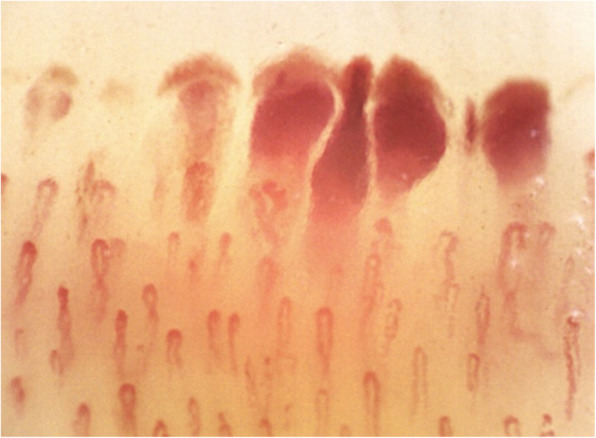
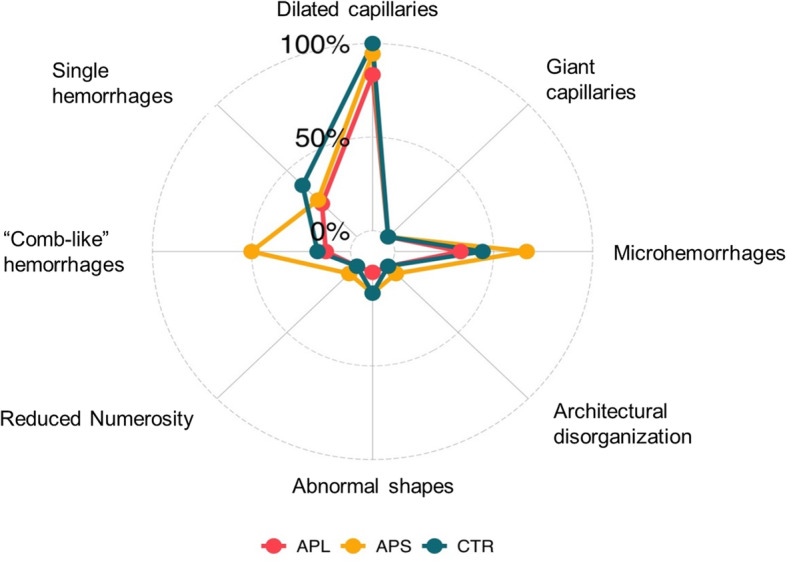
APS patients showed at NVC increased frequency of microhemorrhages (p = 0.039)-particularly a "comb-like" pattern (parallel hemorrhages) (p = 0.002)-than "aPL carriers". Of note, there were no significant differences concerning the isolated number of microhemorrhages between APS and the CTR group (p = 0.314), but "comb-like" hemorrhages were significantly more frequent in the APS group (p = 0.034). Not any significant correlation was found between the aPL subtypes and NVC parameters.
APS patients showed significantly a greater number of non-specific NVC abnormalities than "aPL carriers", particularly the "comb-like" NVC pattern. Oral anticoagulants may represent a confounding factor for isolated microhemorrhages. Not any correlation was found between aPL subtypes and NVC parameters. Further investigations are needed to better characterize the microvascular endothelium damage induced by aPL.
抗磷脂综合征(APS)是一种以特定血管和产科表现及抗磷脂抗体(aPL)阳性为特征的自身免疫性疾病。APS 患者和无症状“aPL 携带者”的微血管损伤以及“aPL 携带者”的微血管损伤研究甚少。
本研究旨在比较 APS 患者和无症状“aPL 携带者”的甲襞毛细血管显微镜(NVC)微血管参数,并探讨它们与不同 aPL 亚型的可能相关性。
在 18 例 APS 患者(平均年龄 50±13.8 岁)、24 例无症状“aPL 携带者”(平均年龄 46.4±16.4 岁)和 18 例接受口服抗凝剂治疗非免疫性疾病(即心血管意外)的对照患者(CTR)中,在标准评估期间进行 NVC。所有患者均通过 NVC 检查有无扩张毛细血管、巨毛细血管、微出血、毛细血管缺失以及其他非特异性/特异性异常(如分支“灌木丛”毛细血管、新生血管形成迹象)。每种改变也根据半定量评分进行分类。在每个患者中均检测狼疮抗凝剂、抗心磷脂抗体和抗β2 糖蛋白 I 抗体。
与“aPL 携带者”相比,APS 患者在 NVC 中显示出微出血(p=0.039)的频率增加,尤其是“梳状”模式(平行出血)(p=0.002)。值得注意的是,APS 和 CTR 组之间孤立微出血的数量没有显著差异(p=0.314),但 APS 组中“梳状”出血更为频繁(p=0.034)。未发现 aPL 亚型与 NVC 参数之间存在任何显著相关性。
APS 患者的非特异性 NVC 异常数量明显多于“aPL 携带者”,尤其是“梳状”NVC 模式。口服抗凝剂可能是孤立性微出血的混杂因素。未发现 aPL 亚型与 NVC 参数之间存在任何相关性。需要进一步研究以更好地描述 aPL 引起的微血管内皮损伤。