Radcliffe Primary Care Building, Radcliffe Observatory Quarter, Woodstock Rd, Oxford, OX2 6GG, UK.
Athena Institute for Health and Life Science, Vrije Universiteit Amsterdam, De Boelelaan 1085, 1081 HV, Amsterdam, The Netherlands.
Ther Innov Regul Sci. 2021 Nov;55(6):1165-1179. doi: 10.1007/s43441-021-00313-9. Epub 2021 Jun 28.
The PARADIGM consortium aimed to make patient engagement in the development and lifecycle management of medicines easier and more effective for all, with the development of new tools that fulfil robustly defined gaps where engagement is suboptimal.
To generate an inventory of gaps in patient engagement practices and process from existing global examples.
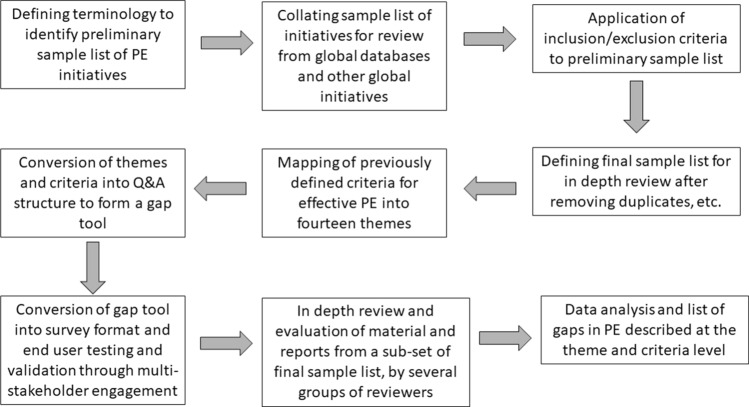
A large set of criteria for effective patient engagement previously defined via a multi-stakeholder Delphi method, were mapped under fourteen overarching themes. A gap analysis was then performed by twenty-seven reviewers against the resulting forty-six mapped criteria, on a sample of seventy initiatives from global databases.
An inventory of gaps was identified including contextual information as to why the gaps exist. Our work identified general patterns where patient engagement was suboptimal-defined as; fragmented reporting and dissemination of patient engagement activities, and the fundamental principles defined in frameworks or guidance being poorly adhered to in actual practice. Specific gaps were identified for sixteen criteria. Additionally, it was also common to observe primary aspects of a process were addressed for a given criteria (i.e. training for roles and responsibilities) but a secondary context element was lacking (i.e. making training material accessible/understandable/meaningful to all participants).
The results show that the evolution towards meaningful and systematic patient engagement is occurring, yet more importantly they provide clear directional insights to help enhance collaborative practices and co-design solutions. This targeted impact to catalyse a needs-oriented health system that integrates patient engagement at its core is essential.
PARADIGM 联盟旨在使所有患者更容易、更有效地参与药品的开发和生命周期管理,为此开发了新工具,以填补参与度不足的明确差距。
从现有的全球范例中生成一份患者参与实践和流程差距清单。
通过多利益相关者德尔菲方法先前定义的一套有效的患者参与标准,被映射到十四个总体主题下。然后,二十七位审阅者根据四十六个映射标准,对来自全球数据库的七十项举措进行了差距分析。
确定了一份差距清单,包括存在差距的原因等背景信息。我们的工作确定了一些普遍的模式,即患者参与度不足——定义为:患者参与活动的报告和传播不完整,以及在实际实践中对框架或指南中定义的基本原则的遵守程度较差。十六项标准中确定了具体的差距。此外,对于给定标准,通常还可以观察到一个过程的主要方面得到了解决(例如,角色和职责的培训),但缺乏次要的背景要素(例如,使培训材料对所有参与者都具有可访问性/可理解性/意义)。
结果表明,迈向有意义和系统的患者参与的演变正在发生,但更重要的是,它们提供了明确的方向洞察力,以帮助加强协作实践和共同设计解决方案。这种有针对性的影响对于催化一个以需求为导向的健康系统至关重要,该系统将患者参与置于核心地位。