Yu Shujuan, Sun Gaohui, Sui Yaqun, Li Hanlin, Mai Yuhan, Wang Guodong, Zhang Ning, Bi Yuhai, Gao George F, Xu Peng, Jiang Longguang, Yuan Cai, Yang Yang, Huang Mingdong
College of Chemistry, Fuzhou University, Fujian, 350108, China.
CAS Key Laboratory of Pathogenic Microbiology and Immunology, Institute of Microbiology, Center for Influenza Research and Early-warning (CASCIRE), CAS-TWAS Center of Excellence for Emerging Infectious Diseases (CEEID), Chinese Academy of Sciences, Beijing, 100101, China.
Dyes Pigm. 2021 Oct;194:109570. doi: 10.1016/j.dyepig.2021.109570. Epub 2021 Jun 22.
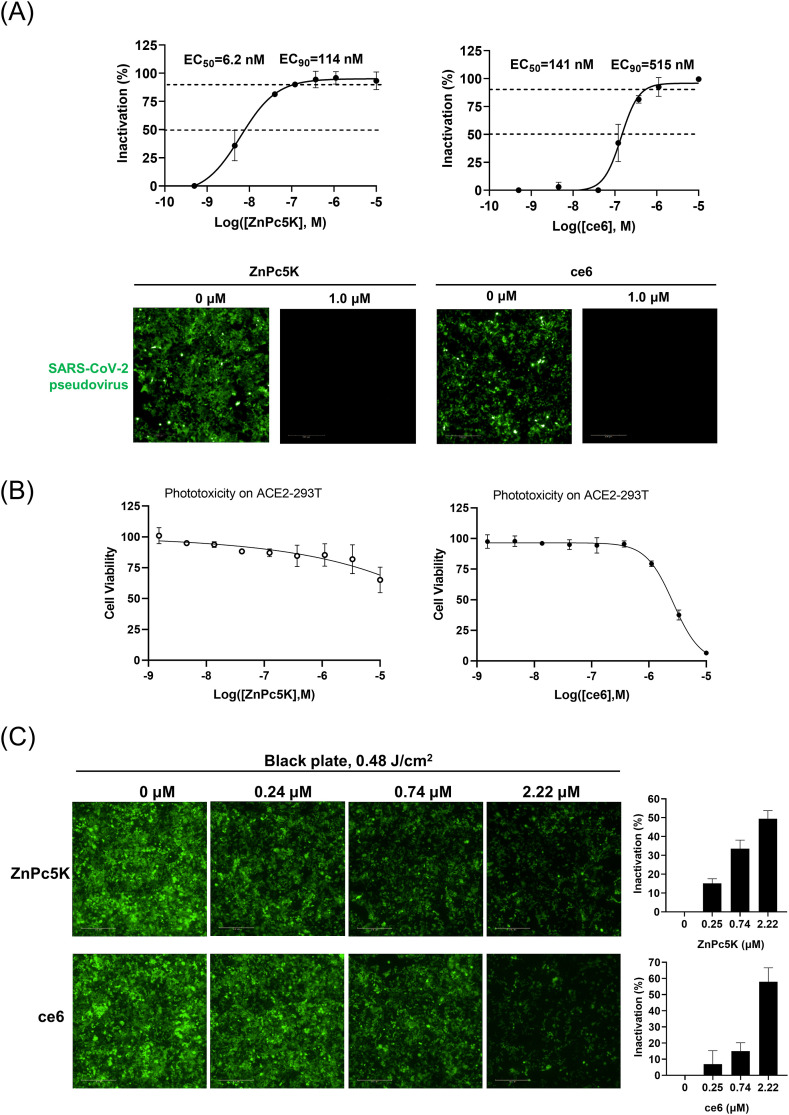
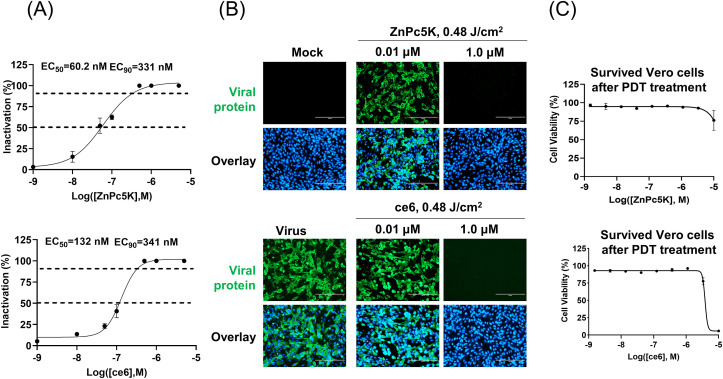
The ongoing pandemic of coronavirus disease 2019 (COVID-19) posed a major challenge to the public health. Currently, no proven antiviral treatment for Severe Acute Respiratory Syndrome Coronavirus 2 (SARS-CoV-2) infection is available. Here we report compounds pentalysine β-carbonylphthalocyanine zinc (ZnPc5K) and chlorin e6 (ce6) potently inhibited the viral infection and replication in vitro with EC values at nanomolar level. These compounds were first identified by screening a panel of photosensitizers for photodynamic viral inactivation. Such viral inactivation strategy is implementable, and has unique advantages, including resistance to virus mutations, affordability compared to the monoclonal antibodies, and lack of long-term toxicity.
2019年冠状病毒病(COVID-19)的持续流行对公共卫生构成了重大挑战。目前,尚无经证实的针对严重急性呼吸综合征冠状病毒2(SARS-CoV-2)感染的抗病毒治疗方法。在此,我们报告化合物五赖氨酸β-羰基酞菁锌(ZnPc5K)和二氢卟吩e6(ce6)在体外能有效抑制病毒感染和复制,其半数有效浓度(EC)值处于纳摩尔水平。这些化合物最初是通过筛选一组用于光动力病毒灭活的光敏剂而鉴定出来的。这种病毒灭活策略是可行的,并且具有独特的优势,包括对病毒突变具有抗性、与单克隆抗体相比价格可承受,以及无长期毒性。