Department of Life, Health and Environmental Sciences, Division of Internal Medicine and Nephrology, Hypertension and Cardiovascular Prevention Unit, University of L'Aquila, San Salvatore Hospital, L'Aquila, Italy.
Department of Life, Health and Environmental Sciences, Division of Geriatrics, University of L'Aquila, SS. Filippo and Nicola Hospital, Avezzano, AQ, Italy.
High Blood Press Cardiovasc Prev. 2021 Sep;28(5):457-466. doi: 10.1007/s40292-021-00465-7. Epub 2021 Jun 29.
Achieving hypertension control is beneficial regardless of age. Fixed-combination pills have the potential of increasing adherence to treatment, improving the benefit/risk ratio, and simplifying therapy, with resulting convenience especially in the elderly.
We examined real-world antihypertensive treatment adherence and hypertension control rates in a cohort of Italian elderly individuals, enrolled in a prospective, pragmatic awareness-raising campaign on blood pressure (BP).
13196 treated hypertensive elderly (mean age 73.2±7.5 years, 55.5% women) were recruited through opportunistic sampling, answered a brief questionnaire on antihypertensive therapy, and were followed-up for 6 months, when BP was measured as per routine care. Controlled hypertension was defined as BP < 140/90 mmHg. Real-world treatment adherence and hypertension control rates were evaluated at 6 months according to different treatment patterns (fixed-dose versus free combinations), using Yates correction for continuity to assess likelihood estimates for differences between treatments.
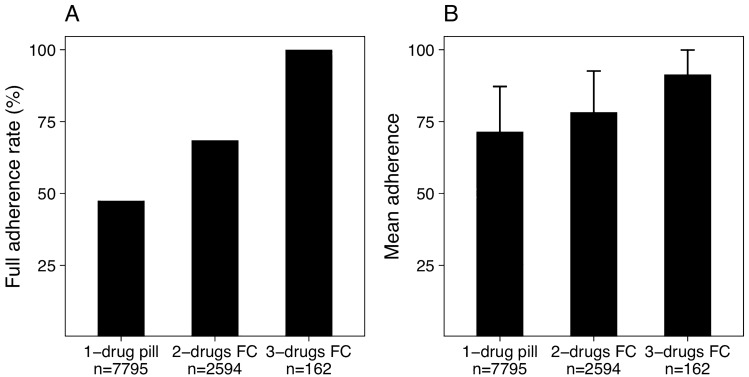
10551 participants (80%) were on a single-pill therapy and 3445 were on a fixed combination therapy of two (24.8%) or three (1.3%) drugs. Individuals on a fixed combination therapy were more adherent to treatment than the counterparts (p < 0.001). Full adherence increased with the number of drugs/pill among single-pill users (47.5%, 68.5%, and 100% with 1, 2, or 3 drugs/pill; p < 0.001). Hypertension control rates were 70% and 65.2% (p = 0.001) according to fixed or free combinations of two drugs and 71% and 63.9% (p = 0.321) for fixed or free combinations of three drugs.
Real-world data suggest that simplified treatment strategies and use of fixed combinations improve adherence to antihypertensive therapy and BP control in the elderly.
无论年龄大小,实现高血压控制都有益处。固定剂量联合用药具有提高治疗依从性、改善获益/风险比以及简化治疗的潜力,从而带来便利,尤其是在老年人中。
我们在一项针对血压的前瞻性、实用意识提高活动中,检查了意大利老年人群队列中真实世界的抗高血压治疗依从性和高血压控制率。
通过机会性抽样,招募了 13196 名接受治疗的高血压老年患者(平均年龄 73.2±7.5 岁,55.5%为女性),他们回答了关于抗高血压治疗的简短问卷,并随访了 6 个月,期间按照常规护理测量血压。将血压<140/90mmHg 定义为控制高血压。根据不同的治疗方案(固定剂量与自由联合),在 6 个月时评估真实世界的治疗依从性和高血压控制率,使用 Yates 连续性校正评估治疗差异的可能性估计。
10551 名参与者(80%)接受单一药物治疗,3445 名参与者接受两种(24.8%)或三种(1.3%)药物的固定联合治疗。接受固定联合治疗的个体比对照者更能坚持治疗(p<0.001)。随着单药治疗中药物/药片数量的增加,完全依从性增加(1、2 或 3 种药物/片时,分别为 47.5%、68.5%和 100%;p<0.001)。根据两种药物的固定或自由联合,高血压控制率分别为 70%和 65.2%(p=0.001),根据三种药物的固定或自由联合,高血压控制率分别为 71%和 63.9%(p=0.321)。
真实世界的数据表明,简化治疗策略和使用固定联合用药可提高老年人抗高血压治疗的依从性和血压控制率。