Department of Biomaterials, Max Planck Institute of Colloids and Interfaces, 14476, Potsdam, Germany.
Department of Experimental Neurology, Charité-Universitätsmedizin Berlin, 10117, Berlin, Germany.
Sci Rep. 2021 Jun 29;11(1):13455. doi: 10.1038/s41598-021-92054-w.
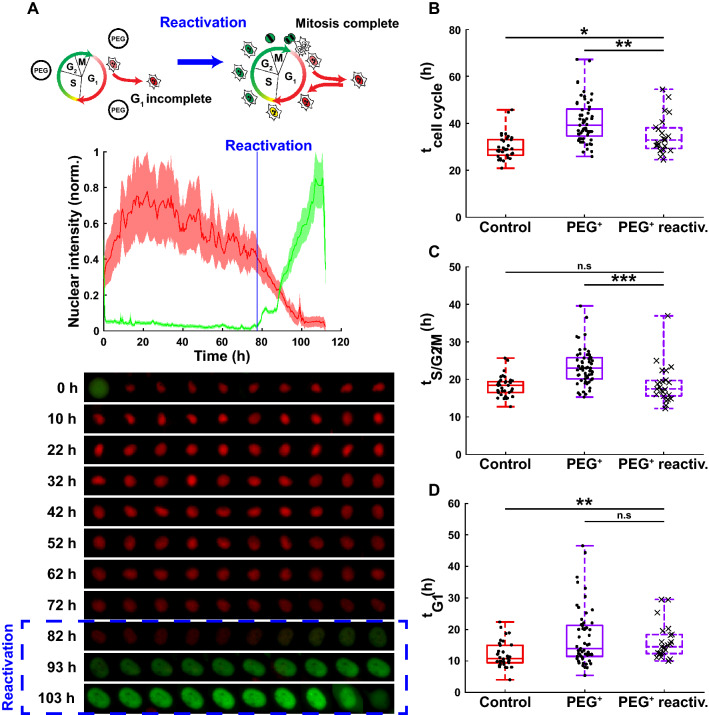
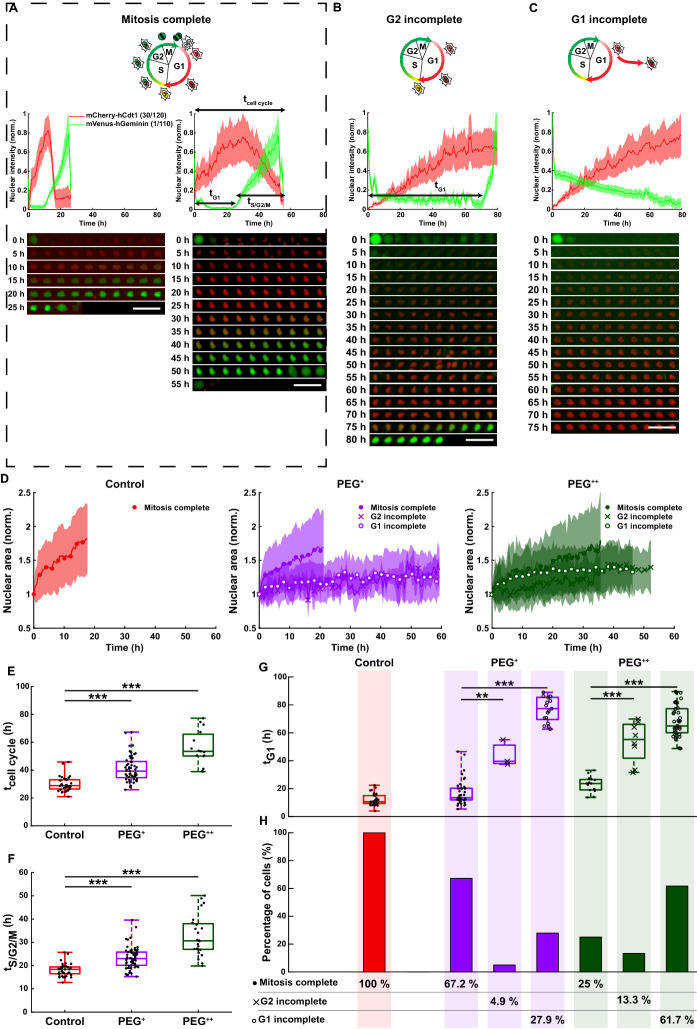
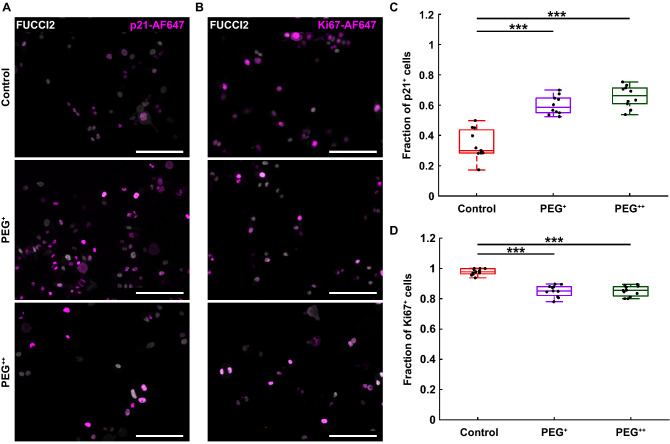
Biophysical cues such as osmotic pressure modulate proliferation and growth arrest of bacteria, yeast cells and seeds. In tissues, osmotic regulation takes place through blood and lymphatic capillaries and, at a single cell level, water and osmoregulation play a critical role. However, the effect of osmotic pressure on single cell cycle dynamics remains poorly understood. Here, we investigate the effect of osmotic pressure on single cell cycle dynamics, nuclear growth, proliferation, migration and protein expression, by quantitative time-lapse imaging of single cells genetically modified with fluorescent ubiquitination-based cell cycle indicator 2 (FUCCI2). Single cell data reveals that under hyperosmotic stress, distinct cell subpopulations emerge with impaired nuclear growth, delayed or growth arrested cell cycle and reduced migration. This state is reversible for mild hyperosmotic stress, where cells return to regular cell cycle dynamics, proliferation and migration. Thus, osmotic pressure can modulate the reversible growth arrest and reactivation of human metastatic cells.
生物物理线索,如渗透压,调节细菌、酵母细胞和种子的增殖和生长停滞。在组织中,渗透压调节通过血液和淋巴毛细管进行,而在单细胞水平上,水和渗透压调节起着关键作用。然而,渗透压对单细胞周期动态的影响仍知之甚少。在这里,我们通过荧光泛素化细胞周期指示剂 2(FUCCI2)基因修饰的单细胞的定量延时成像,研究渗透压对单细胞周期动态、核生长、增殖、迁移和蛋白质表达的影响。单细胞数据表明,在高渗应激下,出现了具有受损核生长、延迟或生长停滞的细胞周期以及减少迁移的不同细胞亚群。对于轻度高渗应激,这种状态是可逆的,细胞恢复到正常的细胞周期动态、增殖和迁移。因此,渗透压可以调节人类转移性细胞的可逆生长停滞和再激活。