School of Food Science and Engineering, Hainan University, Haikou, China.
UCSD Health Department of Pediatrics, University of California, San Diego, 9500 Gilman Drive, La Jolla, CA, 92093, USA.
Microbiome. 2021 Jun 30;9(1):151. doi: 10.1186/s40168-021-01102-0.
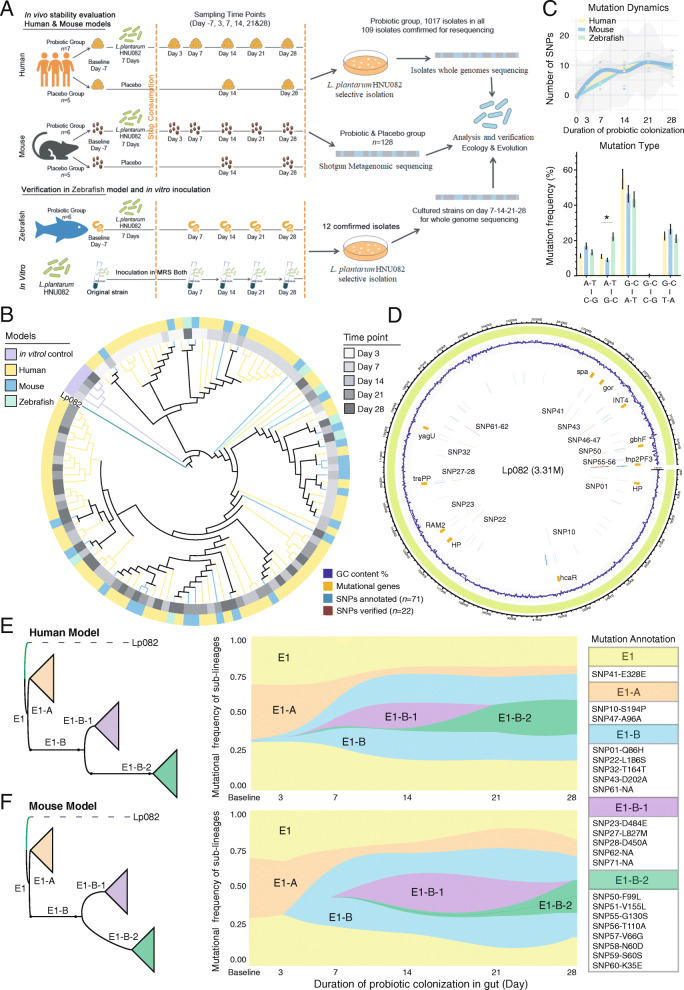
Improving probiotic engraftment in the human gut requires a thorough understanding of the in vivo adaptive strategies of probiotics in diverse contexts. However, for most probiotic strains, these in vivo genetic processes are still poorly characterized. Here, we investigated the effects of gut selection pressures from human, mice, and zebrafish on the genetic stability of a candidate probiotic Lactiplantibacillus plantarum HNU082 (Lp082) as well as its ecological and evolutionary impacts on the indigenous gut microbiota using shotgun metagenomic sequencing in combination with isolate resequencing methods.
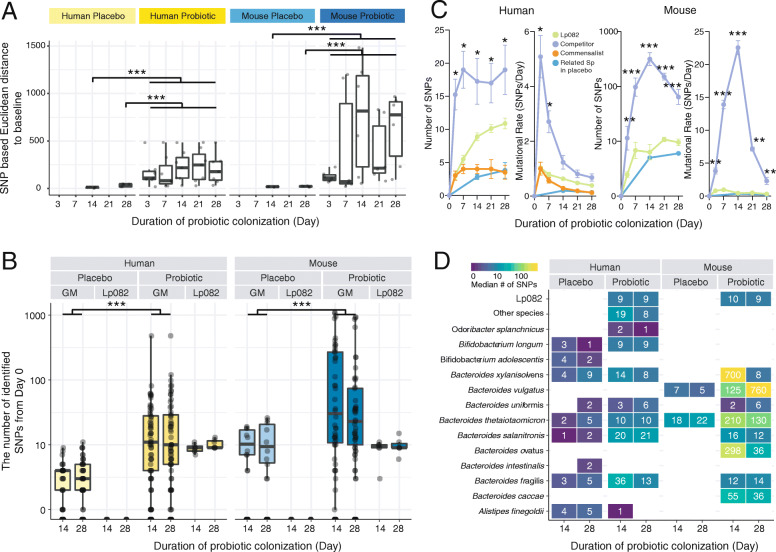
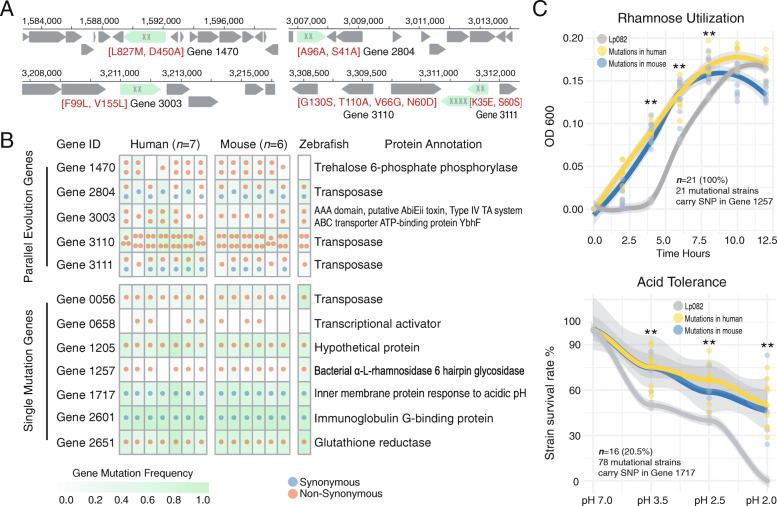
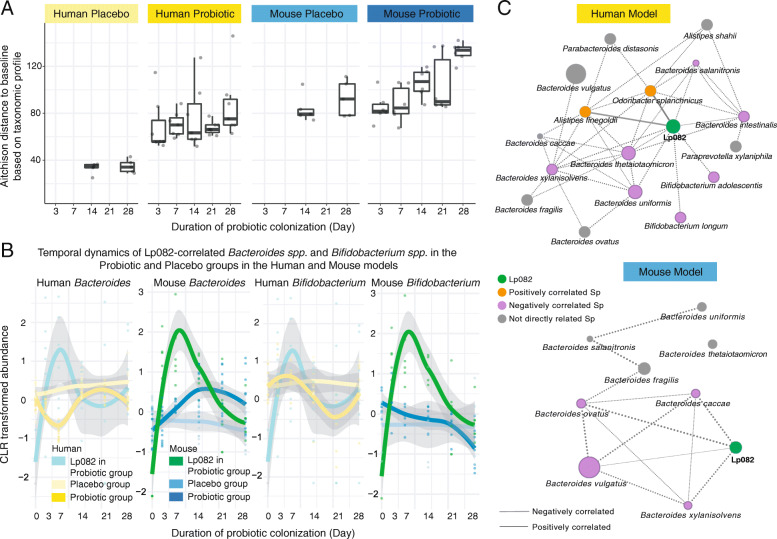
We combined both metagenomics and isolate whole genome sequencing approaches to systematically study the gut-adaptive evolution of probiotic L. plantarum and the ecological and evolutionary changes of resident gut microbiomes in response to probiotic ingestion in multiple host species. Independent of host model, Lp082 colonized and adapted to the gut by acquiring highly consistent single-nucleotide mutations, which primarily modulated carbohydrate utilization and acid tolerance. We cultivated the probiotic mutants and validated that these gut-adapted mutations were genetically stable for at least 3 months and improved their fitness in vitro. In turn, resident gut microbial strains, especially competing strains with Lp082 (e.g., Bacteroides spp. and Bifidobacterium spp.), actively responded to Lp082 engraftment by accumulating 10-70 times more evolutionary changes than usual. Human gut microbiota exhibited a higher ecological and genetic stability than that of mice.
Collectively, our results suggest a highly convergent adaptation strategy of Lp082 across three different host environments. In contrast, the evolutionary changes within the resident gut microbes in response to Lp082 were more divergent and host-specific; however, these changes were not associated with any adverse outcomes. This work lays a theoretical foundation for leveraging animal models for ex vivo engineering of probiotics to improve engraftment outcomes in humans. Video abstract.
要提高益生菌在人体肠道中的定植能力,需要深入了解益生菌在不同环境下的体内适应策略。然而,对于大多数益生菌菌株,这些体内遗传过程仍知之甚少。在这里,我们研究了来自人类、小鼠和斑马鱼的肠道选择压力对候选益生菌植物乳杆菌 HNU082(Lp082)遗传稳定性的影响,以及使用 shotgun 宏基因组测序结合分离物重测序方法对其对土著肠道微生物群的生态和进化影响。
我们结合宏基因组学和分离物全基因组测序方法,系统研究了益生菌植物乳杆菌的肠道适应性进化以及在多个宿主物种中摄入益生菌后常驻肠道微生物组的生态和进化变化。无论宿主模型如何,Lp082 通过获取高度一致的单核苷酸突变来定植和适应肠道,这些突变主要调节碳水化合物利用和耐酸性。我们培养了益生菌突变体,并验证了这些肠道适应突变在至少 3 个月内是遗传稳定的,并提高了它们在体外的适应性。反过来,常驻肠道微生物菌株,特别是与 Lp082 竞争的菌株(例如,拟杆菌属和双歧杆菌属),通过积累比平时多 10-70 倍的进化变化来积极响应 Lp082 的定植。人类肠道微生物群比小鼠具有更高的生态和遗传稳定性。
总的来说,我们的研究结果表明,Lp082 在三种不同的宿主环境中表现出高度趋同的适应策略。相比之下,常驻肠道微生物对 Lp082 的反应中的进化变化更加多样化且具有宿主特异性;然而,这些变化与任何不良后果无关。这项工作为利用动物模型对益生菌进行体外工程改造以改善人类定植结果奠定了理论基础。