Hejna Monika, Kovanda Lauren, Rossi Luciana, Liu Yanhong
Department of Health, Animal Science and Food Safety, Università degli Studi di Milano, Via Trentacoste 2, 20134 Milan, Italy.
Department of Animal Science, University of California, Davis, 4302 Meyer Hall, One Shields Ave, Davis, CA 95616, USA.
Antioxidants (Basel). 2021 Jun 23;10(7):1004. doi: 10.3390/antiox10071004.
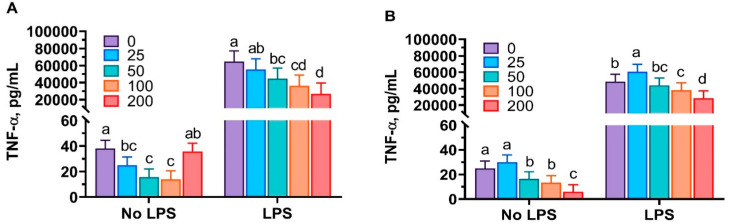
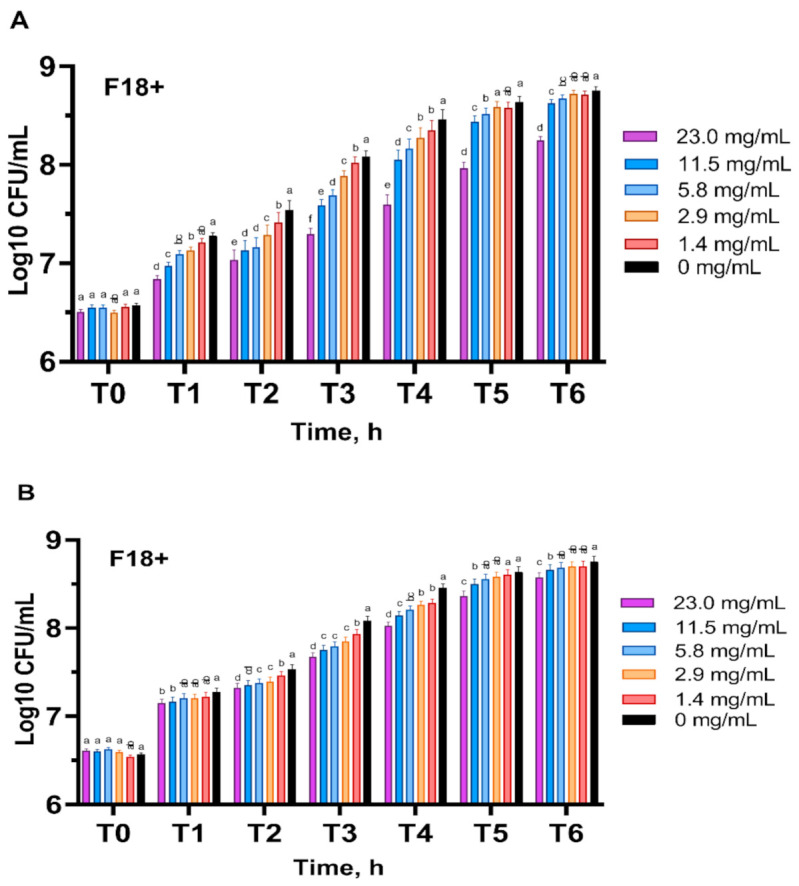
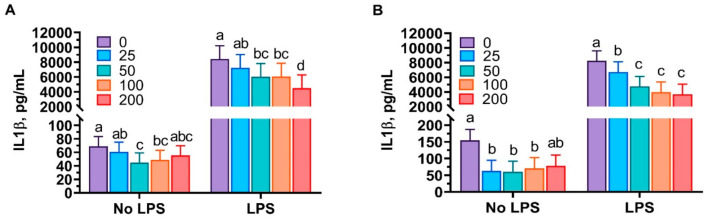
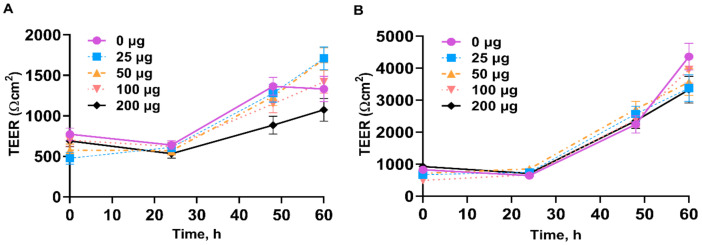
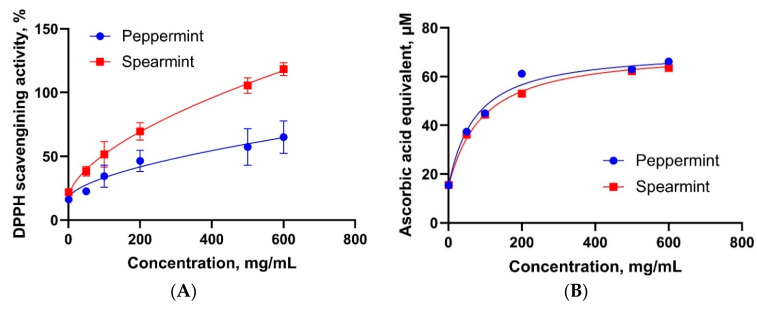
The objectives of the study were to test the biological activities of peppermint and spearmint oils via (i) measuring in vitro anti-inflammatory effects with porcine alveolar macrophages (PAMs), (ii) determining the barrier integrity of IPEC-J2 by analyzing transepithelial electrical resistance (TEER), (iii) testing their antioxidant activities, and (iv) investigating the antimicrobial activity against enterotoxigenic (ETEC) F18+. Briefly, (i) macrophages were seeded at 10 cells/mL and treated (24 h) with mint oils and lipopolysaccharide (LPS). The treatments were 2 (0 or 1 μg/mL of LPS) × 5 (0, 25, 50, 100, 200 µg/mL of mint oils). The supernatants were collected for TNF-α and IL-1β measurement by ELISA; (ii) IPEC-J2 cells were seeded at 5 × 10 cells/mL and treated with mint oils (0, 25, 50, 100, and 200 μg/mL). TEER (Ωcm) was measured at 0, 24, 48, and 72 h; (iii) the antioxidant activity was assessed (0, 1, 50, 100, 200, 500, and 600 mg/mL) using the 2,2-diphenyl-1-picrylhydrazyl (DPPH) radical scavenging and reducing power assays; (iv) overnight-grown ETEC F18+ were quantified (CFU/mL) after supplementing with peppermint and spearmint oils (0, 1.44, 2.87, 5.75, 11.50, and 23.00 mg/mL). All data were analyzed using the MIXED procedure. Both mint oils significantly inhibited ( < 0.05) IL-1β and TNF-α secretion from LPS-stimulated PAMs. Mint oil treatments did not affect TEER in IPEC-J2. Spearmint and peppermint oils exhibited ( < 0.05) strong antioxidant activities in DPPH and reducing power assays. Both mint oils also dose-dependently inhibited ( < 0.05) the growth of ETEC F18+ in vitro. The results of the study indicated that both mint oils are great candidate feed additives due to their in vitro anti-inflammatory, antioxidant, and antimicrobial effects. Further research is needed to evaluate their efficacy in vivo.
(i)用猪肺泡巨噬细胞(PAM)测量体外抗炎作用;(ii)通过分析跨上皮电阻(TEER)确定IPEC-J2的屏障完整性;(iii)测试它们的抗氧化活性;(iv)研究对产肠毒素大肠杆菌(ETEC)F18 +的抗菌活性。简要来说,(i)将巨噬细胞以10个细胞/毫升的密度接种,并用薄荷油和脂多糖(LPS)处理(24小时)。处理方式为2(0或1微克/毫升的LPS)×5(0、25、50、100、200微克/毫升的薄荷油)。收集上清液,通过酶联免疫吸附测定(ELISA)测量肿瘤坏死因子-α(TNF-α)和白细胞介素-1β(IL-1β);(ii)将IPEC-J2细胞以5×10个细胞/毫升的密度接种,并用薄荷油(0、25、50、100和200微克/毫升)处理。在0、24、48和72小时测量TEER(Ω·cm);(iii)使用2,2-二苯基-1-苦基肼基(DPPH)自由基清除和还原能力测定法评估抗氧化活性(0、1、50、100、200、500和600毫克/毫升);(iv)在补充薄荷油和留兰香油(0、1.44、2.87、5.75、11.50和23.00毫克/毫升)后,对过夜培养的ETEC F18 +进行定量(CFU/毫升)。所有数据均使用混合程序进行分析。两种薄荷油均显著抑制(P<0.05)LPS刺激的PAM分泌IL-1β和TNF-α。薄荷油处理对IPEC-J2中的TEER没有影响。留兰香油和薄荷油在DPPH和还原能力测定中表现出(P<0.05)较强的抗氧化活性。两种薄荷油还均剂量依赖性地抑制(P<0.05)ETEC F18 +在体外的生长。研究结果表明,由于两种薄荷油具有体外抗炎、抗氧化和抗菌作用,它们都是很好的候选饲料添加剂。需要进一步研究来评估它们在体内的功效。