Centro de Investigación Clínica Avanzada, Facultad de Medicina and Hospital Clínico Universidad de Chile, Santiago 8380453, CP, Chile.
Departamento de Neurociencia, Facultad de Medicina, Universidad de Chile, Santiago 8380453, CP, Chile.
Int J Mol Sci. 2021 Jun 12;22(12):6311. doi: 10.3390/ijms22126311.
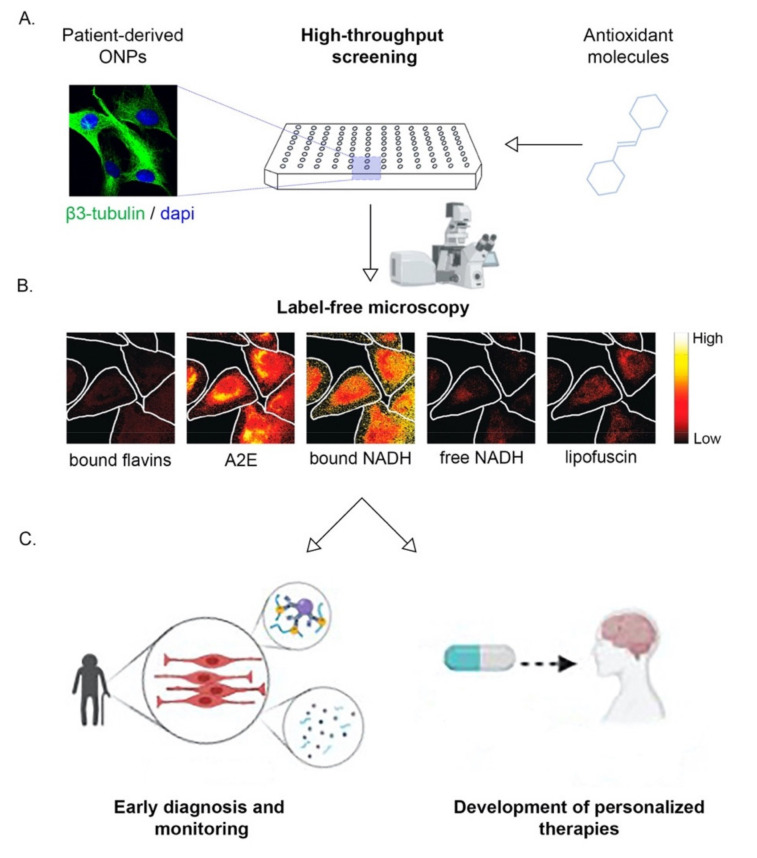
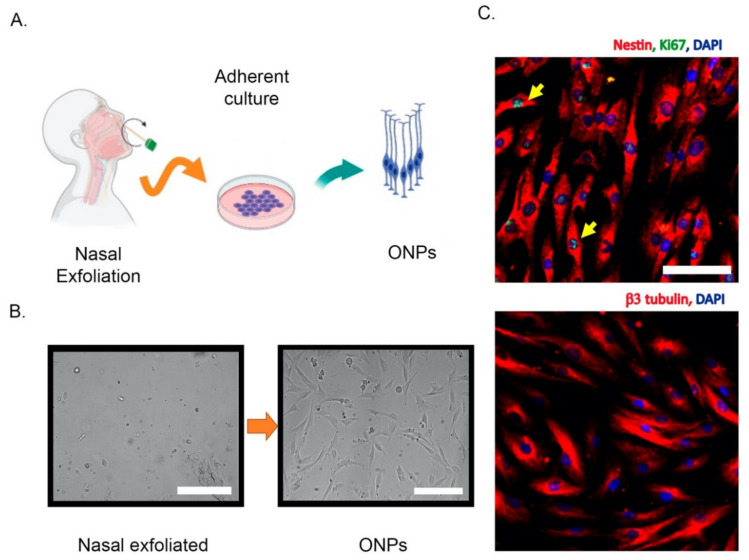
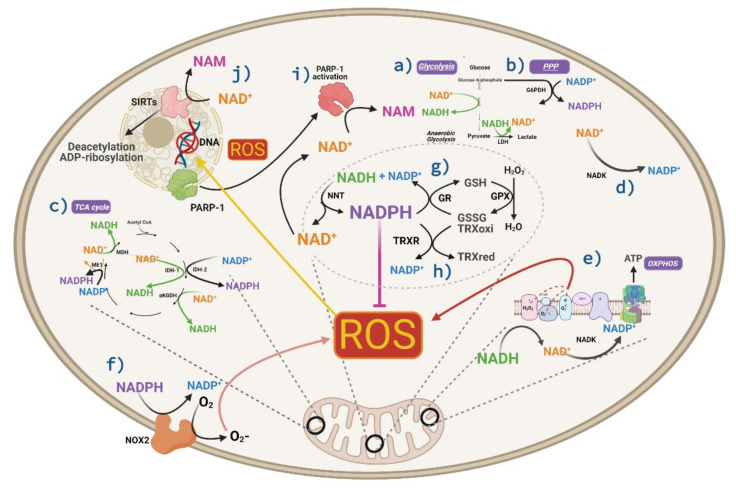
Among all the proposed pathogenic mechanisms to understand the etiology of Alzheimer's disease (AD), increased oxidative stress seems to be a robust and early disease feature where many of those hypotheses converge. However, despite the significant lines of evidence accumulated, an effective diagnosis and treatment of AD are not yet available. This limitation might be partially explained by the use of cellular and animal models that recapitulate partial aspects of the disease and do not account for the particular biology of patients. As such, cultures of patient-derived cells of peripheral origin may provide a convenient solution for this problem. Peripheral cells of neuronal lineage such as olfactory neuronal precursors (ONPs) can be easily cultured through non-invasive isolation, reproducing AD-related oxidative stress. Interestingly, the autofluorescence of key metabolic cofactors such as reduced nicotinamide adenine dinucleotide (NADH) can be highly correlated with the oxidative state and antioxidant capacity of cells in a non-destructive and label-free manner. In particular, imaging NADH through fluorescence lifetime imaging microscopy (FLIM) has greatly improved the sensitivity in detecting oxidative shifts with minimal intervention to cell physiology. Here, we discuss the translational potential of analyzing patient-derived ONPs non-invasively isolated through NADH FLIM to reveal AD-related oxidative stress. We believe this approach may potentially accelerate the discovery of effective antioxidant therapies and contribute to early diagnosis and personalized monitoring of this devastating disease.
在所有用于理解阿尔茨海默病 (AD) 病因的潜在发病机制中,氧化应激增加似乎是一种强大且早期的疾病特征,许多假说都以此为中心。然而,尽管积累了大量的证据,但 AD 的有效诊断和治疗方法仍未出现。这种局限性可能部分归因于使用细胞和动物模型,这些模型仅能重现疾病的部分方面,而无法反映患者的特定生物学特征。因此,源自患者外周来源的细胞培养物可能为解决这一问题提供了一种便捷的方法。外周神经源性细胞,如嗅球神经前体细胞 (ONP),可通过非侵入性分离进行轻松培养,从而重现 AD 相关的氧化应激。有趣的是,关键代谢辅因子(如还原型烟酰胺腺嘌呤二核苷酸 (NADH))的自发荧光可以以非破坏性且无需标记的方式与细胞的氧化状态和抗氧化能力高度相关。特别是,通过荧光寿命成像显微镜 (FLIM) 对 NADH 进行成像,可极大地提高检测氧化变化的灵敏度,同时对细胞生理学的干预最小。在这里,我们讨论了通过 NADH FLIM 对非侵入性分离的患者源性 ONP 进行分析,以揭示 AD 相关氧化应激的转化潜力。我们相信,这种方法可能有助于加速发现有效的抗氧化治疗方法,并为该毁灭性疾病的早期诊断和个性化监测做出贡献。