Lojkić Ivana, Šimić Ivana, Bedeković Tomislav, Krešić Nina
Laboratory for Rabies and General Virology, Department of Virology, Croatian Veterinary Institute, 10000 Zagreb, Croatia.
Laboratory for Molecular Virology, Division of Molecular Medicine, Ruđer Bošković Institute, 10000 Zagreb, Croatia.
Pathogens. 2021 Jun 12;10(6):742. doi: 10.3390/pathogens10060742.
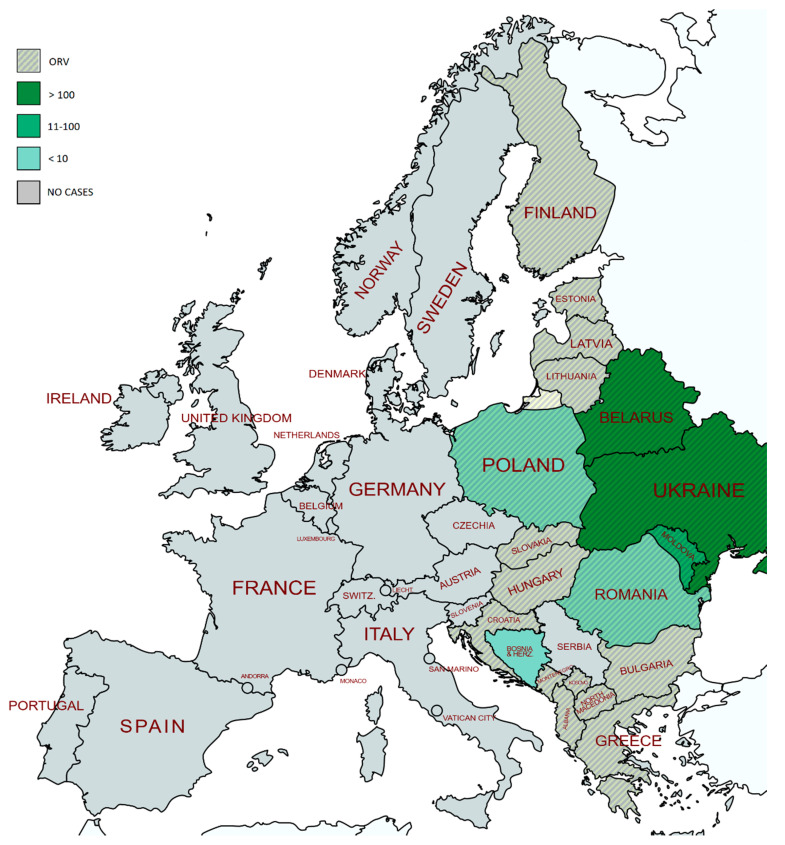
The objective of this paper is to provide an overview of the current status of rabies in Europe, with special emphasis on Croatia and Southeast and East Europe. Due to the systematic implementation of a rabies eradication program by oral vaccination of wild animals, by the end of the 20th century, most West and Central European countries were rabies-free. The EU goal was to eradicate rabies in wildlife and domestic animals by 2020. No matter how achievable the goal seemed to be, the disease is still present in the eastern part of the EU, as was notified in 2020 by two member states-Poland and Romania. Croatia has been rabies-free for the last seven years but given that it borders a non-EU country in which a case of rabies was confirmed in 2020, it will continue to contribute to the maintenance of the rabies-free region. A rabies-free EU can only be achieved by continuous oral vaccination, coordination and a regional approach. The prevention of reintroductions from bordering countries in which rabies has not been eradicated yet, and the support for the eradication efforts made by these countries, are goals still pending.
本文旨在概述欧洲狂犬病的现状,特别着重于克罗地亚以及东南欧和东欧地区。由于通过对野生动物进行口服疫苗接种系统地实施了狂犬病根除计划,到20世纪末,大多数西欧和中欧国家已无狂犬病。欧盟的目标是到2020年根除野生动物和家畜中的狂犬病。无论该目标看似多么可实现,正如两个成员国——波兰和罗马尼亚在2020年所通报的那样,该病仍在欧盟东部地区存在。克罗地亚在过去七年一直无狂犬病,但鉴于其与一个在2020年确诊了一例狂犬病病例的非欧盟国家接壤,它将继续为维持无狂犬病地区作出贡献。只有通过持续的口服疫苗接种、协调以及区域方法,才能实现无狂犬病的欧盟。防止尚未根除狂犬病的周边国家重新引入狂犬病,以及支持这些国家的根除努力,仍是有待实现的目标。