Lebedenko Charlotta G, Banerjee Ipsita A
Department of Chemistry, Fordham University, 441 East Fordham Road, Bronx, NY 10458, USA.
Biomimetics (Basel). 2021 Jun 16;6(2):40. doi: 10.3390/biomimetics6020040.
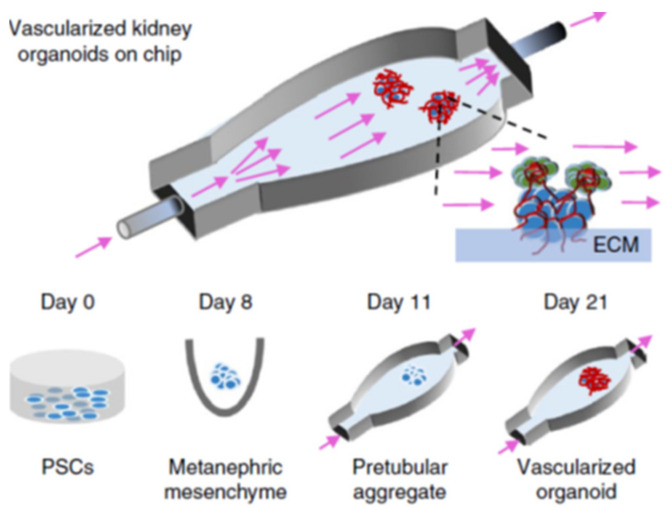
Chronic kidney diseases are a leading cause of fatalities around the world. As the most sought-after organ for transplantation, the kidney is of immense importance in the field of tissue engineering. The primary obstacle to the development of clinically relevant tissue engineered kidneys is precise vascularization due to the organ's large size and complexity. Current attempts at whole-kidney tissue engineering include the repopulation of decellularized kidney extracellular matrices or vascular corrosion casts, but these approaches do not eliminate the need for a donor organ. Stem cell-based approaches, such as kidney organoids vascularized in microphysiological systems, aim to construct a kidney without the need for organ donation. These organ-on-a-chip models show complex, functioning kidney structures, albeit at a small scale. Novel methodologies for developing engineered scaffolds will allow for improved differentiation of kidney stem cells and organoids into larger kidney grafts with clinical applications. While currently, kidney tissue engineering remains mostly limited to individual renal structures or small organoids, further developments in vascularization techniques, with technologies such as organoids in microfluidic systems, could potentially open doors for a large-scale growth of whole engineered kidneys for transplantation.
慢性肾脏病是全球死亡的主要原因之一。作为移植领域最受追捧的器官,肾脏在组织工程领域具有极其重要的意义。由于肾脏体积大且结构复杂,精确的血管化是临床相关组织工程肾脏发展的主要障碍。目前全肾组织工程的尝试包括在脱细胞肾细胞外基质或血管铸型中重新填充细胞,但这些方法并不能消除对供体器官的需求。基于干细胞的方法,如在微生理系统中实现血管化的肾类器官,旨在构建无需器官捐赠的肾脏。这些芯片上器官模型展示了复杂的、具有功能的肾脏结构,尽管规模较小。开发工程支架的新方法将有助于改善肾干细胞和类器官向具有临床应用价值的更大肾脏移植物的分化。虽然目前肾组织工程大多仍局限于单个肾脏结构或小型类器官,但血管化技术的进一步发展,如微流控系统中的类器官技术,可能为用于移植的全工程化肾脏的大规模生长打开大门。