Centre for Infectious Disease Control, Centre for Zoonoses and Environmental Microbiology, National Institute for Public Health and the Environment (RIVM), P.O. Box 1, 3720 BA Bilthoven, The Netherlands.
Viruses. 2021 Jun 16;13(6):1155. doi: 10.3390/v13061155.
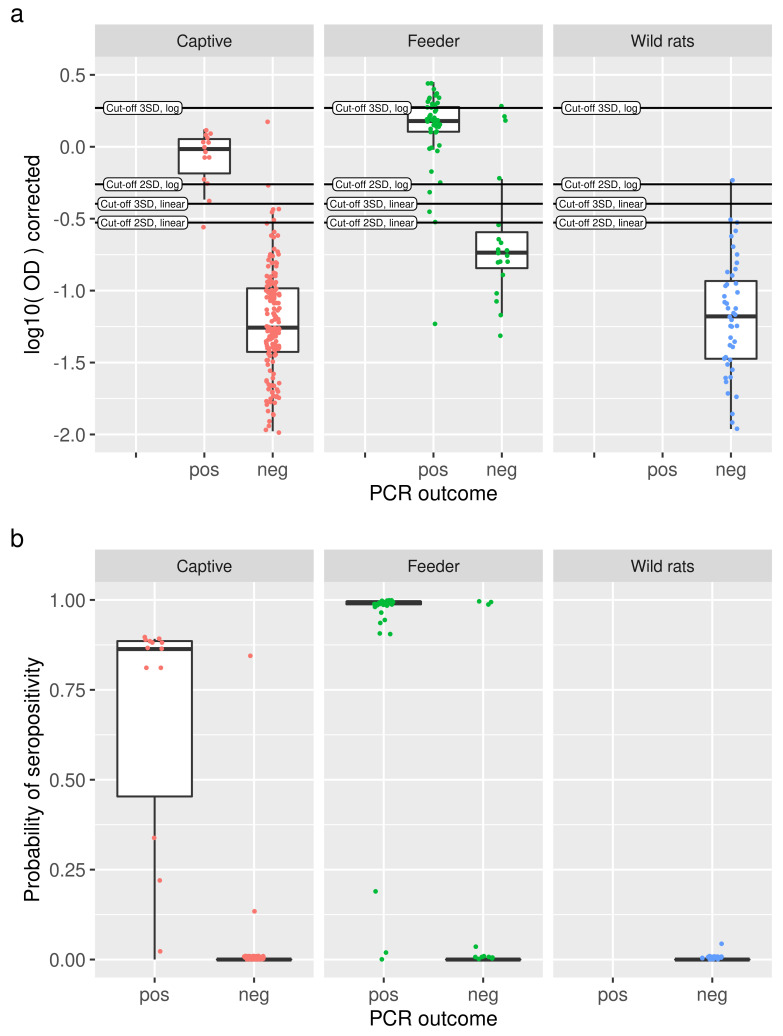
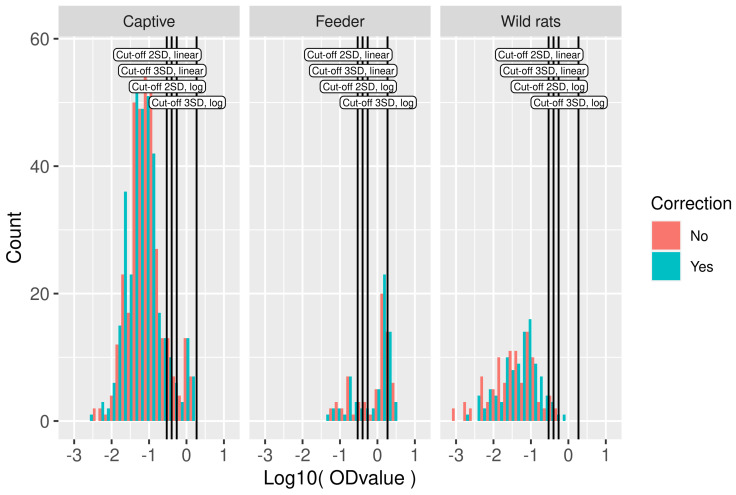
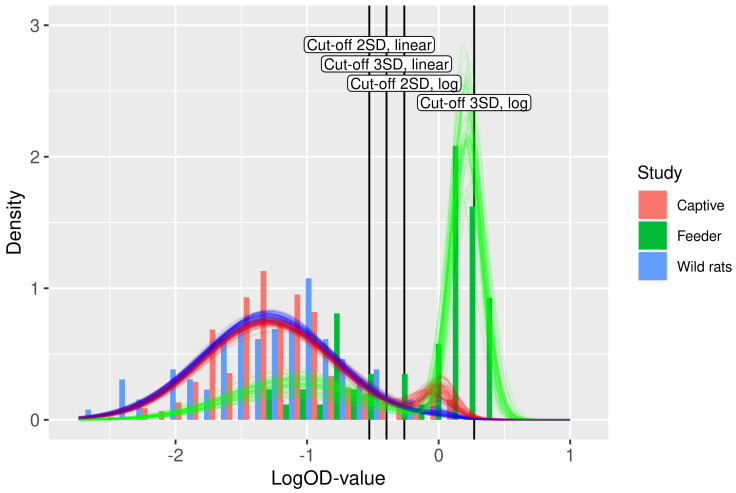
Serological assays, such as the enzyme-linked immunosorbent assay (ELISA), are popular tools for establishing the seroprevalence of various infectious diseases in humans and animals. In the ELISA, the optical density is measured and gives an indication of the antibody level. However, there is variability in optical density values for individuals that have been exposed to the pathogen of interest, as well as individuals that have not been exposed. In general, the distribution of values that can be expected for these two categories partly overlap. Often, a cut-off value is determined to decide which individuals should be considered seropositive or seronegative. However, the classical cut-off approach based on a putative threshold ignores heterogeneity in immune response in the population and is thus not the optimal solution for the analysis of serological data. A binary mixture model does include this heterogeneity, offers measures of uncertainty and the direct estimation of seroprevalence without the need for correction based on sensitivity and specificity. Furthermore, the probability of being seropositive can be estimated for individual samples, and both continuous and categorical covariates (risk-factors) can be included in the analysis. Using ELISA results from rats tested for the Seoul orthohantavirus, we compared the classical cut-off method with a binary mixture model set in a Bayesian framework. We show that it performs similarly or better than cut-off methods, by comparing with real-time quantitative polymerase chain reaction (RT-qPCR) results. We therefore recommend binary mixture models as an analysis tool over classical cut-off methods. An example code is included to facilitate the practical use of binary mixture models in everyday practice.
血清学检测,如酶联免疫吸附测定(ELISA),是用于确定人类和动物各种传染病血清流行率的常用工具。在 ELISA 中,测量光密度并指示抗体水平。然而,已经接触过感兴趣病原体的个体和未接触过的个体的光密度值存在差异。一般来说,这两类个体的预期值分布有部分重叠。通常,确定一个截止值来决定哪些个体应被视为血清阳性或血清阴性。然而,基于假设阈值的经典截止值方法忽略了人群中免疫反应的异质性,因此不是分析血清学数据的最佳解决方案。二项混合模型确实包括这种异质性,提供了不确定性的度量,并直接估计了血清流行率,而无需基于灵敏度和特异性进行校正。此外,可以估计个体样本呈血清阳性的概率,并且可以在分析中包含连续和分类协变量(风险因素)。使用针对首尔正汉坦病毒检测的大鼠的 ELISA 结果,我们在贝叶斯框架中比较了经典截止值方法和二项混合模型。我们通过与实时定量聚合酶链反应(RT-qPCR)结果进行比较,表明它的性能与截止值方法相似或更好。因此,我们建议将二项混合模型作为分析工具,而不是经典截止值方法。我们提供了一个示例代码,以方便在日常实践中使用二项混合模型。