Chiang Chi-Ling, Cheng Ming-Huei, Lin Chih-Hsin
Comprehensive Cancer Center, Division of Hematology, Ohio State University, Columbus, OH 43202, USA.
NSEC Center for Affordable Nanoengineering of Polymeric Biomedical Devices, Ohio State University, Columbus, OH 43202, USA.
Nanomaterials (Basel). 2021 Jun 30;11(7):1727. doi: 10.3390/nano11071727.
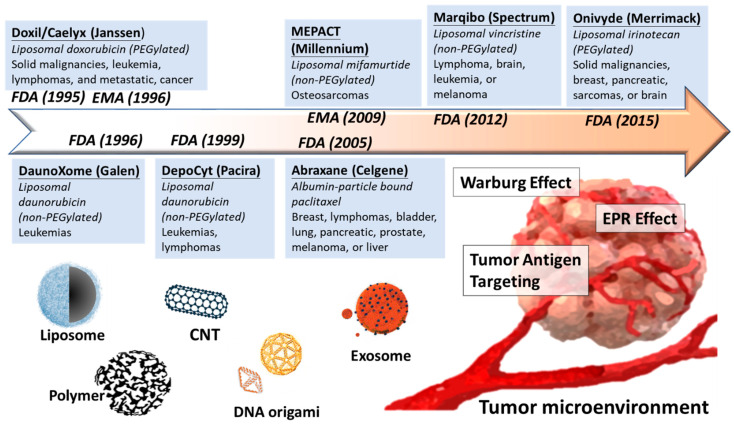
Anticancer nanomedicines have been studied over 30 years, but fewer than 10 formulations have been approved for clinical therapy today. Despite abundant options of anticancer drugs, it remains challenging to have agents specifically target cancer cells while reducing collateral toxicity to healthy tissue. Nanocompartments that can be selective toward points deeply within malignant tissues are a promising concept, but the heterogeneity of tumor tissue, inefficiency of cargo loading and releasing, and low uniformity of manufacture required from preclinical to commercialization are major obstacles. Technological advances have been made in this field, creating engineered nanomaterials with improved uniformity, flexibility of cargo loading, diversity of surface modification, and less inducible immune responses. This review highlights the developmental process of approved nanomedicines and the opportunities for novel materials that combine insights of tumors and nanotechnology to develop a more effective nanomedicine for cancer patients.
抗癌纳米药物已被研究了30多年,但目前获批用于临床治疗的制剂不到10种。尽管有大量的抗癌药物可供选择,但要使药物特异性靶向癌细胞同时减少对健康组织的附带毒性仍然具有挑战性。能够选择性地作用于恶性组织深处靶点的纳米隔室是一个很有前景的概念,但肿瘤组织的异质性、药物装载和释放效率低下以及从临床前到商业化所需的低制造均匀性是主要障碍。该领域已取得技术进步,创造出具有更高均匀性、药物装载灵活性、表面修饰多样性和较低诱导免疫反应的工程纳米材料。本综述重点介绍了已获批纳米药物的开发过程,以及结合肿瘤学见解和纳米技术以开发更有效的癌症患者纳米药物的新型材料所面临的机遇。