Agago Tesfamichael Alaro, Wonde Shewatatek Gedamu, Bramo Senait Samuel, Asaminew Tsedeke
Health Sciences Institute, Jimma University, Jimma, Ethiopia.
College of Natural Sciences, Jimma University, Jimma, Ethiopia.
Adv Med Educ Pract. 2021 Jun 25;12:713-721. doi: 10.2147/AMEP.S308102. eCollection 2021.
Educational strategies following interactive methods of teaching enhance communication skill acquisition of medical students. However, which method of interactivity results in the most compelling communication skill improvement is the prime question yet unanswered.
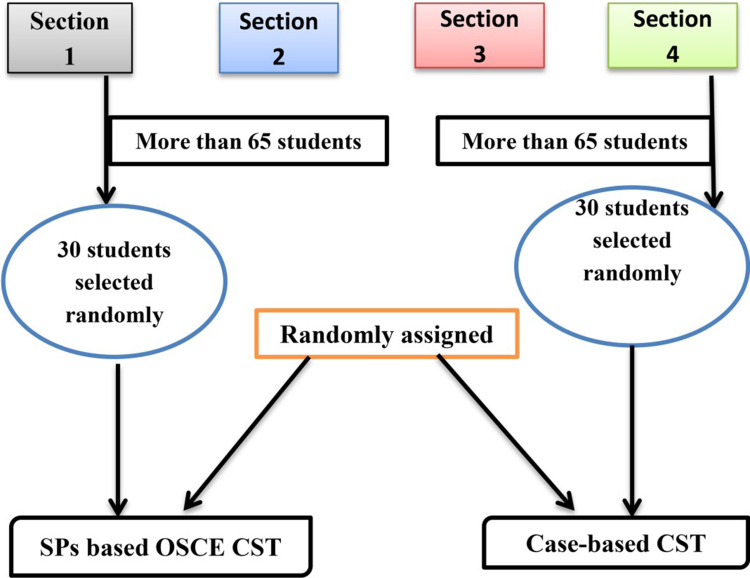
In this study, experimental study design was employed among pre-clerkship II medical students of Jimma University, in the 2017/18 academic year. Accordingly, study participants were grouped in to two arms randomly. Arm 1 students were trained using simulated patients in a skill development lab and arm 2 students were trained using case-based role-plays. Both forms of training lasted for 20 hours and focused on 7 important communication skill dimensions key to patient care tasks, as adapted from the Kalamazoo II Report. An objective structured clinical examination (OSCE) form of assessment with a standardized checklist was utilized to investigate communication skill acquisition.
In this study a total of 60 medical students was assessed for communication skills via 12 SP-based OSCE stations. This study discerned that, out of the total students, 21 (35.0%) were found to be poor at listening effectively. Similarly, 19 (31.7%), 18 (30.0%) and 16 (26.7%) were rated as poor at demonstrating caring and respectful behaviors, building and maintaining a therapeutic relationship and making informed judgments based on client data and preferences, respectively. Furthermore, the modalities of communication skill training are associated with key communication skill competencies except for eliciting information with effective questioning skills and counseling and educating patients. Thus, the SP-based training approach was found to be significantly associated with communication skill acquisition as compared to the case-based role-play approach, with AOR 21.696 at a p-value of <0.001.
In this study, it was concluded that an SP-based communication skill training approach is superior to a case-based role-play approach.
采用互动式教学方法的教育策略可提高医学生的沟通技能。然而,哪种互动方法能带来最显著的沟通技能提升仍是一个尚未得到解答的主要问题。
本研究采用实验性研究设计,于2017/18学年在吉姆马大学临床实习前II的医学生中进行。据此,研究参与者被随机分为两组。第一组学生在技能发展实验室使用模拟患者进行培训,第二组学生使用基于案例的角色扮演进行培训。两种培训形式均持续20小时,并聚焦于根据卡拉马祖II报告改编的、对患者护理任务至关重要的7个重要沟通技能维度。采用带有标准化检查表的客观结构化临床考试(OSCE)评估形式来调查沟通技能的获得情况。
在本研究中,通过12个基于标准化病人(SP)的OSCE站点对总共60名医学生的沟通技能进行了评估。该研究发现,在所有学生中,有21名(35.0%)被发现有效倾听能力较差。同样,分别有19名(31.7%)、18名(30.0%)和16名(26.7%)在表现出关爱和尊重行为、建立和维持治疗关系以及根据患者数据和偏好做出明智判断方面被评为较差。此外,除了以有效的提问技巧获取信息以及为患者提供咨询和教育外,沟通技能培训方式与关键沟通技能能力相关。因此,与基于案例的角色扮演方法相比,基于标准化病人的培训方法被发现与沟通技能的获得显著相关,调整后的优势比(AOR)为21.696,p值<0.001。
在本研究中,得出的结论是基于标准化病人的沟通技能培训方法优于基于案例的角色扮演方法。