Tiwari Anshul, Wang Alberta L, Li Jiang, Lutz Sharon M, Kho Alvin T, Weiss Scott T, Tantisira Kelan G, McGeachie Michael J
Channing Division of Network Medicine, Brigham and Women's Hospital and Harvard Medical School, Boston, MA, USA.
PRecisiOn Medicine Translational Research (PROMoTeR) Center, Department of Population Medicine, Harvard Pilgrim Health Care Institute and Harvard Medical School, Boston, MA, USA.
Allergy Asthma Immunol Res. 2021 Jul;13(4):576-588. doi: 10.4168/aair.2021.13.4.576.
MicroRNAs (miRs) are small non-coding RNA molecules of around 18-22 nucleotides that are key regulators of many biologic processes, particularly inflammation. The purpose of this study was to determine the association of circulating miRs from asthmatic children with seasonal variation in allergic inflammation and asthma symptoms.
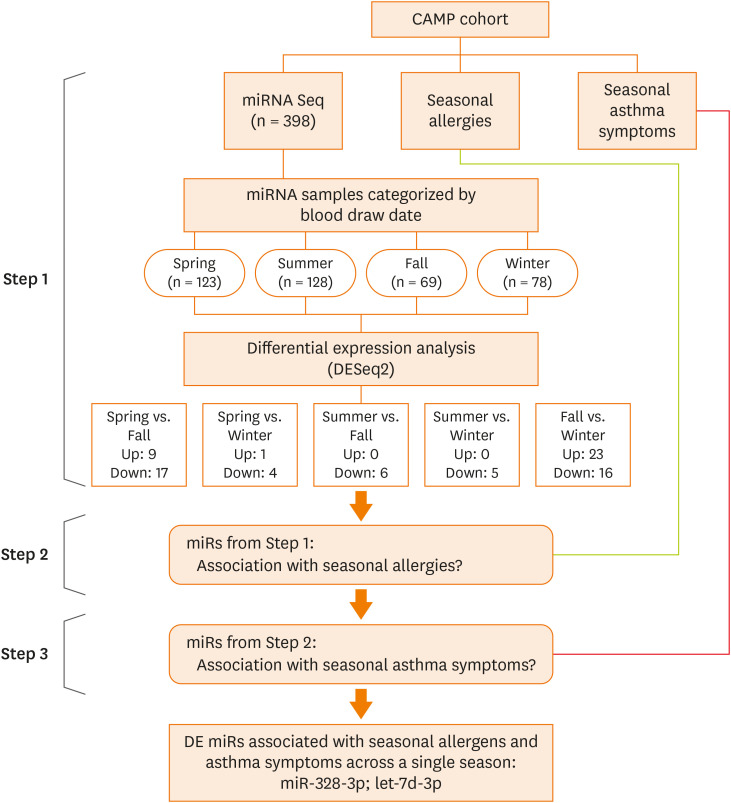
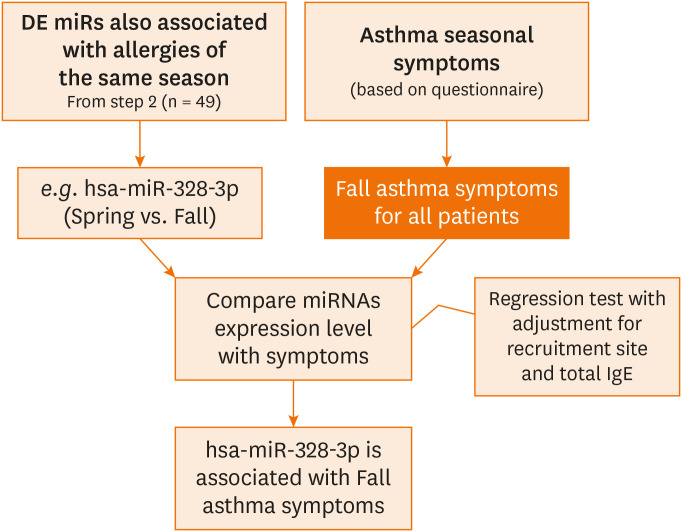
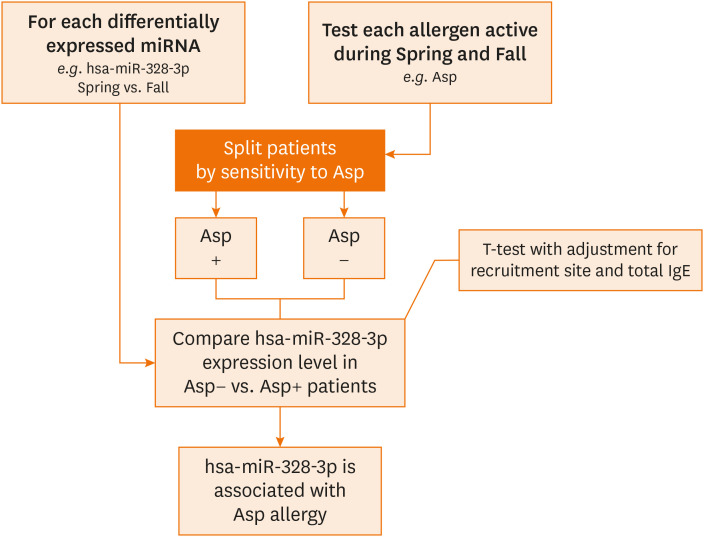
We used available small RNA sequencing on blood serum from 398 children with mild-to-moderate asthma from the Childhood Asthma Management Program. We used seasonal asthma symptom data at the study baseline and allergen affection status from baseline skin prick tests as primary outcomes. We identified differentially expressed (DE) miRs between pairs of seasons using DESeq2. Regression analysis was used to identify associations between allergy status to specific seasonal allergens and DE miRs in 4 seasons and between seasonal asthma symptom data and DE miRs. We performed pathway enrichment analysis for target genes of the DE miRs using DAVID.
After quality control, 398 samples underwent differential analysis between the 4 seasons. We found 52 unique miRs from a total of 81 DE miRs across seasons. Further investigation of the association between these miRs and sensitization to seasonal allergens using skin prick tests revealed that 26 unique miRs from a total of 38 miRs were significantly associated with a same-season allergen. Comparison between seasonal asthma symptom data revealed that 2 of these 26 miRs also had significant associations with asthma symptoms in the same seasons: miR-328-3p ( < 0.03) and let-7d-3p ( < 0.05). Enrichment analysis showed that the most enriched pathway clusters were Rap1, Ras, and MAPK signaling pathways.
Our results show seasonal variation in miR-328-3p and let-7d-3p are significantly associated with seasonal asthma symptoms and seasonal allergies. These indicate a potentially protective role for let-7d-3p and a deleterious role for miR-328-3p in asthmatics sensitized to mulberry. Further work will determine whether these miRs are drivers or results of the allergic response.
微小RNA(miR)是一类长度约为18 - 22个核苷酸的小型非编码RNA分子,是许多生物学过程(尤其是炎症)的关键调节因子。本研究旨在确定哮喘儿童循环miR与过敏性炎症和哮喘症状季节性变化之间的关联。
我们对儿童哮喘管理项目中398名轻至中度哮喘儿童的血清进行了小RNA测序。我们将研究基线时的季节性哮喘症状数据和基线皮肤点刺试验中的过敏原影响状况作为主要观察指标。我们使用DESeq2软件确定不同季节之间差异表达(DE)的miR。回归分析用于确定特定季节过敏原过敏状态与四季中DE miR之间的关联,以及季节性哮喘症状数据与DE miR之间的关联。我们使用DAVID软件对DE miR的靶基因进行通路富集分析。
经过质量控制后,对398个样本进行了四季之间的差异分析。我们在四季共81个DE miR中发现了52个独特的miR。通过皮肤点刺试验进一步研究这些miR与季节性过敏原致敏之间的关联,结果显示,在总共38个miR中,有26个独特的miR与同季节过敏原显著相关。季节性哮喘症状数据比较显示,这26个miR中的2个在相同季节也与哮喘症状显著相关:miR - 328 - 3p(<0.03)和let - 7d - 3p(<0.05)。富集分析表明,最富集的通路簇是Rap1、Ras和MAPK信号通路。
我们的结果表明,miR - 328 - 3p和let - 7d - 3p的季节性变化与季节性哮喘症状和季节性过敏显著相关。这表明let - 7d - 3p在对桑树过敏的哮喘患者中可能具有保护作用,而miR - 328 - 3p可能具有有害作用。进一步的研究将确定这些miR是过敏反应的驱动因素还是结果。