Mehdipour Mahdieh, Daghigh-Kia Hossein, Najafi Abouzar, Martínez-Pastor Felipe
Department of Animal Science, College of Agriculture, University of Tabriz, Tabriz, Iran.
Department of Animal Science, College of Agriculture, University of Tabriz, Tabriz, Iran.
Poult Sci. 2021 Aug;100(8):101291. doi: 10.1016/j.psj.2021.101291. Epub 2021 May 27.
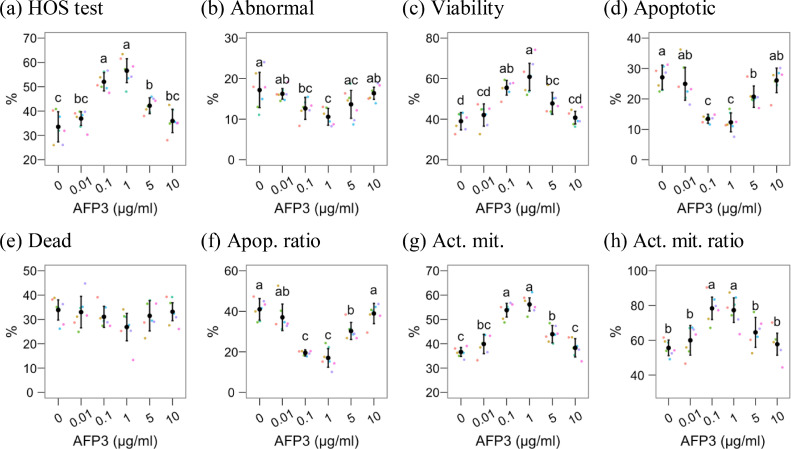
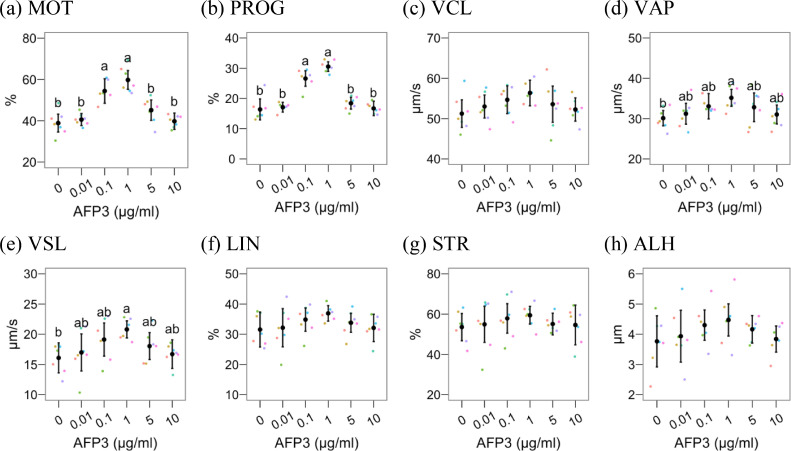
Antifreeze proteins (AFP) have the potential for improving sperm cryopreservation. We have applied Type III antifreeze protein (AFP3) on the cryopreservation of spermatozoa from broiler breeder roosters, aiming to enhance post-thawing quality and fertility. Semen was extended at 37°C in Lake's extender containing AFP3 at 0.01, 0.1, 1, 5, and 10 µg/mL (no AFP3 as control). Post-thawing sperm assessment included sperm motility (CASA), morphology, membrane functionality by hypoosmotic swelling test (HOST), lipoperoxidation as malondialdehyde (MDA) production, and sperm viability, early apoptosis (phosphatidylserine exposure as annexin V-positive staining in viable spermatozoa), and mitochondrial activity by flow cytometry. Fertility was assessed after artificial insemination (30 hens/treatment). Total and progressive motility, membrane functionality, and mitochondrial activity increased in 0.1 and 1 µg/mL AFP, compared to control and other concentrations, whereas apoptosis was significantly lower. VAP, VSL, and viability were significantly higher for 1 µg/mL AFP3 than with the other treatments except for 0.1 µg/mL (which was not always significantly different from the control or other concentrations), and with abnormal forms being significantly lower. The proportion of fertilized and hatched eggs was also higher for 1 µg/mL AFP3, with 0.1 µg/mL also showing significantly higher results than the control, and no differences with other concentrations). In conclusion, 1 µg/mL AFP3 could improve the post-thawing results of rooster spermatozoa frozen in Lake's extender. According to our results, concentrations between 1 and 0.1 µg/mL could be similarly efficient.
抗冻蛋白(AFP)具有改善精子冷冻保存的潜力。我们已将III型抗冻蛋白(AFP3)应用于肉种鸡公鸡精子的冷冻保存,旨在提高解冻后的质量和受精能力。精液在37°C下用含有0.01、0.1、1、5和10μg/mL AFP3的Lake's稀释液进行稀释(无AFP3作为对照)。解冻后精子评估包括精子活力(计算机辅助精子分析)、形态、通过低渗肿胀试验(HOST)评估膜功能、脂质过氧化作为丙二醛(MDA)生成、精子活力、早期凋亡(通过膜联蛋白V阳性染色检测活精子中的磷脂酰丝氨酸暴露)以及通过流式细胞术检测线粒体活性。人工授精后评估受精能力(每组30只母鸡)。与对照和其他浓度相比,0.1和1μg/mL AFP组的总活力和前向运动性、膜功能以及线粒体活性增加,而凋亡显著降低。1μg/mL AFP3组的平均路径速度(VAP)、直线运动速度(VSL)和活力显著高于除0.1μg/mL外的其他处理组(0.1μg/mL与对照或其他浓度组并不总是有显著差异),且异常形态显著更低。1μg/mL AFP3组的受精蛋和孵化蛋比例也更高,0.1μg/mL组的结果也显著高于对照组,与其他浓度组无差异。总之,1μg/mL AFP3可改善在Lake's稀释液中冷冻的公鸡精子的解冻后结果。根据我们的结果,1至0.1μg/mL之间的浓度可能同样有效。