Department of Communication, Philosophy and Technology, Wageningen University, Wageningen, the Netherlands.
Wageningen Economic Research, The Hague, the Netherlands.
Life Sci Soc Policy. 2021 Jul 5;17(1):6. doi: 10.1186/s40504-021-00113-x.
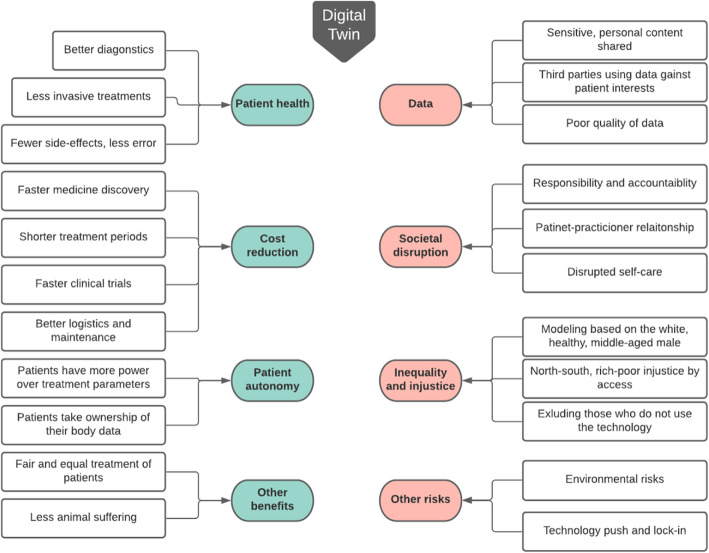
Anticipating the ethical impact of emerging technologies is an essential part of responsible innovation. One such emergent technology is the digital twin which we define here as a living replica of a physical system (human or non-human). A digital twin combines various emerging technologies such as AI, Internet of Things, big data and robotics, each component bringing its own socio-ethical issues to the resulting artefacts. The question thus arises which of these socio-ethical themes surface in the process and how they are perceived by stakeholders in the field. In this report we present the results of a qualitative study into the socio-ethical benefits and socio-ethical risks of using digital twins in healthcare. Employing insights from ethics of technology and the Quadruple Helix theory of innovation, we conducted desk research of white literature and 23 interviews with representatives from the four helixes: industry, research, policy and civil society. The ethical scan revealed several important areas where the digital twin can produce socio-ethical value (e.g., prevention and treatment of disease, cost reduction, patient autonomy and freedom, equal treatment) but also several important areas of socio-ethical risks (e.g., privacy and property of data, disruption of existing societal structures, inequality and injustice). We conclude with a reflection on the employed analytical tool and suggestions for further research.
预测新兴技术的伦理影响是负责任创新的重要组成部分。其中一种新兴技术是数字孪生,我们将其定义为物理系统(人类或非人类)的实时副本。数字孪生结合了人工智能、物联网、大数据和机器人等各种新兴技术,每个组件都会给最终的人工制品带来自己的社会伦理问题。因此,出现了这样一个问题,即这些社会伦理主题中的哪些会在这个过程中浮现出来,以及利益相关者如何看待这些问题。在本报告中,我们展示了一项定性研究的结果,该研究探讨了在医疗保健中使用数字孪生的社会伦理收益和社会伦理风险。我们运用技术伦理和创新的四重螺旋理论的见解,对白色文献进行了桌面研究,并对来自四个螺旋体的 23 名代表进行了访谈:产业、研究、政策和民间社会。伦理扫描揭示了数字孪生可以产生社会伦理价值的几个重要领域(例如,疾病的预防和治疗、成本降低、患者自主权和自由、平等对待),但也揭示了几个重要的社会伦理风险领域(例如,数据的隐私和财产、现有社会结构的中断、不平等和不公正)。最后,我们对所使用的分析工具进行了反思,并提出了进一步研究的建议。