Mas Bermejo Pedro, Sánchez Valdés Lizet, Somarriba López Lorenzo, Valdivia Onega Nelly Cristina, Vidal Ledo María Josefina, Alfonso Sánchez Ileana, Seuc Jo Armando, Almeida Cruz Yudivian, Morales Ojeda Roberto
Pedro Kouri Institute of Tropical Medicine Havana Cuba Pedro Kouri Institute of Tropical Medicine, Havana, Cuba.
Molecular Immunology Center Havana Cuba Molecular Immunology Center, Havana, Cuba.
Rev Panam Salud Publica. 2021 Jul 1;45:e80. doi: 10.26633/RPSP.2021.80. eCollection 2021.
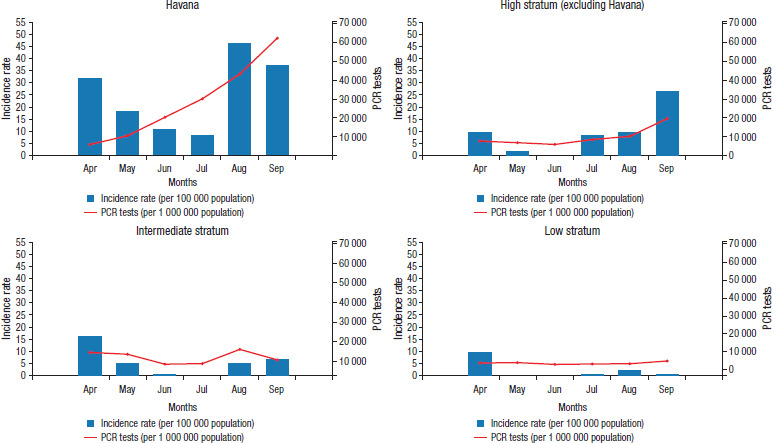
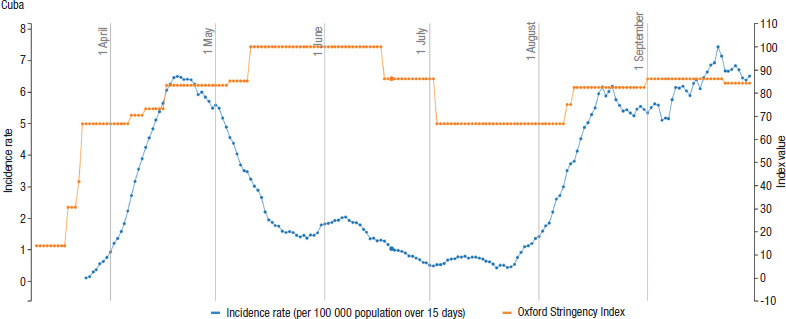
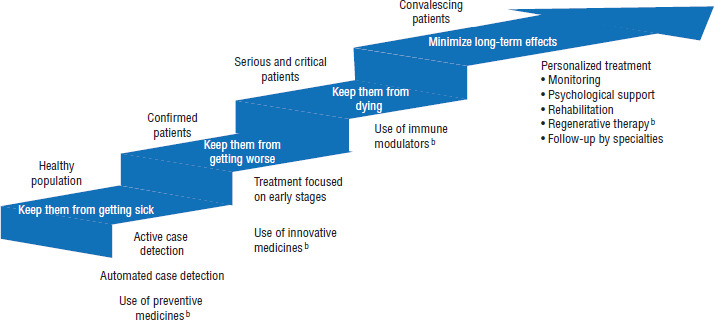
Cuba's National Health System has managed to guarantee an effective and equitable response to COVID-19. Universal and free health coverage, based on primary care, follows the principle of equity and the greatest resources are allocated to areas of the lowest socioeconomic stratum (where higher risk is concentrated), followed by those of medium and high strata, in that order. This allowed for similar mortality rates in the three strata, and Cuban national mortality rate was one of the lowest in the Region of the Americas. Before the first case was identified in Cuba, a Plan for Coronavirus Prevention and Control was elaborated with multisectoral participation, and when the first case was confirmed the Temporary National Working Group to Fight COVID-19 was created as an advisory body of the government. The actions to face the pandemic began with preventive measures in the community, continued in the isolation centers and ended again in the community with actions of surveillance and follow up of recovered patients. Following the principle of territoriality, molecular diagnosis laboratories were created in the provinces that did not have one. Free medical care and treatment; the preparation of a single national intersectoral government plan; the use of particular strategies for research, diagnosis and case tracing; and the implementation of a universal protocol for disease prevention and treatment of confirmed cases made it possible to control the disease with a health equity perspective.
古巴国家卫生系统成功确保了对新冠疫情作出有效且公平的应对。基于初级保健的全民免费医疗覆盖遵循公平原则,最大份额的资源被分配到社会经济地位最低的阶层(高风险人群集中于此),其次是中高阶层,依此顺序。这使得三个阶层的死亡率相近,古巴的全国死亡率是美洲地区最低的之一。在古巴确诊首例病例之前,就已制定了多部门参与的冠状病毒预防与控制计划,首例病例确诊后,成立了抗击新冠疫情国家临时工作组作为政府的咨询机构。应对疫情的行动始于社区预防措施,在隔离中心持续进行,并再次在社区以对康复患者的监测和跟踪行动告终。遵循属地原则,在没有分子诊断实验室的省份建立了此类实验室。免费医疗护理与治疗;制定单一的国家跨部门政府计划;运用特定的研究、诊断和病例追踪策略;以及实施针对确诊病例的疾病预防与治疗通用方案,使得能够从卫生公平的角度控制疫情。