Bellaiche Mathias M J, Fan Winnie, Walbert Harold John, McClave Egan H, Goodnight Bradley L, Sieling Fred H, Moore Rebekah A, Meng Weilin, Black Christopher M
Guidehouse Inc., McLean, VA, United States.
Precision Medicine & Nurse Education, AstraZeneca Pharmaceuticals, Gaithersburg, MD, United States.
Front Oncol. 2021 Jun 16;11:689927. doi: 10.3389/fonc.2021.689927. eCollection 2021.
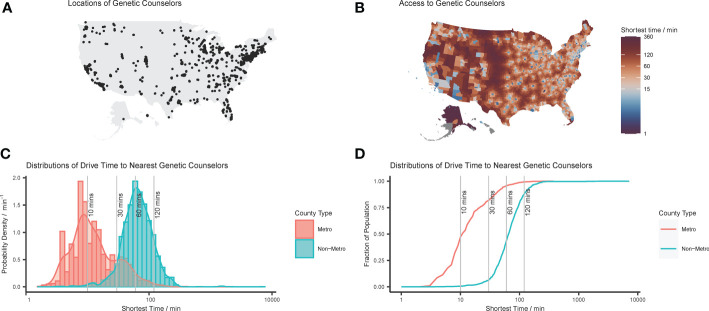
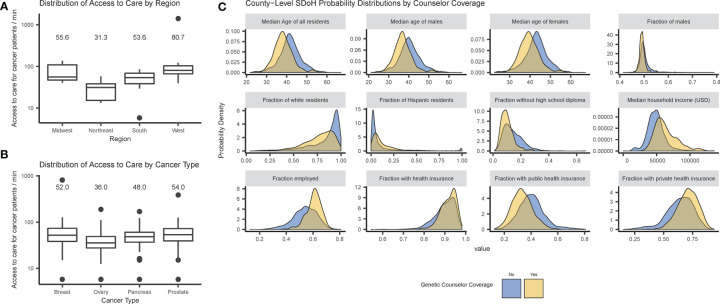
In the US, the growing demand for precision medicine, particularly in oncology, continues to put pressure on the availability of genetic counselors to meet that demand. This is especially true in certain geographic locations due to the uneven distribution of genetic counselors throughout the US. To assess these disparities, access to genetic counselors of all specialties is explored by geography, cancer type, and social determinants of health. Geospatial technology was used to combine and analyze genetic counselor locations and cancer incidence at the county level across the US, with a particular focus on tumors associated with mutations including ovarian, pancreatic, prostate and breast. Access distributions were quantified, and associations with region, cancer type, and socioeconomic variables were investigated using correlational tests. Nationally, in 2020, there were 4,813 genetic counselors, or 1.49 genetic counselors per 100,000 people, varying between 0.17 to 5.7 per 100,000 at the state level. Seventy-one percent of U.S. residents live within a 30-minute drive-time to a genetic counselor. Drive-times, however, are not equally distributed across the country - while 82% of people in metropolitan areas are 30 minutes from a genetic counselor, only 6% of people in nonmetro areas live within 30 minutes' drive time. There are statistically significant differences in access across geographical regions, socioeconomics and cancer types. Access to genetic counselors for cancer patients differs across groups, including regional, socioeconomic, and cancer type. These findings highlight areas of the country that may benefit from increased genetic counseling provider supply, by increasing the number of genetic counselors in a region or by expanding the use of telegenetics a term used to describe virtual genetic counseling consults that occur videoconference. Policy intervention to allow genetic counselors to bill for their services may be an effective route for increasing availability of genetic counselors' services However, genetic counselors in direct patient care settings also face other challenges such as salary, job satisfaction, job recognition, overwork/burnout, and appropriate administrative/clinical support, and addressing these issues should also be considered along with policy support. These results could support targeted policy reform and alternative service models to increase access to identified pockets of unmet need, such as telemedicine. Data and analysis are available to the public through an interactive dashboard.
在美国,对精准医疗的需求不断增长,尤其是在肿瘤学领域,这持续给遗传咨询师的供应带来压力,以满足这一需求。由于遗传咨询师在美国各地分布不均,在某些地理位置尤其如此。为了评估这些差异,我们从地理、癌症类型和健康的社会决定因素等方面探讨了获取各类遗传咨询师服务的情况。利用地理空间技术,我们在美国县级层面综合分析了遗传咨询师的分布地点和癌症发病率,特别关注与特定突变相关的肿瘤,包括卵巢癌、胰腺癌、前列腺癌和乳腺癌。对获取服务的分布情况进行了量化,并使用相关性测试研究了其与地区、癌症类型和社会经济变量之间的关联。在全国范围内,2020年有4813名遗传咨询师,即每10万人中有1.49名遗传咨询师,各州的比例在每10万人0.17至5.7名之间。71%的美国居民居住在距离遗传咨询师车程30分钟以内的范围内。然而,车程时间在全国分布并不均匀——大都市地区82%的人距离遗传咨询师在30分钟以内,而非大都市地区只有6%的人居住在车程30分钟以内。在地理区域、社会经济状况和癌症类型方面,获取服务的情况存在统计学上的显著差异。癌症患者获取遗传咨询师服务的情况因群体而异,包括地区、社会经济状况和癌症类型。这些发现凸显了美国国内那些可能受益于增加遗传咨询服务提供者供应的地区,比如通过增加某个地区的遗传咨询师数量,或者扩大远程遗传学(一个用于描述通过视频会议进行的虚拟遗传咨询的术语)的使用。允许遗传咨询师为其服务计费的政策干预可能是增加遗传咨询师服务可及性的有效途径。然而,直接参与患者护理工作的遗传咨询师还面临其他挑战,如薪资、工作满意度、工作认可度、过度劳累/职业倦怠以及适当的行政/临床支持,在提供政策支持的同时也应考虑解决这些问题。这些结果可为有针对性的政策改革和替代服务模式提供支持,以增加对未满足需求的特定领域(如远程医疗)的服务可及性。数据和分析可通过一个交互式仪表板向公众提供。