Institute for Memory Impairments and Neurological Disorders, University of California, Irvine, California, USA.
Department of Statistics, University of California, Irvine, California, USA.
Ann Clin Transl Neurol. 2021 Aug;8(8):1646-1655. doi: 10.1002/acn3.51414. Epub 2021 Jul 6.
Preclinical Alzheimer's disease (AD) clinical trials screen cognitively unimpaired older adults for biomarker criteria and disclose their results. We examined whether participants in the Anti-Amyloid Treatment in Asymptomatic Alzheimer's disease Study with "elevated" and "not elevated" amyloid differed in scores on the "Views and Perceptions of Amyloid Imaging" questionnaire. We hypothesized that, prior to disclosure, those with elevated amyloid would score higher than those with not elevated amyloid. We also quantified how responses changed after result disclosure.
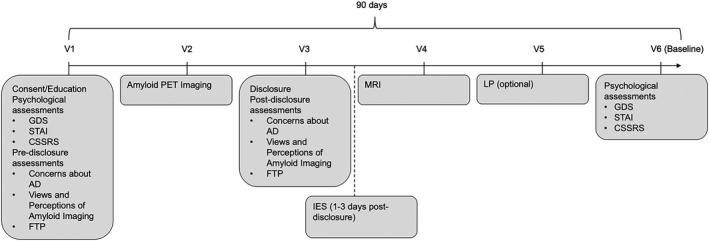
We assessed data from 4327 individuals who completed the questionnaire at screening visit 1 and after amyloid disclosure. We used linear regression models to assess the relationship between questionnaire category scores and amyloid status. We also quantified the relationship between category score changes and amyloid status.
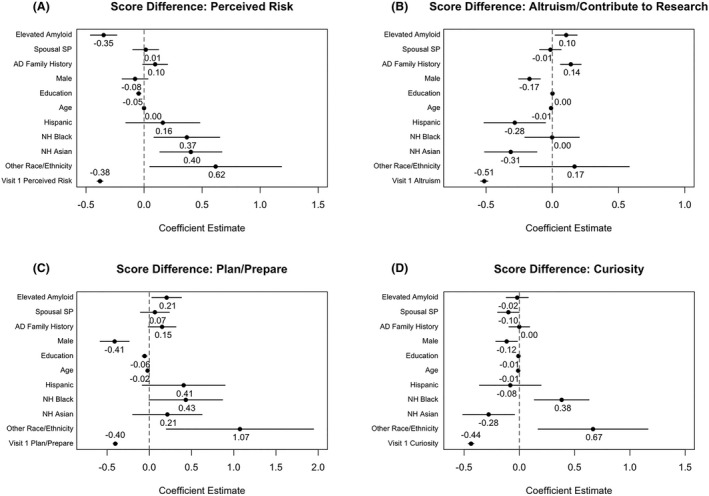
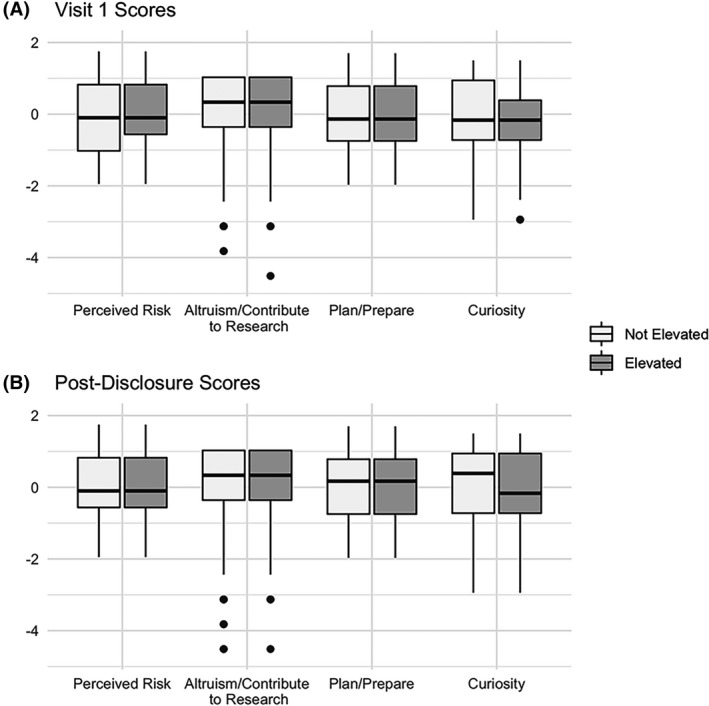
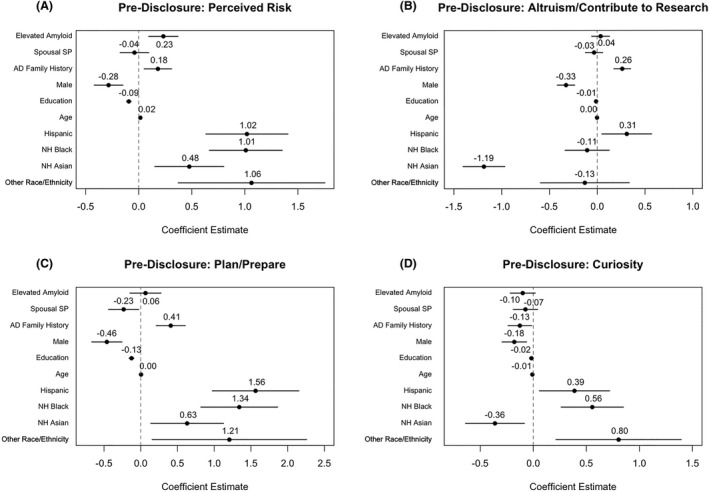
Overall, participants scored altruism and contribution to research as the strongest motivations for undergoing amyloid imaging. Those with elevated amyloid scored 0.23 points higher in the Perceived Risk category, on average, than those who had not elevated amyloid prior to disclosure; this effect attenuated towards zero after adjusting for Cognitive Function Instrument score. After disclosure, participants with elevated amyloid demonstrated less within-subject change in Perceived Risk, on average, compared to those with similar pre-disclosure scores who had not elevated amyloid, while demonstrating greater changes in the altruism and planning categories.
Altruism and learning disease risk motivated enrollment in this preclinical AD trial. Participants with elevated amyloid differed from their not elevated counterparts in their perceptions of amyloid imaging, even before undergoing the procedure.
在临床前阿尔茨海默病(AD)临床试验中,对认知正常的老年人进行生物标志物标准筛查,并公布其结果。我们研究了在无症状 AD 中的抗淀粉样蛋白治疗研究中,“淀粉样蛋白升高”和“淀粉样蛋白不升高”的参与者在“对淀粉样蛋白成像的看法和看法”问卷上的得分是否存在差异。我们假设,在披露之前,淀粉样蛋白升高的参与者的得分高于淀粉样蛋白不升高的参与者。我们还量化了披露结果后反应的变化。
我们评估了在筛选访问 1 时和在淀粉样蛋白披露后完成问卷的 4327 个人的数据。我们使用线性回归模型来评估问卷类别得分与淀粉样蛋白状态之间的关系。我们还量化了类别评分变化与淀粉样蛋白状态之间的关系。
总体而言,参与者将利他主义和对研究的贡献视为接受淀粉样蛋白成像的最强动机。与披露前淀粉样蛋白不升高的参与者相比,淀粉样蛋白升高的参与者在感知风险类别中平均得分高 0.23 分;在调整认知功能仪器评分后,这种影响趋于零。披露后,与具有相似披露前评分且淀粉样蛋白不升高的参与者相比,淀粉样蛋白升高的参与者在感知风险方面的平均个体内变化较小,而在利他主义和计划类别中表现出更大的变化。
利他主义和了解疾病风险促使人们参加了这项临床前 AD 试验。即使在进行该程序之前,淀粉样蛋白升高的参与者与淀粉样蛋白不升高的参与者在对淀粉样蛋白成像的看法上也存在差异。