Department of Food Science and Human Nutrition, University of Illinois at Urbana-Champaign, Urbana, IL, USA.
Division of Nutrition Sciences, University of Illinois at Urbana-Champaign, Urbana, IL, USA.
Adv Nutr. 2021 Dec 1;12(6):2190-2215. doi: 10.1093/advances/nmab077.
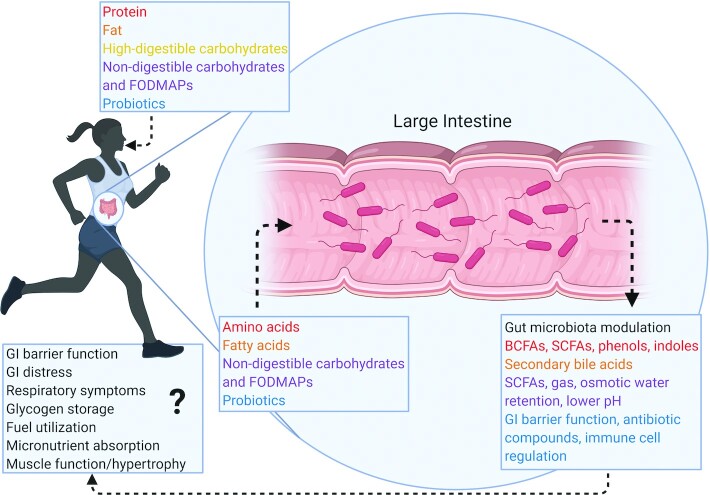
The athlete's goal is to optimize their performance. Towards this end, nutrition has been used to improve the health of athletes' brains, bones, muscles, and cardiovascular system. However, recent research suggests that the gut and its resident microbiota may also play a role in athlete health and performance. Therefore, athletes should consider dietary strategies in the context of their potential effects on the gut microbiota, including the impact of sports-centric dietary strategies (e.g., protein supplements, carbohydrate loading) on the gut microbiota as well as the effects of gut-centric dietary strategies (e.g., probiotics, prebiotics) on performance. This review provides an overview of the interaction between diet, exercise, and the gut microbiota, focusing on dietary strategies that may impact both the gut microbiota and athletic performance. Current evidence suggests that the gut microbiota could, in theory, contribute to the effects of dietary intake on athletic performance by influencing microbial metabolite production, gastrointestinal physiology, and immune modulation. Common dietary strategies such as high protein and simple carbohydrate intake, low fiber intake, and food avoidance may adversely impact the gut microbiota and, in turn, performance. Conversely, intake of adequate dietary fiber, a variety of protein sources, and emphasis on unsaturated fats, especially omega-3 (ɷ-3) fatty acids, in addition to consumption of prebiotics, probiotics, and synbiotics, have shown promising results in optimizing athlete health and performance. Ultimately, while this is an emerging and promising area of research, more studies are needed that incorporate, control, and manipulate all 3 of these elements (i.e., diet, exercise, and gut microbiome) to provide recommendations for athletes on how to "fuel their microbes."
运动员的目标是优化表现。为此,营养已被用于改善运动员的大脑、骨骼、肌肉和心血管系统的健康。然而,最近的研究表明,肠道及其常驻微生物群也可能在运动员的健康和表现中发挥作用。因此,运动员应考虑饮食策略对肠道微生物群的潜在影响,包括以运动为中心的饮食策略(例如蛋白质补充剂、碳水化合物负荷)对肠道微生物群的影响以及以肠道为中心的饮食策略(例如益生菌、益生元)对表现的影响。
这篇综述概述了饮食、运动和肠道微生物群之间的相互作用,重点介绍了可能影响肠道微生物群和运动表现的饮食策略。目前的证据表明,肠道微生物群理论上可以通过影响微生物代谢产物的产生、胃肠道生理学和免疫调节来影响饮食摄入对运动表现的影响。常见的饮食策略,如高蛋白和简单碳水化合物摄入、低纤维摄入和食物回避,可能会对肠道微生物群产生不利影响,进而影响表现。相反,摄入足够的膳食纤维、多种蛋白质来源和强调不饱和脂肪,特别是ω-3(ɷ-3)脂肪酸,以及摄入益生元、益生菌和合生菌,已显示出优化运动员健康和表现的有希望的结果。
归根结底,尽管这是一个新兴且有前途的研究领域,但需要更多的研究来整合、控制和操纵这三个元素(即饮食、运动和肠道微生物组),为运动员提供如何“为他们的微生物提供燃料”的建议。