Yan Yanhua, Nie Kechao, Zheng Junhui, Jiang Xiaotao, Huang Yuancheng, Zheng Zhihua, Wen Yi, Li Peiwu
The First Clinical Medical College, Guangzhou University of Chinese Medicine, Guangzhou, 510000, People's Republic of China.
Department of Integrated Traditional Chinese & Western Medicine, The Second Xiangya Hospital, Central South University, Changsha, Hunan, 410011, People's Republic of China.
Cancer Manag Res. 2021 Jun 28;13:5013-5026. doi: 10.2147/CMAR.S313078. eCollection 2021.
Stomach adenocarcinoma (STAD) is the most common gastrointestinal cancer and is associated with high mortality worldwide. Endothelin receptor type A (EDNRA) is associated with guanine-nucleotide-binding (G) proteins and plays important roles in cellular processes and various diseases.
To investigate the prognosis value of EDNRA expression and its correlation with immune infiltrates in patients with STAD.
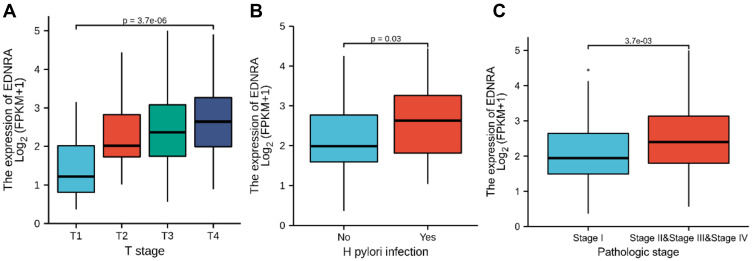
The association between clinical characteristics and EDNRA expression in STAD was analyzed using the Wilcoxon signed-rank test and logistic regression. The Kaplan-Meier plotter analysis and Cox regression were constructed to evaluate the influence of EDNRA on prognosis, and a receiver operating characteristic (ROC) curve and nomogram were constructed. Gene set enrichment analysis (GSEA) and single-sample gene set enrichment analysis (ssGSEA) were conducted to analyze the correlation between EDNRA and immune infiltrates. In addition, Oncomine, TIMER databases and qRT-PCR of STAD cell lines were used to verify the EDNRA expression in STAD.
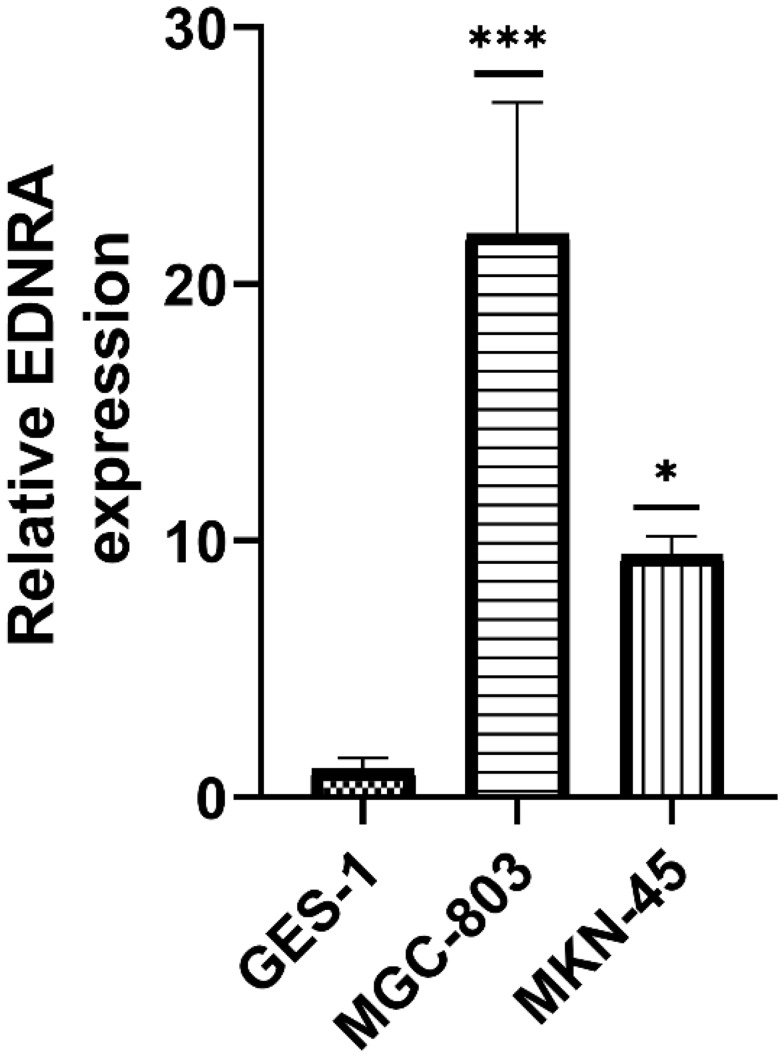
Our results revealed that EDNRA expression was significantly higher in patients with STAD than normal gastric tissues, and the results have been confirmed by RT-qPCR. KM-plotter analysis revealed that patients with STAD had shorter OS, FP, and PPS (P<0.001). Multivariate Cox analysis further confirmed that high EDNRA expression was an independent risk factor for OS in patients with STAD. Moreover, other clinicopathologic features were related with worse prognosis in STAD, including age, lymph nodes metastases and primary outcome. More importantly, ROC analysis also confirmed the diagnostic value, and a prognostic nomogram involving age, T, M, N classification, pathologic stage, residual tumor and EDNRA was constructed. GSEA revealed that high EDNRA expression was correlated with immunoregulatory interactions between lymphoid and non lymphoid cells pathways, natural killer cell activation involved in immune response, interleukin 1 receptor binding and pathways in cancer, and ssGSEA showed that EDNRA is correlated with macrophages and NK cells.
Collectively, EDNRA can be an independent prognostic biomarker and correlated with immune infiltration in stomach adenocarcinoma.
胃腺癌(STAD)是最常见的胃肠道癌症,在全球范围内死亡率较高。A型内皮素受体(EDNRA)与鸟嘌呤核苷酸结合(G)蛋白相关,在细胞过程和各种疾病中发挥重要作用。
探讨EDNRA表达在胃腺癌患者中的预后价值及其与免疫浸润的相关性。
采用Wilcoxon符号秩检验和逻辑回归分析胃腺癌临床特征与EDNRA表达之间的关联。构建Kaplan-Meier生存曲线分析和Cox回归模型以评估EDNRA对预后的影响,并构建受试者工作特征(ROC)曲线和列线图。进行基因集富集分析(GSEA)和单样本基因集富集分析(ssGSEA)以分析EDNRA与免疫浸润之间的相关性。此外,利用Oncomine、TIMER数据库以及胃腺癌细胞系的qRT-PCR验证胃腺癌中EDNRA的表达。
我们的结果显示,胃腺癌患者中EDNRA表达显著高于正常胃组织,且该结果已通过RT-qPCR得到证实。KM-plotter分析显示,胃腺癌患者的总生存期(OS)、无进展生存期(FP)和无进展生存期(PPS)较短(P<0.001)。多变量Cox分析进一步证实,EDNRA高表达是胃腺癌患者OS的独立危险因素。此外,其他临床病理特征与胃腺癌预后较差相关,包括年龄、淋巴结转移和主要结局。更重要的是,ROC分析也证实了其诊断价值,并构建了一个涉及年龄、T、M、N分类、病理分期、残留肿瘤和EDNRA的预后列线图。GSEA显示,EDNRA高表达与淋巴细胞和非淋巴细胞之间的免疫调节相互作用途径、参与免疫反应的自然杀伤细胞激活、白细胞介素1受体结合以及癌症中的途径相关,ssGSEA显示EDNRA与巨噬细胞和自然杀伤细胞相关。
总体而言,EDNRA可作为胃腺癌的独立预后生物标志物,并与免疫浸润相关。