• 文献检索
  • 文档翻译
  • 深度研究
  • 学术资讯
  • Suppr Zotero 插件Zotero 插件
  • 邀请有礼
  • 套餐&价格
  • 历史记录
应用&插件
Suppr Zotero 插件Zotero 插件浏览器插件Mac 客户端Windows 客户端微信小程序
定价
高级版会员购买积分包购买API积分包
服务
文献检索文档翻译深度研究API 文档MCP 服务
关于我们
关于 Suppr公司介绍联系我们用户协议隐私条款
关注我们

Suppr 超能文献

核心技术专利:CN118964589B侵权必究
粤ICP备2023148730 号-1Suppr @ 2026

文献检索

告别复杂PubMed语法,用中文像聊天一样搜索,搜遍4000万医学文献。AI智能推荐,让科研检索更轻松。

立即免费搜索

文件翻译

保留排版,准确专业,支持PDF/Word/PPT等文件格式,支持 12+语言互译。

免费翻译文档

深度研究

AI帮你快速写综述,25分钟生成高质量综述,智能提取关键信息,辅助科研写作。

立即免费体验

患者对数据共享和将人工智能应用于医疗保健数据的看法:横断面调查。

Patient Perceptions on Data Sharing and Applying Artificial Intelligence to Health Care Data: Cross-sectional Survey.

机构信息

Institute of Global Health Innovation, Imperial College London, London, United Kingdom.

出版信息

J Med Internet Res. 2021 Aug 26;23(8):e26162. doi: 10.2196/26162.

DOI:10.2196/26162
PMID:34236994
原文链接:https://pmc.ncbi.nlm.nih.gov/articles/PMC8430862/
Abstract

BACKGROUND

Considerable research is being conducted as to how artificial intelligence (AI) can be effectively applied to health care. However, for the successful implementation of AI, large amounts of health data are required for training and testing algorithms. As such, there is a need to understand the perspectives and viewpoints of patients regarding the use of their health data in AI research.

OBJECTIVE

We surveyed a large sample of patients for identifying current awareness regarding health data research, and for obtaining their opinions and views on data sharing for AI research purposes, and on the use of AI technology on health care data.

METHODS

A cross-sectional survey with patients was conducted at a large multisite teaching hospital in the United Kingdom. Data were collected on patient and public views about sharing health data for research and the use of AI on health data.

RESULTS

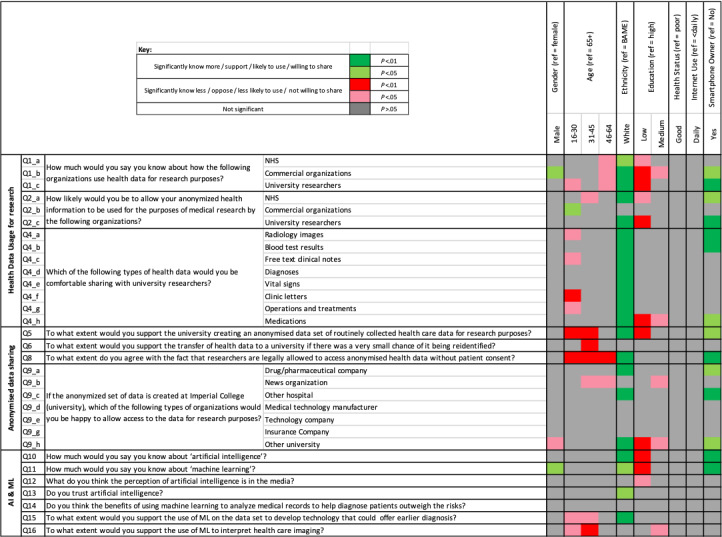
A total of 408 participants completed the survey. The respondents had generally low levels of prior knowledge about AI. Most were comfortable with sharing health data with the National Health Service (NHS) (318/408, 77.9%) or universities (268/408, 65.7%), but far fewer with commercial organizations such as technology companies (108/408, 26.4%). The majority endorsed AI research on health care data (357/408, 87.4%) and health care imaging (353/408, 86.4%) in a university setting, provided that concerns about privacy, reidentification of anonymized health care data, and consent processes were addressed.

CONCLUSIONS

There were significant variations in the patient perceptions, levels of support, and understanding of health data research and AI. Greater public engagement levels and debates are necessary to ensure the acceptability of AI research and its successful integration into clinical practice in future.

摘要

背景

人们正在研究如何有效地将人工智能(AI)应用于医疗保健领域。然而,为了成功实施 AI,需要大量的健康数据来训练和测试算法。因此,有必要了解患者对使用其健康数据进行 AI 研究的看法和观点。

目的

我们对大量患者进行了调查,以了解他们对健康数据研究的认知程度,并获得他们对 AI 研究数据共享以及 AI 技术在医疗保健数据中应用的意见和看法。

方法

在英国的一家大型多地点教学医院进行了一项横断面调查,对患者进行了调查。收集了患者和公众对共享健康数据进行研究以及使用 AI 处理健康数据的看法。

结果

共有 408 名参与者完成了调查。受访者对 AI 的了解程度普遍较低。大多数人愿意与国民保健制度(NHS)(318/408,77.9%)或大学(268/408,65.7%)共享健康数据,但与商业组织(如科技公司)(108/408,26.4%)共享健康数据的意愿要低得多。大多数人支持在大学环境中进行医疗保健数据(357/408,87.4%)和医疗保健成像(353/408,86.4%)的 AI 研究,前提是解决隐私、匿名医疗保健数据重新识别以及同意过程等问题。

结论

患者对健康数据研究和 AI 的看法、支持程度和理解存在显著差异。需要进行更多的公众参与和辩论,以确保 AI 研究的可接受性及其未来在临床实践中的成功整合。
https://cdn.ncbi.nlm.nih.gov/pmc/blobs/d6b5/8430862/1272bf6c584e/jmir_v23i8e26162_fig1.jpg

相似文献

1
Patient Perceptions on Data Sharing and Applying Artificial Intelligence to Health Care Data: Cross-sectional Survey.患者对数据共享和将人工智能应用于医疗保健数据的看法:横断面调查。
J Med Internet Res. 2021 Aug 26;23(8):e26162. doi: 10.2196/26162.
2
Multi-stakeholder preferences for the use of artificial intelligence in healthcare: A systematic review and thematic analysis.多利益相关方对人工智能在医疗保健中的应用的偏好:系统评价和主题分析。
Soc Sci Med. 2023 Dec;338:116357. doi: 10.1016/j.socscimed.2023.116357. Epub 2023 Nov 4.
3
Patients' Perceptions Toward Human-Artificial Intelligence Interaction in Health Care: Experimental Study.患者对医疗保健中人机交互的看法:实验研究。
J Med Internet Res. 2021 Nov 25;23(11):e25856. doi: 10.2196/25856.
4
Medical Student Experiences and Perceptions of ChatGPT and Artificial Intelligence: Cross-Sectional Study.医学生对 ChatGPT 和人工智能的体验和看法:一项横断面研究。
JMIR Med Educ. 2023 Dec 22;9:e51302. doi: 10.2196/51302.
5
Perceptions of Artificial Intelligence Integration into Dermatology Clinical Practice: A Cross-Sectional Survey Study.人工智能融入皮肤科临床实践的认知:一项横断面调查研究。
J Drugs Dermatol. 2022 Feb 1;21(2):135-140. doi: 10.36849/jdd.6398.
6
Patient Perspectives on Artificial Intelligence in Radiology.患者对放射科人工智能的看法。
J Am Coll Radiol. 2023 Sep;20(9):863-867. doi: 10.1016/j.jacr.2023.05.017. Epub 2023 Jul 14.
7
Patient Perspectives on AI for Mental Health Care: Cross-Sectional Survey Study.患者对精神健康护理中人工智能的看法:横断面调查研究。
JMIR Ment Health. 2024 Sep 18;11:e58462. doi: 10.2196/58462.
8
Artificial Intelligence Bias in Health Care: Web-Based Survey.人工智能在医疗保健中的偏见:基于网络的调查。
J Med Internet Res. 2023 Jun 22;25:e41089. doi: 10.2196/41089.
9
Conditionally positive: a qualitative study of public perceptions about using health data for artificial intelligence research.有条件地为阳性:公众对使用健康数据进行人工智能研究的看法的定性研究。
BMJ Open. 2020 Oct 28;10(10):e039798. doi: 10.1136/bmjopen-2020-039798.
10
Experiences of using artificial intelligence in healthcare: a qualitative study of UK clinician and key stakeholder perspectives.在医疗保健中使用人工智能的体验:英国临床医生和主要利益相关者观点的定性研究。
BMJ Open. 2023 Dec 11;13(12):e076950. doi: 10.1136/bmjopen-2023-076950.

引用本文的文献

1
Parents' understanding and attitudes toward the application of AI in pediatric healthcare: a cross-sectional survey study.家长对人工智能在儿科医疗保健中应用的理解和态度:一项横断面调查研究。
Front Public Health. 2025 Aug 20;13:1654482. doi: 10.3389/fpubh.2025.1654482. eCollection 2025.
2
Evolutionary game analysis of healthcare data governance in China's experimental data trading pilots.中国实验性数据交易试点中医疗数据治理的演化博弈分析
NPJ Digit Med. 2025 Sep 1;8(1):562. doi: 10.1038/s41746-025-01950-2.
3
Worldwide willingness to share health data high but privacy, consent and transparency paramount, a meta-analysis.

本文引用的文献

1
Conditionally positive: a qualitative study of public perceptions about using health data for artificial intelligence research.有条件地为阳性:公众对使用健康数据进行人工智能研究的看法的定性研究。
BMJ Open. 2020 Oct 28;10(10):e039798. doi: 10.1136/bmjopen-2020-039798.
2
The state of artificial intelligence-based FDA-approved medical devices and algorithms: an online database.基于人工智能且获美国食品药品监督管理局批准的医疗设备及算法的现状:一个在线数据库。
NPJ Digit Med. 2020 Sep 11;3:118. doi: 10.1038/s41746-020-00324-0. eCollection 2020.
3
Public perceptions on data sharing: key insights from the UK and the USA.
一项荟萃分析表明,全球范围内共享健康数据的意愿很高,但隐私、同意和透明度至关重要。
NPJ Digit Med. 2025 Aug 23;8(1):540. doi: 10.1038/s41746-025-01868-9.
4
Exploring the Utility of Digital Voice Assistants for Primary Care Patients, Including Those With Physical and Visual Disabilities: Cross-Sectional Study.探索数字语音助手对初级保健患者(包括身体和视力残疾患者)的效用:横断面研究。
JMIR Mhealth Uhealth. 2025 Aug 14;13:e66185. doi: 10.2196/66185.
5
Informed Consent for Ambient Documentation Using Generative AI in Ambulatory Care.门诊护理中使用生成式人工智能进行环境记录的知情同意书。
JAMA Netw Open. 2025 Jul 1;8(7):e2522400. doi: 10.1001/jamanetworkopen.2025.22400.
6
Patient and clinician opinions on internet search data use in therapy: Insights, considerations, and guidelines for integrating a new digital phenotyping measure.患者与临床医生对治疗中使用互联网搜索数据的看法:整合一种新的数字表型测量方法的见解、考量因素及指导原则
Digit Health. 2025 Jun 2;11:20552076251327044. doi: 10.1177/20552076251327044. eCollection 2025 Jan-Dec.
7
Lessons from Henrietta Lacks inform a transparency framework to catalyze generative artificial intelligence in medicine.海瑞塔·拉克斯的故事为推动医学领域生成式人工智能的透明框架提供了借鉴。
NPJ Digit Med. 2025 May 14;8(1):280. doi: 10.1038/s41746-025-01656-5.
8
Context-Contingent Privacy Concerns and Exploration of the Privacy Paradox in the Age of AI, Augmented Reality, Big Data, and the Internet of Things: Systematic Review.人工智能、增强现实、大数据和物联网时代的情境相关隐私担忧与隐私悖论探索:系统综述
J Med Internet Res. 2025 May 14;27:e71951. doi: 10.2196/71951.
9
Leveraging Datathons to Teach AI in Undergraduate Medical Education: Case Study.利用数据马拉松在本科医学教育中教授人工智能:案例研究
JMIR Med Educ. 2025 Apr 16;11:e63602. doi: 10.2196/63602.
10
AI-Derived Blood Biomarkers for Ovarian Cancer Diagnosis: Systematic Review and Meta-Analysis.用于卵巢癌诊断的人工智能衍生血液生物标志物:系统评价与荟萃分析
J Med Internet Res. 2025 Mar 24;27:e67922. doi: 10.2196/67922.
公众对数据共享的看法:来自英国和美国的关键见解。
Lancet Digit Health. 2020 Sep;2(9):e444-e446. doi: 10.1016/S2589-7500(20)30161-8. Epub 2020 Jul 24.
4
Public Perception of Artificial Intelligence in Medical Care: Content Analysis of Social Media.公众对医疗人工智能的看法:社交媒体的内容分析。
J Med Internet Res. 2020 Jul 13;22(7):e16649. doi: 10.2196/16649.
5
Public Perceptions of Artificial Intelligence and Robotics in Medicine.公众对人工智能和医学机器人的看法。
J Endourol. 2020 Oct;34(10):1041-1048. doi: 10.1089/end.2020.0137. Epub 2020 Sep 29.
6
Patient Perspectives on the Use of Artificial Intelligence for Skin Cancer Screening: A Qualitative Study.患者对人工智能用于皮肤癌筛查的看法:一项定性研究。
JAMA Dermatol. 2020 May 1;156(5):501-512. doi: 10.1001/jamadermatol.2019.5014.
7
Ethical concerns around use of artificial intelligence in health care research from the perspective of patients with meningioma, caregivers and health care providers: a qualitative study.从脑膜瘤患者、护理人员和医疗保健提供者的角度出发,探讨人工智能在医疗保健研究中的使用所引发的伦理问题:一项定性研究。
CMAJ Open. 2020 Feb 18;8(1):E90-E95. doi: 10.9778/cmajo.20190151. Print 2020 Jan-Mar.
8
Perceptions of artificial intelligence in healthcare: findings from a qualitative survey study among actors in France.医疗保健领域对人工智能的看法:法国利益相关者定性调查研究的结果。
J Transl Med. 2020 Jan 9;18(1):14. doi: 10.1186/s12967-019-02204-y.
9
Assessing Radiology Research on Artificial Intelligence: A Brief Guide for Authors, Reviewers, and Readers-From the Editorial Board.评估人工智能放射学研究:给作者、审稿人和读者的简要指南——来自编辑委员会
Radiology. 2020 Mar;294(3):487-489. doi: 10.1148/radiol.2019192515. Epub 2019 Dec 31.
10
Patients' and public views and attitudes towards the sharing of health data for research: a narrative review of the empirical evidence.患者和公众对健康数据用于研究的看法和态度:实证证据的叙述性综述。
J Med Ethics. 2022 Jan;48(1):3-13. doi: 10.1136/medethics-2019-105651. Epub 2019 Nov 12.