Department of Gastroenterology and Hepatology, Federal University of Health Sciences of Porto Alegre, Porto Alegre 90020-090, Brazil.
Department of Medicine, Division of Gastroenterology and Infectious Diseases, University of Minnesota, Minneapolis, MN 55455, United States.
World J Gastroenterol. 2021 Jun 28;27(24):3556-3567. doi: 10.3748/wjg.v27.i24.3556.
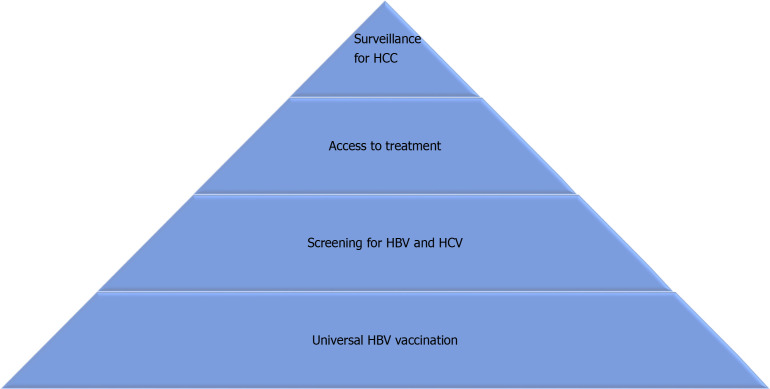
Chronic infections due to hepatitis B and hepatitis C viruses are responsible for most cases of hepatocellular carcinoma (HCC) worldwide, and this association is likely to remain during the next decade. Moreover, viral hepatitis-related HCC imposes an important burden on public health in terms of disability-adjusted life years. In order to reduce such a burden, some major challenges must be faced. Universal vaccination against hepatitis B virus, especially in the neonatal period, is probably the most relevant primary preventive measure against the development of HCC. Moreover, considering the large adult population already infected with hepatitis B and C viruses, it is also imperative to identify these individuals to ensure their access to treatment. Both hepatitis B and C currently have highly effective therapies, which are able to diminish the risk of development of liver cancer. Finally, it is essential for individuals at high-risk of HCC to be included in surveillance programs, so that tumors are detected at an early stage. Patients with hepatitis B or C and advanced liver fibrosis or cirrhosis benefit from being followed in a surveillance program. As hepatitis B virus is oncogenic and capable of leading to liver cancer even in individuals with early stages of liver fibrosis, other high-risk groups of patients with hepatitis B are also candidates for surveillance. Considerable effort is required concerning these strategies in order to decrease the incidence and the mortality of viral hepatitis-related HCC.
慢性乙型肝炎和丙型肝炎病毒感染是导致全球大多数肝细胞癌(HCC)的原因,这种关联在未来十年内可能仍然存在。此外,病毒性肝炎相关 HCC 给公共卫生带来了重要的残疾调整生命年负担。为了减轻这种负担,必须应对一些重大挑战。乙型肝炎病毒的普遍疫苗接种,特别是在新生儿期,可能是预防 HCC 发展的最重要的初级预防措施。此外,考虑到已经感染乙型肝炎和丙型肝炎病毒的大量成年人口,也必须确定这些人,以确保他们获得治疗。乙型肝炎和丙型肝炎目前都有非常有效的治疗方法,能够降低肝癌发展的风险。最后,对于 HCC 高危人群,必须将其纳入监测计划,以便在早期发现肿瘤。患有乙型肝炎或丙型肝炎且肝纤维化或肝硬化处于晚期的患者从监测计划中受益。由于乙型肝炎病毒具有致癌性,即使在肝纤维化早期阶段也能导致肝癌,因此乙型肝炎的其他高危人群也有资格进行监测。需要为此类策略付出巨大努力,以降低病毒性肝炎相关 HCC 的发病率和死亡率。