State Key Laboratory of Respiratory Disease, Center of Infection and Immunity, Guangzhou Institutes of Biomedicine and Health, Chinese Academy of Sciences, Guangzhou, 510530, China.
CAS-Lamvac Biotech Co., Ltd, Guangzhou, 510530, China.
Cell Commun Signal. 2021 Jul 9;19(1):74. doi: 10.1186/s12964-021-00748-5.
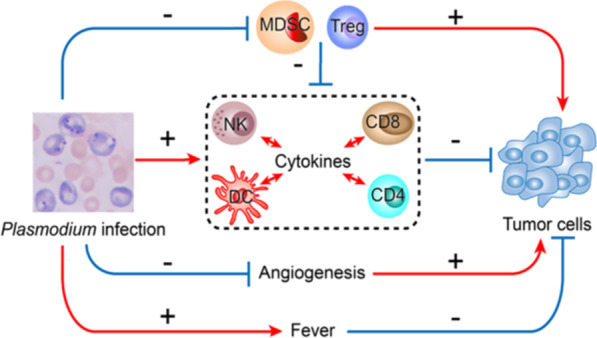
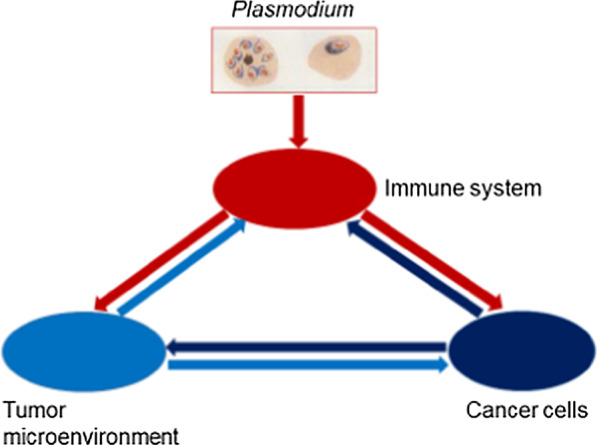
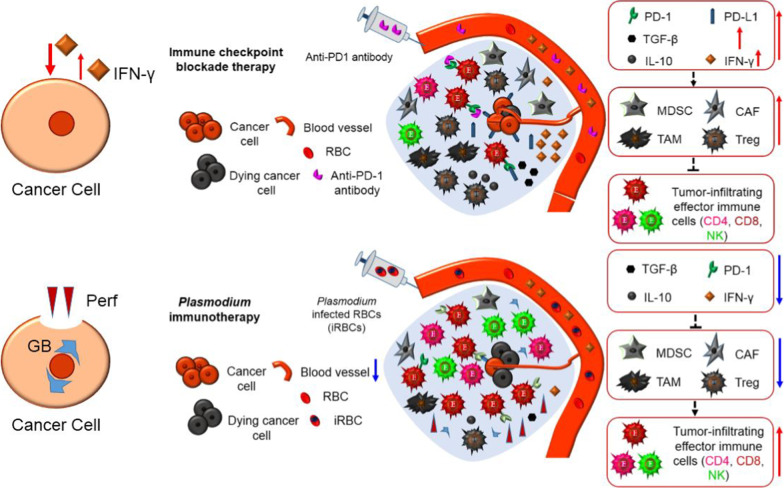
Our murine cancer model studies have demonstrated that Plasmodium infection activates the immune system that has been inhibited by cancer cells, counteracts tumor immunosuppressive microenvironment, inhibits tumor angiogenesis, inhibits tumor growth and metastasis, and prolongs the survival time of tumor-bearing mice. Based on these studies, three clinical trials of Plasmodium immunotherapy for advanced cancers have been approved and are ongoing in China. After comparing the mechanisms of action of Plasmodium immunotherapy with those of immune checkpoint blockade therapy, we propose the notion that cancer is an ecological disease and that Plasmodium immunotherapy is a systemic ecological counterattack therapy for this ecological disease, with limited side effects and without danger to public health based on the use of artesunate and other measures. Recent reports of tolerance to treatment and limitations in majority of patients associated with the use of checkpoint blockers further support this notion. We advocate further studies on the mechanisms of action of Plasmodium infection against cancer and investigations on Plasmodium-based combination therapy in the coming future. Video Abstract.
我们的鼠类癌症模型研究表明,疟原虫感染激活了被癌细胞抑制的免疫系统,拮抗肿瘤免疫抑制微环境,抑制肿瘤血管生成,抑制肿瘤生长和转移,并延长荷瘤小鼠的生存时间。基于这些研究,三种疟原虫免疫疗法治疗晚期癌症的临床试验已在中国获得批准并正在进行中。在比较疟原虫免疫疗法与免疫检查点阻断疗法的作用机制后,我们提出癌症是一种生态疾病的概念,疟原虫免疫疗法是针对这种生态疾病的系统性生态反击疗法,基于青蒿琥酯和其他措施的使用,副作用有限,不会对公共健康造成危害。最近关于治疗耐受性和大多数患者对检查点阻滞剂使用的局限性的报告进一步支持了这一观点。我们主张在未来进一步研究疟原虫感染对癌症的作用机制,并研究基于疟原虫的联合治疗。视频摘要。