Department of Medical Psychology, Army Medical University, Chongqing, China.
School of Psychology, Southwest University, Chongqing, China.
Transl Psychiatry. 2021 Jul 9;11(1):384. doi: 10.1038/s41398-021-01501-9.
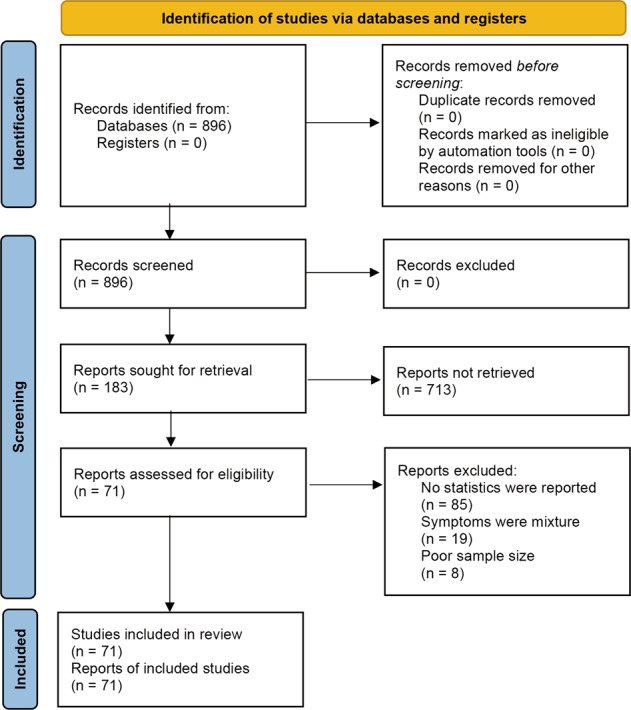
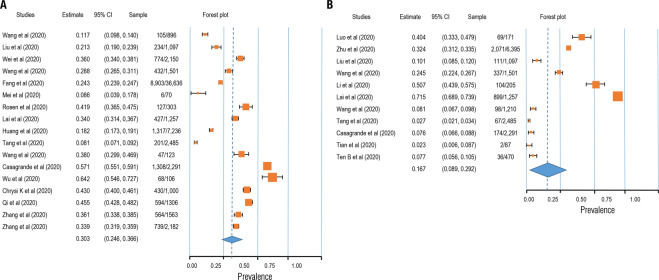
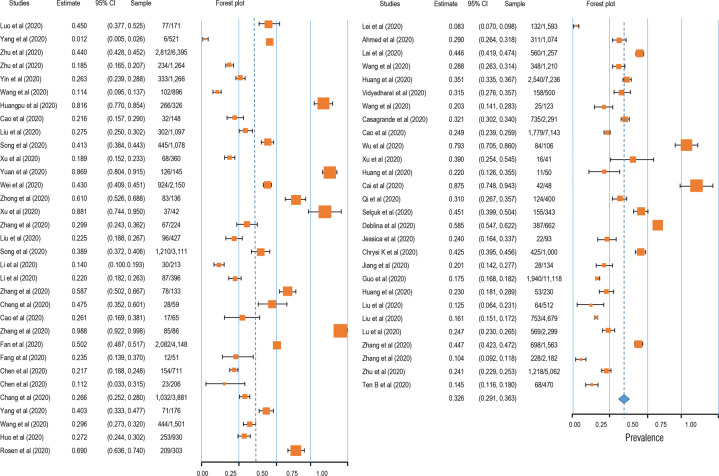
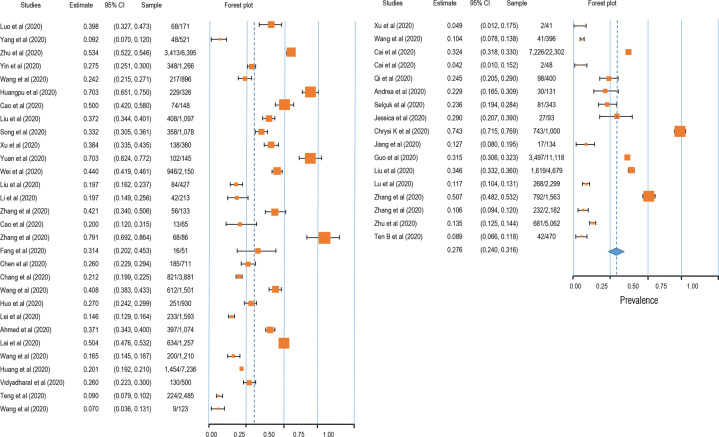
The coronavirus disease 2019 (COVID-19) pandemic has exposed humans to the highest physical and mental risks. Thus, it is becoming a priority to probe the mental health problems experienced during the pandemic in different populations. We performed a meta-analysis to clarify the prevalence of postpandemic mental health problems. Seventy-one published papers (n = 146,139) from China, the United States, Japan, India, and Turkey were eligible to be included in the data pool. These papers reported results for Chinese, Japanese, Italian, American, Turkish, Indian, Spanish, Greek, and Singaporean populations. The results demonstrated a total prevalence of anxiety symptoms of 32.60% (95% confidence interval (CI): 29.10-36.30) during the COVID-19 pandemic. For depression, a prevalence of 27.60% (95% CI: 24.00-31.60) was found. Further, insomnia was found to have a prevalence of 30.30% (95% CI: 24.60-36.60). Of the total study population, 16.70% (95% CI: 8.90-29.20) experienced post-traumatic stress disorder (PTSD) symptoms during the COVID-19 pandemic. Subgroup analysis revealed the highest prevalence of anxiety (63.90%) and depression (55.40%) in confirmed and suspected patients compared with other cohorts. Notably, the prevalence of each symptom in other countries was higher than that in China. Finally, the prevalence of each mental problem differed depending on the measurement tools used. In conclusion, this study revealed the prevalence of mental problems during the COVID-19 pandemic by using a fairly large-scale sample and further clarified that the heterogeneous results for these mental health problems may be due to the nonstandardized use of psychometric tools.
新型冠状病毒肺炎(COVID-19)大流行使人类面临着最高的身心风险。因此,探究不同人群在大流行期间经历的心理健康问题已成为当务之急。我们进行了一项荟萃分析,以阐明大流行后心理健康问题的流行率。从中国、美国、日本、印度和土耳其的 71 篇已发表论文(n=146139)符合纳入数据池的标准。这些论文报告了中国、日本、意大利、美国、土耳其、印度、西班牙、希腊和新加坡人群的结果。结果表明,在 COVID-19 大流行期间,焦虑症状的总流行率为 32.60%(95%置信区间(CI):29.10-36.30)。抑郁的流行率为 27.60%(95%CI:24.00-31.60)。此外,失眠的流行率为 30.30%(95%CI:24.60-36.60)。在总研究人群中,16.70%(95%CI:8.90-29.20)在 COVID-19 大流行期间经历了创伤后应激障碍(PTSD)症状。亚组分析显示,与其他队列相比,确诊和疑似患者的焦虑(63.90%)和抑郁(55.40%)的流行率最高。值得注意的是,其他国家的每种症状的流行率均高于中国。最后,每种心理问题的流行率因使用的心理测量工具而异。总之,本研究使用相当大规模的样本揭示了 COVID-19 大流行期间心理问题的流行率,并进一步阐明这些心理健康问题的异质结果可能归因于心理计量工具的非标准化使用。