Hsueh Laboratory, The Ohio State University Wexner Medical Center, Diabetes and Metabolism Research Center, Columbus, OH, United States.
Front Immunol. 2021 Jun 24;12:650768. doi: 10.3389/fimmu.2021.650768. eCollection 2021.
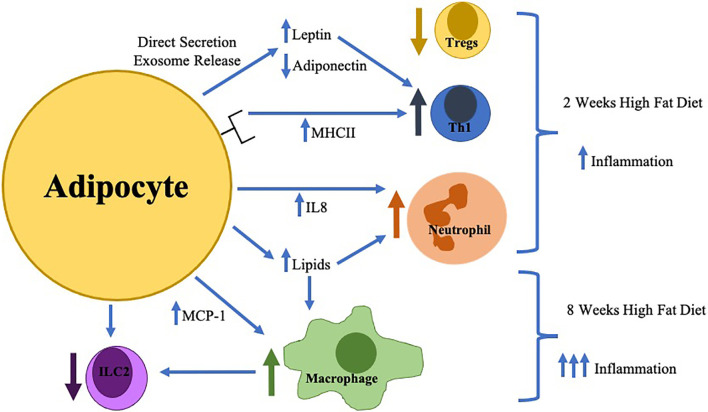
The role of adipose tissue (AT) inflammation in obesity and its multiple related-complications is a rapidly expanding area of scientific interest. Within the last 30 years, the role of the adipocyte as an endocrine and immunologic cell has been progressively established. Like the macrophage, the adipocyte is capable of linking the innate and adaptive immune system through the secretion of adipokines and cytokines; exosome release of lipids, hormones, and microRNAs; and contact interaction with other immune cells. Key innate immune cells in AT include adipocytes, macrophages, neutrophils, and innate lymphoid cells type 2 (ILC2s). The role of the innate immune system in promoting adipose tissue inflammation in obesity will be highlighted in this review. T cells and B cells also play important roles in contributing to AT inflammation and are discussed in this series in the chapter on adaptive immunity.
脂肪组织(AT)炎症在肥胖及其多种相关并发症中的作用是一个迅速发展的科学研究领域。在过去的 30 年中,脂肪细胞作为内分泌和免疫细胞的作用逐渐得到确立。与巨噬细胞一样,脂肪细胞能够通过分泌脂肪因子和细胞因子、外泌体释放脂质、激素和 microRNAs 以及与其他免疫细胞的接触相互作用来连接先天免疫和适应性免疫系统。脂肪组织中关键的先天免疫细胞包括脂肪细胞、巨噬细胞、中性粒细胞和 2 型固有淋巴细胞(ILC2)。本综述将重点介绍先天免疫系统在促进肥胖症脂肪组织炎症中的作用。T 细胞和 B 细胞在促进脂肪组织炎症中也发挥着重要作用,本系列的适应性免疫系统章节对此进行了讨论。