Department of Microbiology and Systems Biology, Nederlandse Organisatie voor Toegepast Natuurwetenschappelijk Onderzoek, Zeist, Netherlands.
Faculty of Science, Athena Institute, Vrije Universiteit Amsterdam, Amsterdam, Netherlands.
J Med Internet Res. 2021 Jul 6;23(7):e26813. doi: 10.2196/26813.
Conventional clinical trials are essential for generating high-quality evidence by measuring the efficacy of interventions in rigorously controlled clinical environments. However, their execution can be expensive and time-consuming. In addition, clinical trials face several logistical challenges regarding the identification, recruitment, and retention of participants; consistent data collection during trials; and adequate patient follow-up. This might lead to inefficient resource utilization. In order to partially address the current problems with conventional clinical trials, there exists the need for innovations. One such innovation is the virtual clinical trial (VCT). VCTs allow for the collection and integration of diverse data from multiple information sources, such as electronic health records, clinical and demographic data, patient-reported outcomes, anthropometric and activity measurements, and data collected by digital biomarkers or (small) samples that participants can collect themselves. Although VCTs have the potential to provide substantial value to clinical research and patients because they can lower clinical trial costs, increase the volume of data collected from patients' daily environment, and reduce the burden of patient participation, so far VCT adoption is not commonplace.
This paper aims to better understand the barriers and facilitators to VCT adoption by determining the factors that influence individuals' considerations regarding VCTs from the perspective of various stakeholders.
Based on online semistructured interviews, a qualitative study was conducted with pharmaceutical companies, food and health organizations, and an applied research organization in Europe. Data were thematically analyzed using Rogers' diffusion of innovation theory.
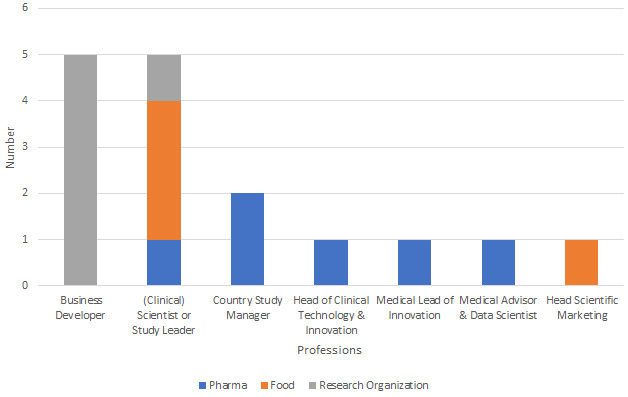
A total of 16 individuals with interest and experience in VCTs were interviewed, including persons from pharmaceutical companies (n=6), food and health organizations (n=4), and a research organization (n=6). Key barriers included a potentially low degree of acceptance by regulatory authorities, technical issues (standardization, validation, and data storage), compliance and adherence, and lack of knowledge or comprehension regarding the opportunities VCTs have to offer. Involvement of regulators in development processes, stakeholder exposure to the results of pilot studies, and clear and simple instructions and assistance for patients were considered key facilitators.
Collaboration among all stakeholders in VCT development is crucial to increase knowledge and awareness. Organizations should invest in accurate data collection technologies, and compliance of patients in VCTs needs to be ensured. Multicriteria decision analysis can help determine if a VCT is a preferred option by stakeholders. The findings of this study can be a good starting point to accelerate the development and widespread implementation of VCTs.
传统临床试验通过在严格控制的临床环境中测量干预措施的疗效,对于产生高质量证据至关重要。然而,它们的执行可能既昂贵又耗时。此外,临床试验在参与者的识别、招募和保留方面面临着一些后勤挑战;在试验期间进行一致的数据收集;以及对患者进行充分的随访。这可能导致资源利用效率低下。为了部分解决传统临床试验目前存在的问题,需要进行创新。其中一项创新是虚拟临床试验(VCT)。VCT 允许从多个信息源(如电子健康记录、临床和人口统计学数据、患者报告的结果、人体测量和活动测量以及参与者自行收集的数字生物标志物或(小)样本数据)中收集和整合多样化的数据。尽管 VCT 有可能为临床研究和患者带来巨大价值,因为它们可以降低临床试验成本、增加从患者日常环境中收集的数据量并减轻患者参与的负担,但迄今为止,VCT 的采用并不普遍。
本研究旨在通过从不同利益相关者的角度确定影响个人对 VCT 考虑的因素,更好地了解采用 VCT 的障碍和促进因素。
本研究基于在线半结构化访谈,对欧洲的制药公司、食品和健康组织以及一家应用研究组织进行了定性研究。使用罗杰斯创新扩散理论对数据进行了主题分析。
共采访了 16 名对 VCT 感兴趣且有经验的个人,包括制药公司(n=6)、食品和健康组织(n=4)以及研究组织(n=6)的人员。主要障碍包括监管机构可能接受程度低、技术问题(标准化、验证和数据存储)、合规性和依从性,以及对 VCT 提供的机会缺乏了解或理解。监管机构参与开发过程、利益相关者接触试点研究结果以及为患者提供清晰简单的说明和帮助被认为是关键的促进因素。
VCT 开发过程中所有利益相关者的合作对于增加知识和意识至关重要。组织应投资于准确的数据收集技术,并确保 VCT 中患者的合规性。多标准决策分析可以帮助利益相关者确定 VCT 是否是首选方案。本研究的结果可以为加速 VCT 的开发和广泛实施提供良好的起点。