Scandurra Cristiano, Bochicchio Vincenzo, Dolce Pasquale, Valerio Paolo, Muzii Benedetta, Maldonato Nelson Mauro
Department of Neuroscience, Reproductive Sciences and Dentistry, University of Naples Federico II, Via Sergio Pansini 5, 80131 Naples, Italy.
Department of Humanistic Studies, University of Calabria, Via Ponte Bucci Cubo 18/C, 87036 Rende, Italy.
Curr Psychol. 2023;42(9):7403-7413. doi: 10.1007/s12144-021-02059-x. Epub 2021 Jul 13.
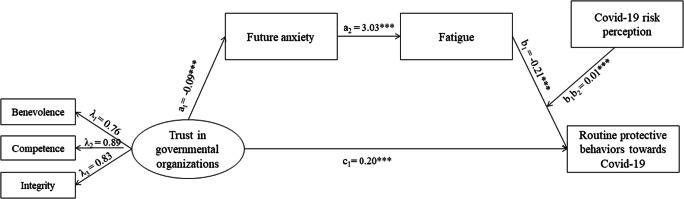
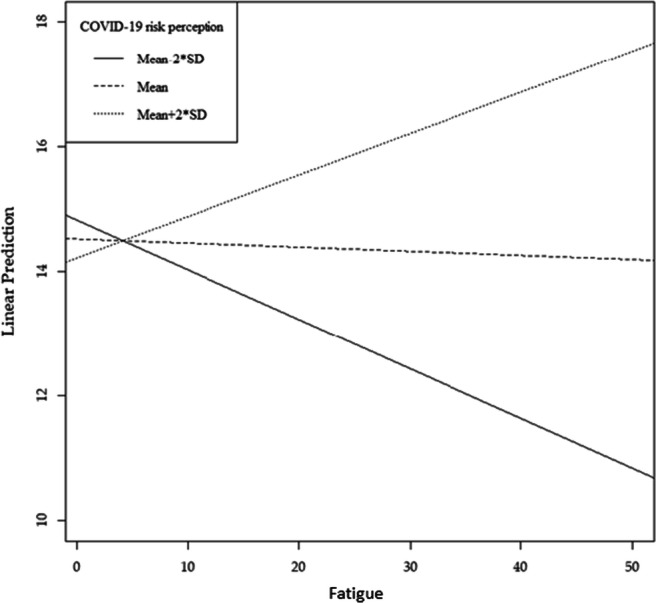
Trust in governmental organizations is a crucial factor in terms of encouraging people to conform to public health regulations, such as those recommended to slow down the spread of SARS-CoV-2. However, trust in governmental organizations tends to decline over time, reducing the compliance with public health regulations. This study aimed at exploring, first, the role of future anxiety and fatigue as serial mediators of the relationship between trust in governmental organizations and protective behaviors, and, secondly, the role of Covid-19 risk perception as a moderator between fatigue and protective behaviors. A total of 948 Italian participants (302 males and 646 females), ranged from 18 to 80 years ( = 27.20, = 11.01), answered an online survey during the second wave of the Covid-19 outbreak. A moderated serial mediation model was performed using a structural equation modeling. The results indicate that: (1) a higher trust in Italian governmental organizations was associated with a greater compliance in terms of adopting protective behaviors; (2) a lower trust in Italian governmental organizations increased anxiety about the future which, in turn, raised levels of fatigue, leading, finally, to a reduction in the levels of protective behaviors; and (3) as the perceived risk related to Covid-19 increased, the effect of fatigue on protective behaviors decreased. The findings of the current study may provide indications for public health policy on how to increase compliance with the recommended behaviors to be adopted in order to decrease the spread of the SARS-CoV-2.
在鼓励人们遵守公共卫生规定方面,对政府组织的信任是一个关键因素,例如那些为减缓SARS-CoV-2传播而推荐的规定。然而,对政府组织的信任往往会随着时间的推移而下降,从而降低对公共卫生规定的遵守程度。本研究旨在首先探讨未来焦虑和疲劳作为政府组织信任与保护行为之间关系的连续中介的作用,其次探讨新冠病毒风险认知作为疲劳与保护行为之间调节变量的作用。共有948名意大利参与者(302名男性和646名女性),年龄在18至80岁之间(平均年龄 = 27.20,标准差 = 11.01),在新冠疫情第二波期间回答了一项在线调查。使用结构方程模型进行了有调节的连续中介模型分析。结果表明:(1)对意大利政府组织的信任度越高,在采取保护行为方面的依从性就越高;(2)对意大利政府组织的信任度越低,会增加对未来的焦虑,进而提高疲劳程度,最终导致保护行为水平下降;(3)随着对新冠病毒感知风险的增加,疲劳对保护行为的影响减小。本研究结果可为公共卫生政策提供参考,说明如何提高对推荐行为的依从性,以减少SARS-CoV-2的传播。