Guangdong Provincial Key Laboratory of Medical Image Processing, School of Biomedical Engineering, Southern Medical University, Guangzhou 510515, China.
National-Regional Key Technology Engineering Laboratory for Medical Ultrasound, School of Biomedical Engineering, Health Science Center, Shenzhen University, Shenzhen 518060, China; Department of Medicine, Indiana University School of Medicine, Indianapolis, IN 46202, USA.
Genomics Proteomics Bioinformatics. 2021 Dec;19(6):1032-1042. doi: 10.1016/j.gpb.2020.06.026. Epub 2021 Jul 17.
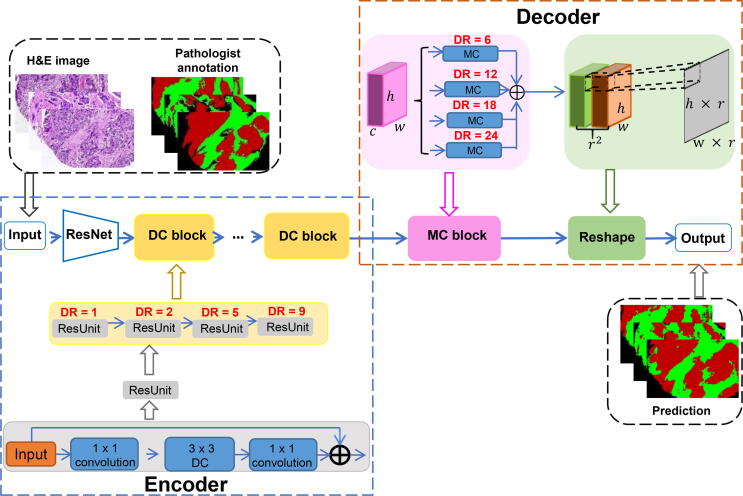
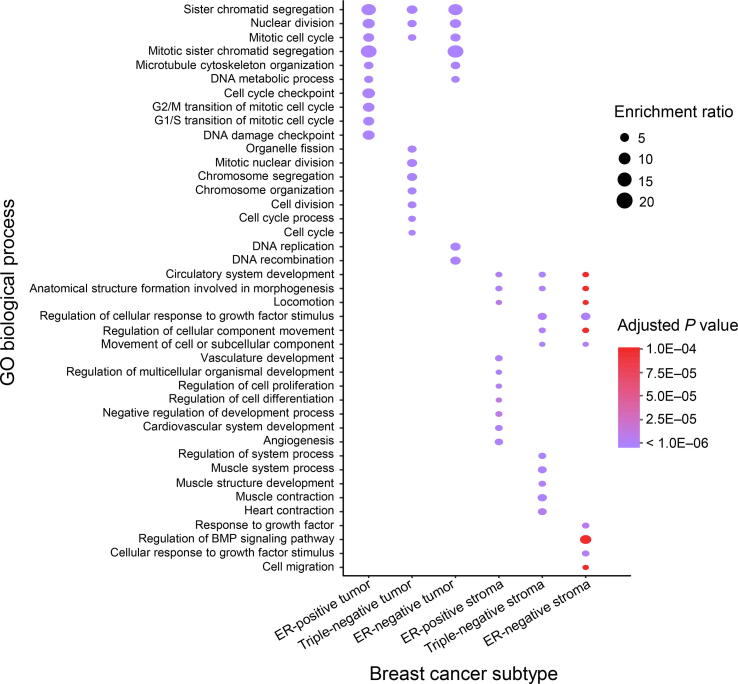
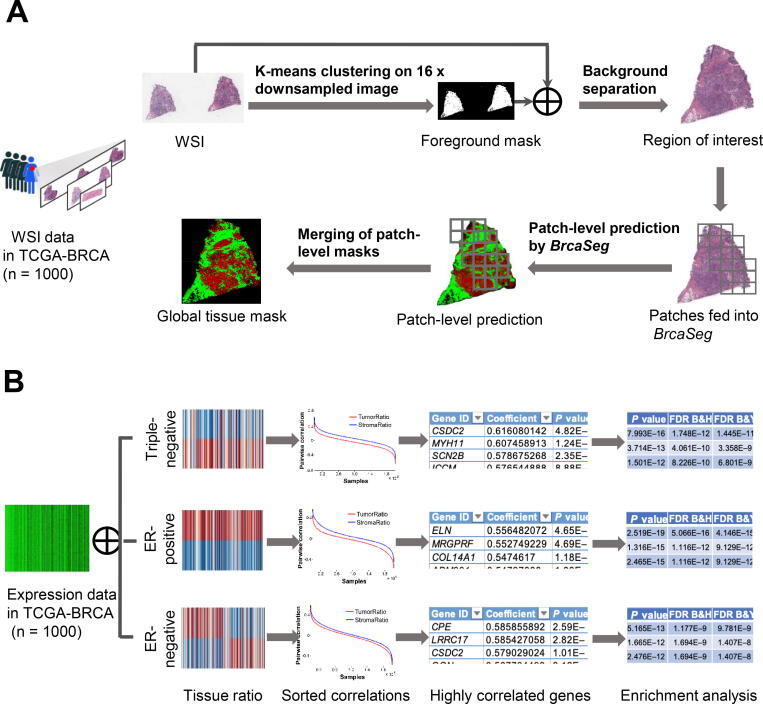
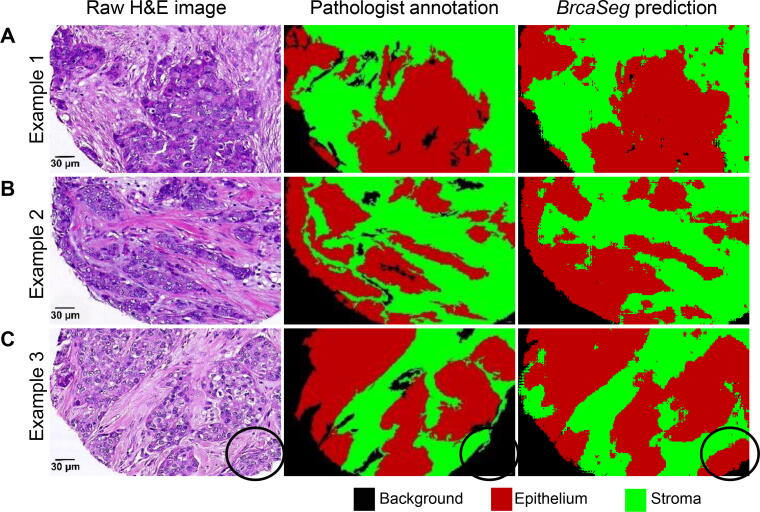
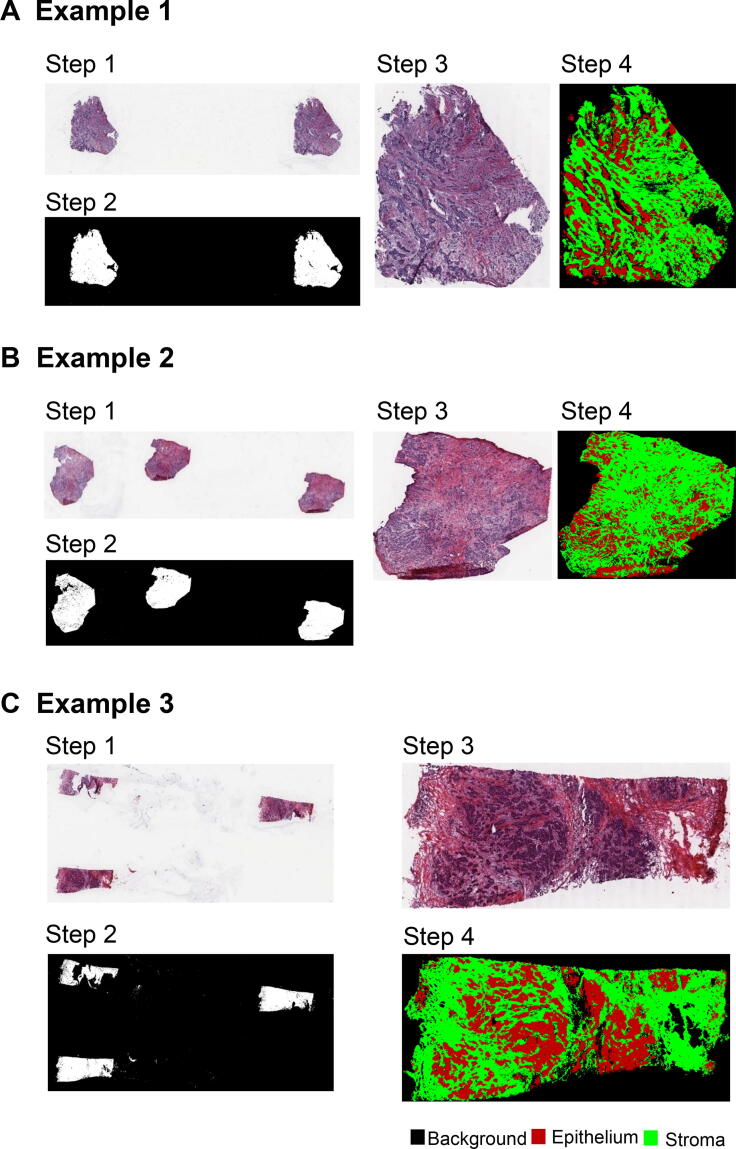
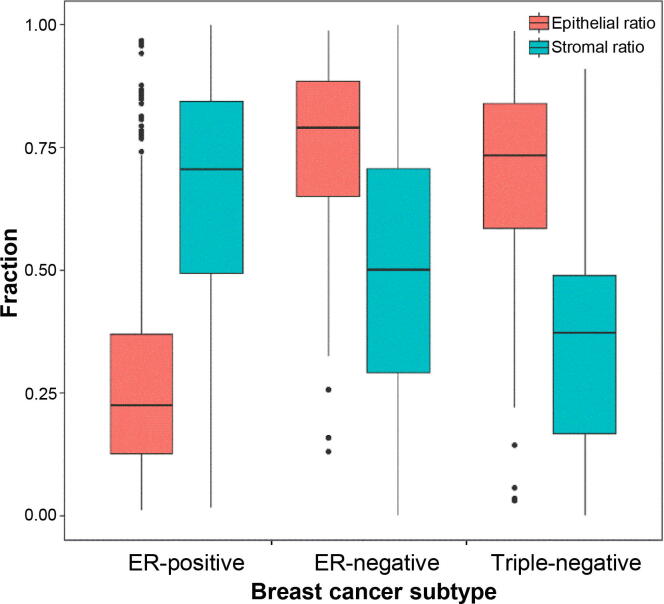
Epithelial and stromal tissues are components of the tumor microenvironment and play a major role in tumor initiation and progression. Distinguishing stroma from epithelial tissues is critically important for spatial characterization of the tumor microenvironment. Here, we propose BrcaSeg, an image analysis pipeline based on a convolutional neural network (CNN) model to classify epithelial and stromal regions in whole-slide hematoxylin and eosin (H&E) stained histopathological images. The CNN model is trained using well-annotated breast cancer tissue microarrays and validated with images from The Cancer Genome Atlas (TCGA) Program. BrcaSeg achieves a classification accuracy of 91.02%, which outperforms other state-of-the-art methods. Using this model, we generate pixel-level epithelial/stromal tissue maps for 1000 TCGA breast cancer slide images that are paired with gene expression data. We subsequently estimate the epithelial and stromal ratios and perform correlation analysis to model the relationship between gene expression and tissue ratios. Gene Ontology (GO) enrichment analyses of genes that are highly correlated with tissue ratios suggest that the same tissue is associated with similar biological processes in different breast cancer subtypes, whereas each subtype also has its own idiosyncratic biological processes governing the development of these tissues. Taken all together, our approach can lead to new insights in exploring relationships between image-based phenotypes and their underlying genomic events and biological processes for all types of solid tumors. BrcaSeg can be accessed at https://github.com/Serian1992/ImgBio.
上皮组织和基质组织是肿瘤微环境的组成部分,在肿瘤的发生和发展中起着重要作用。区分基质和上皮组织对于肿瘤微环境的空间特征具有重要意义。在这里,我们提出了 BrcaSeg,这是一种基于卷积神经网络(CNN)模型的图像分析管道,用于对全幻灯片苏木精和伊红(H&E)染色组织病理学图像中的上皮和基质区域进行分类。该 CNN 模型使用经过充分注释的乳腺癌组织微阵列进行训练,并使用癌症基因组图谱(TCGA)计划的图像进行验证。BrcaSeg 的分类准确率达到 91.02%,优于其他最先进的方法。使用这个模型,我们为 1000 张 TCGA 乳腺癌幻灯片图像生成了像素级别的上皮/基质组织图谱,这些图像与基因表达数据配对。随后,我们估计上皮和基质的比例,并进行相关性分析,以建立基因表达与组织比例之间的关系模型。与组织比例高度相关的基因的基因本体论(GO)富集分析表明,同一组织与不同乳腺癌亚型中的相似生物学过程相关,而每个亚型也有其自身特有的控制这些组织发育的生物学过程。总的来说,我们的方法可以为探索基于图像的表型与其潜在的基因组事件和生物学过程之间的关系提供新的见解,适用于所有类型的实体瘤。BrcaSeg 可在 https://github.com/Serian1992/ImgBio 上访问。