Emory University, School of Medicine, Atlanta, GA, USA.
Department of Biostatistics and Bioinformatics, Emory University, Atlanta, GA, USA.
Cancer Med. 2021 Sep;10(17):6070-6077. doi: 10.1002/cam4.4134. Epub 2021 Jul 20.
Tobacco and alcohol use are risk factors for Squamous Cell Carcinoma of the Head and Neck (SCCHN); however, there is growing recognition of HPV as a risk factor for SCCHN. HPV-related SCCHN is thought to affect mostly middle-aged individuals but as the US population ages, it is important to evaluate the change in incidence of HPV- and non-HPV-related SCCHN in individuals who are ≥65 years old.
This was a retrospective study using data from a population-based cancer registry (SEER) to identify individuals ≥65 years old diagnosed with SCCHN between 2000 and 2016 also stratified by sex, race, and birth cohort. The subgroups of HPV-associated and non-HPV associated sites were analyzed independently. The incidence per year was calculated and joinpoint detection was used to identity significant changes in incidence trends and annual percent change (APC).
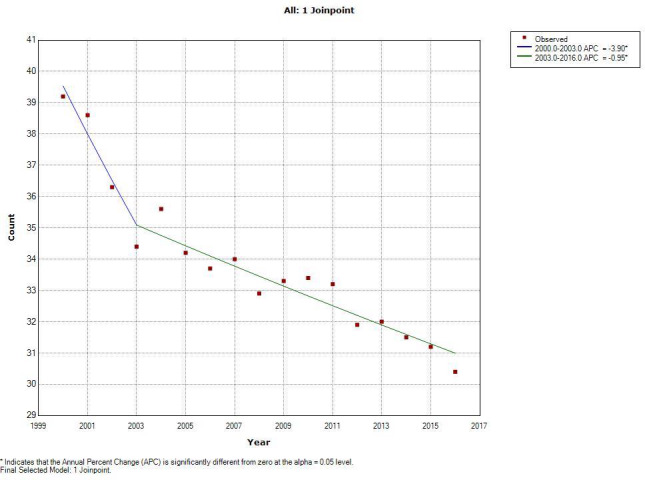
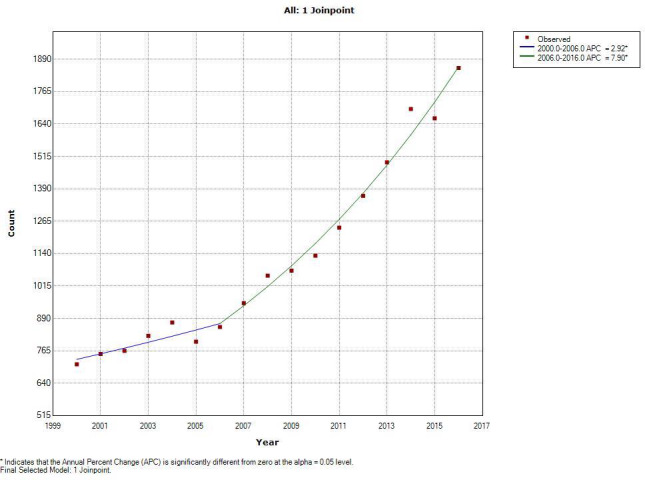
For HPV-associated sites from 2000 to 2016, there was an average annual rate of 10.8 per 100,000 individuals with an APC of 2.92% (p = <0.05). For HPV- and non-HPV-related SCCHN males had a higher annual rate compared to females, 54.5 versus 18.0 in non-HPV-related and 19.1 versus 4.4 in HPV-related sites. For non-HPV-related sites there was a decrease in APC across all stratified groups. For HPV-related sites there was an increase in APC across all stratified groups, especially males (APC 8.82% 2006-2016 p < 0.05) and White individuals (APC 8.19% 2006-2016 p < 0.05). When stratified by birth cohort, HPV-related SCCHN sites had a higher APC in ages 65-69 (8.38% p < 0.05) and 70-74 (8.54% p < 0.05).
Among the population ≥65 years old from 2000 to 2016, the incidence rate for HPV-related SCCHN sites has increased across all stratified groups, especially in White individuals, males, and age groups 65-74. The incidence rate for non-HPV-related sites has decreased across all stratified groups during this time.
烟草和酒精的使用是头颈部鳞状细胞癌(SCCHN)的危险因素;然而,HPV 作为 SCCHN 的危险因素正日益得到认可。HPV 相关的 SCCHN 被认为主要影响中年人群,但随着美国人口老龄化,评估≥65 岁人群中 HPV 和非 HPV 相关 SCCHN 的发病率变化非常重要。
这是一项使用人群癌症登记处(SEER)数据的回顾性研究,以确定 2000 年至 2016 年间诊断为 SCCHN 的≥65 岁人群,并按性别、种族和出生队列进行分层。分析了 HPV 相关和非 HPV 相关部位的亚组。计算了每年的发病率,并使用连接点检测确定发病率趋势和年平均变化百分比(APC)的显著变化。
在 2000 年至 2016 年期间,HPV 相关部位的平均年发病率为每 10 万人中有 10.8 例,APC 为 2.92%(p<0.05)。HPV-和非 HPV 相关的 SCCHN 中,男性的年发病率高于女性,非 HPV 相关部位为 54.5 比 18.0,HPV 相关部位为 19.1 比 4.4。在所有分层组中,非 HPV 相关部位的 APC 均呈下降趋势。在 HPV 相关部位,所有分层组的 APC 均呈上升趋势,尤其是男性(2006-2016 年 APC8.82%,p<0.05)和白人(2006-2016 年 APC8.19%,p<0.05)。按出生队列分层时,HPV 相关的 SCCHN 部位在 65-69 岁(APC8.38%,p<0.05)和 70-74 岁(APC8.54%,p<0.05)年龄组中的 APC 更高。
在 2000 年至 2016 年间≥65 岁的人群中,所有分层组的 HPV 相关 SCCHN 部位的发病率均有所增加,尤其是白人、男性和 65-74 岁年龄组。在此期间,所有分层组中非 HPV 相关部位的发病率均有所下降。