Diamond Light Source, Harwell Science and Innovation Campus, Didcot, UK.
Research Complex at Harwell, Rutherford Appleton Laboratory, Didcot, UK.
Nat Commun. 2021 Jul 22;12(1):4461. doi: 10.1038/s41467-021-24757-7.
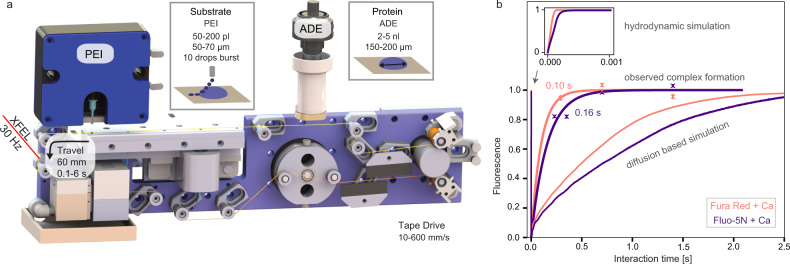
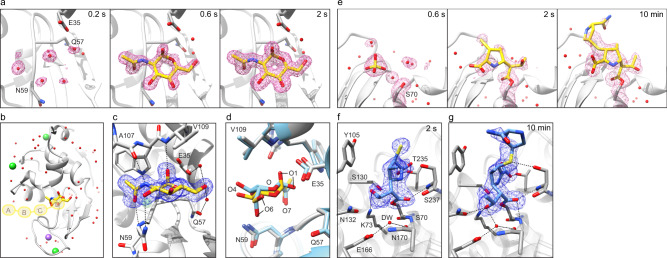
Serial femtosecond crystallography has opened up many new opportunities in structural biology. In recent years, several approaches employing light-inducible systems have emerged to enable time-resolved experiments that reveal protein dynamics at high atomic and temporal resolutions. However, very few enzymes are light-dependent, whereas macromolecules requiring ligand diffusion into an active site are ubiquitous. In this work we present a drop-on-drop sample delivery system that enables the study of enzyme-catalyzed reactions in microcrystal slurries. The system delivers ligand solutions in bursts of multiple picoliter-sized drops on top of a larger crystal-containing drop inducing turbulent mixing and transports the mixture to the X-ray interaction region with temporal resolution. We demonstrate mixing using fluorescent dyes, numerical simulations and time-resolved serial femtosecond crystallography, which show rapid ligand diffusion through microdroplets. The drop-on-drop method has the potential to be widely applicable to serial crystallography studies, particularly of enzyme reactions with small molecule substrates.
连续的飞秒晶体学在结构生物学中开辟了许多新的机会。近年来,出现了几种利用光诱导系统的方法,可以进行时间分辨实验,以高原子和时间分辨率揭示蛋白质动力学。然而,很少有酶是依赖光的,而需要配体扩散到活性部位的大分子是普遍存在的。在这项工作中,我们提出了一种液滴传递样品的输送系统,该系统可以在微晶体悬浮液中研究酶催化反应。该系统在较大的含有晶体的液滴顶部以多个皮升大小的液滴脉冲形式输送配体溶液,诱导湍流混合,并以时间分辨率将混合物输送到 X 射线相互作用区域。我们使用荧光染料、数值模拟和时间分辨连续飞秒晶体学证明了混合,表明配体通过微液滴快速扩散。液滴传递方法有可能广泛应用于连续结晶学研究,特别是对小分子底物的酶反应。