Department of Information Engineering, University of Padova, via G. Gradenigo 6b, 35131, Padova, Italy.
NCNP, National Centre of Neurology and Psychiatry, Tokyo, Japan.
Sci Rep. 2021 Jul 22;11(1):14938. doi: 10.1038/s41598-021-94526-5.
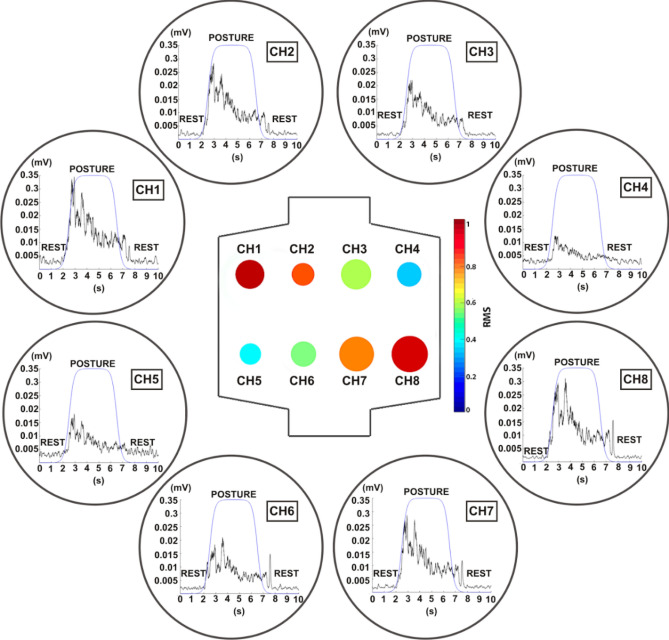
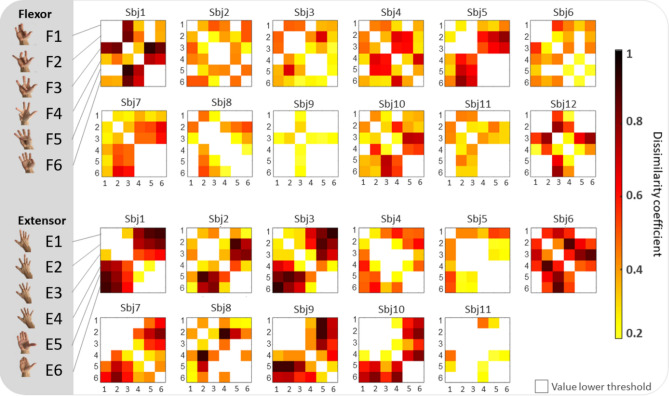
The use of surface electromyography (sEMG) is rapidly spreading, from robotic prostheses and muscle computer interfaces to rehabilitation devices controlled by residual muscular activities. In this context, sEMG-based gesture recognition plays an enabling role in controlling prosthetics and devices in real-life settings. Our work aimed at developing a low-cost, print-and-play platform to acquire and analyse sEMG signals that can be arranged in a fully customized way, depending on the application and the users' needs. We produced 8-channel sEMG matrices to measure the muscular activity of the forearm using innovative nanoparticle-based inks to print the sensors embedded into each matrix using a commercial inkjet printer. Then, we acquired the multi-channel sEMG data from 12 participants while repeatedly performing twelve standard finger movements (six extensions and six flexions). Our results showed that inkjet printing-based sEMG signals ensured significant similarity values across repetitions in every participant, a large enough difference between movements (dissimilarity index above 0.2), and an overall classification accuracy of 93-95% for flexion and extension, respectively.
表面肌电图(sEMG)的应用正在迅速普及,从机器人假肢和肌肉计算机接口到由残余肌肉活动控制的康复设备。在这种情况下,基于 sEMG 的手势识别在控制假肢和设备方面发挥了重要作用,这些假肢和设备可以在真实环境中进行控制。我们的工作旨在开发一种低成本、可打印和可玩的平台,以获取和分析 sEMG 信号,这些信号可以根据应用和用户的需求进行完全定制。我们使用创新的基于纳米颗粒的油墨制作了 8 通道 sEMG 矩阵,以测量前臂的肌肉活动,使用商业喷墨打印机将嵌入每个矩阵的传感器打印出来。然后,我们从 12 名参与者那里获取了多通道 sEMG 数据,同时反复执行 12 个标准手指运动(6 个伸展和 6 个弯曲)。我们的结果表明,基于喷墨打印的 sEMG 信号在每个参与者的每次重复中都能确保显著的相似值,运动之间的差异足够大(不相似指数高于 0.2),并且弯曲和伸展的整体分类准确率分别为 93-95%。