Dini Hossein, Sendi Mohammad S E, Sui Jing, Fu Zening, Espinoza Randall, Narr Katherine L, Qi Shile, Abbott Christopher C, van Rooij Sanne J H, Riva-Posse Patricio, Bruni Luis Emilio, Mayberg Helen S, Calhoun Vince D
Department of Architecture, Design and Media Technology, Aalborg University, Copenhagen, Denmark.
Wallace H. Coulter Department of Biomedical Engineering at Georgia Institute of Technology and Emory University, Atlanta, GA, United States.
Front Hum Neurosci. 2021 Jul 6;15:689488. doi: 10.3389/fnhum.2021.689488. eCollection 2021.
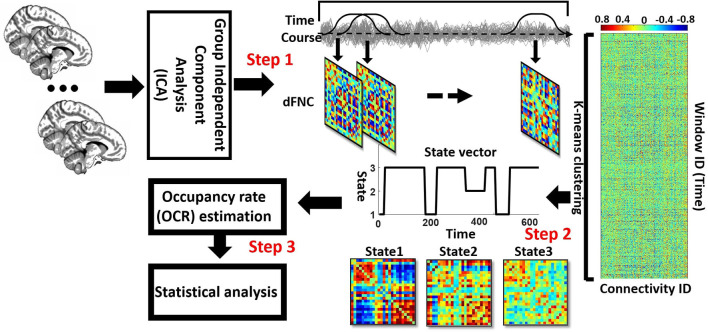
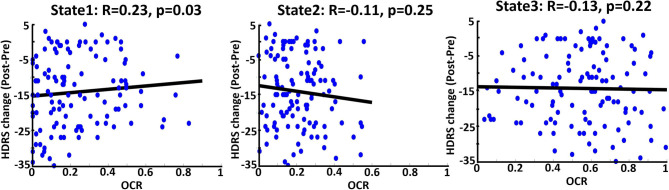
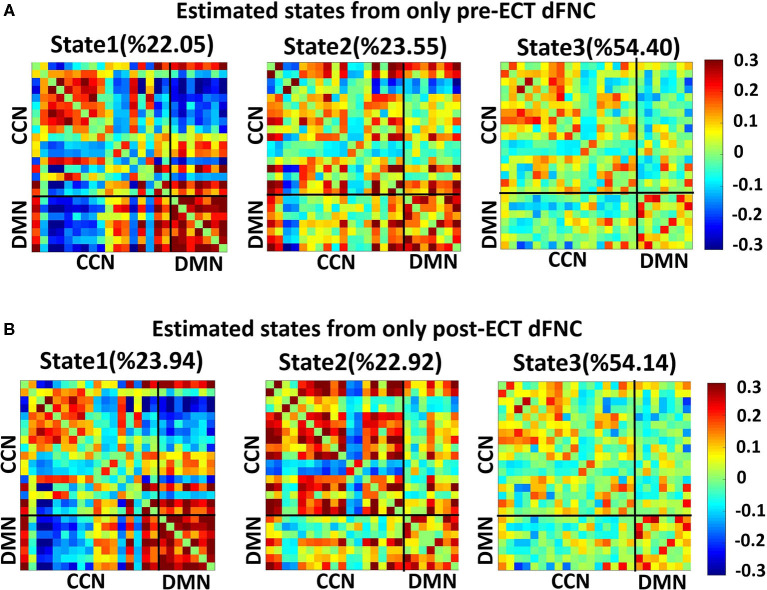
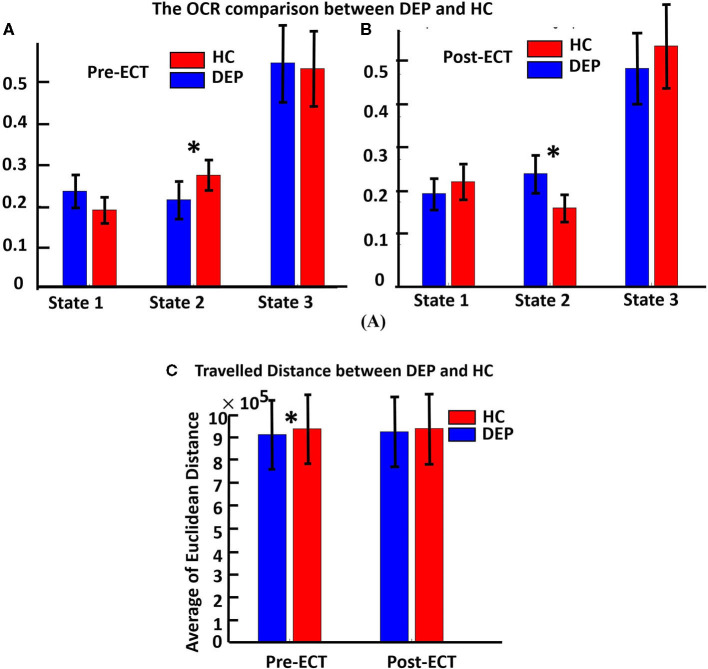
Electroconvulsive therapy (ECT) is one of the most effective treatments for major depressive disorder. Recently, there has been increasing attention to evaluate the effect of ECT on resting-state functional magnetic resonance imaging (rs-fMRI). This study aims to compare rs-fMRI of depressive disorder (DEP) patients with healthy participants, investigate whether pre-ECT dynamic functional network connectivity network (dFNC) estimated from patients rs-fMRI is associated with an eventual ECT outcome, and explore the effect of ECT on brain network states. Resting-state functional magnetic resonance imaging (fMRI) data were collected from 119 patients with depression or depressive disorder (DEP) (76 females), and 61 healthy (HC) participants (34 females), with an age mean of 52.25 ( = 180) years old. The pre-ECT and post-ECT Hamilton Depression Rating Scale (HDRS) were 25.59 ± 6.14 and 11.48 ± 9.07, respectively. Twenty-four independent components from default mode (DMN) and cognitive control network (CCN) were extracted, using group-independent component analysis from pre-ECT and post-ECT rs-fMRI. Then, the sliding window approach was used to estimate the pre-and post-ECT dFNC of each subject. Next, k-means clustering was separately applied to pre-ECT dFNC and post-ECT dFNC to assess three distinct states from each participant. We calculated the amount of time each subject spends in each state, which is called "occupancy rate" or OCR. Next, we compared OCR values between HC and DEP participants. We also calculated the partial correlation between pre-ECT OCRs and HDRS change while controlling for age, gender, and site. Finally, we evaluated the effectiveness of ECT by comparing pre- and post-ECT OCR of DEP and HC participants. The main findings include (1) depressive disorder (DEP) patients had significantly lower OCR values than the HC group in state 2, where connectivity between cognitive control network (CCN) and default mode network (DMN) was relatively higher than other states (corrected = 0.015), (2) Pre-ECT OCR of state, with more negative connectivity between CCN and DMN components, is linked with the HDRS changes (R = 0.23 corrected = 0.03). This means that those DEP patients who spent less time in this state showed more HDRS change, and (3) The post-ECT OCR analysis suggested that ECT increased the amount of time DEP patients spent in state 2 (corrected = 0.03). Our finding suggests that dynamic functional network connectivity (dFNC) features, estimated from CCN and DMN, show promise as a predictive biomarker of the ECT outcome of DEP patients. Also, this study identifies a possible underlying mechanism associated with the ECT effect on DEP patients.
电休克治疗(ECT)是重度抑郁症最有效的治疗方法之一。近年来,人们越来越关注评估ECT对静息态功能磁共振成像(rs-fMRI)的影响。本研究旨在比较抑郁症(DEP)患者与健康参与者的rs-fMRI,调查从患者rs-fMRI估计的ECT前动态功能网络连接网络(dFNC)是否与最终的ECT结果相关,并探讨ECT对脑网络状态的影响。收集了119例抑郁症或抑郁障碍(DEP)患者(76例女性)和61例健康(HC)参与者(34例女性)的静息态功能磁共振成像(fMRI)数据,平均年龄为52.25(=180)岁。ECT前和ECT后汉密尔顿抑郁量表(HDRS)分别为25.59±6.14和11.48±9.07。使用ECT前和ECT后rs-fMRI的组独立成分分析,从默认模式(DMN)和认知控制网络(CCN)中提取24个独立成分。然后,采用滑动窗口方法估计每个受试者的ECT前和ECT后dFNC。接下来,将k均值聚类分别应用于ECT前dFNC和ECT后dFNC,以评估每个参与者的三种不同状态。我们计算了每个受试者在每种状态下花费的时间量,即“占有率”或OCR。接下来,我们比较了HC和DEP参与者之间的OCR值。我们还在控制年龄、性别和部位的同时,计算了ECT前OCR与HDRS变化之间的偏相关性。最后,我们通过比较DEP和HC参与者的ECT前和ECT后OCR来评估ECT的有效性。主要发现包括:(1)抑郁障碍(DEP)患者在状态2中的OCR值显著低于HC组,在该状态下认知控制网络(CCN)和默认模式网络(DMN)之间的连接相对高于其他状态(校正后=0.015);(2)状态2的ECT前OCR,CCN和DMN成分之间的负连接性越强,与HDRS变化相关(R=0.23,校正后=0.03)。这意味着那些在该状态下花费时间较少的DEP患者显示出更多的HDRS变化;(3)ECT后OCR分析表明,ECT增加了DEP患者在状态2中花费的时间量(校正后=0.03)。我们的发现表明,从CCN和DMN估计的动态功能网络连接(dFNC)特征有望作为DEP患者ECT结果的预测生物标志物。此外,本研究确定了一种与ECT对DEP患者的影响相关的潜在机制。