Rappaport Faculty of Medicine, Department of Immunology, Technion-Israel Institute of Technology, Haifa, Israel.
Radiotherapy Unit, Oncology Division, Rambam Health Care Campus, Haifa, Israel.
Blood. 2021 Nov 11;138(19):1817-1829. doi: 10.1182/blood.2021012428.
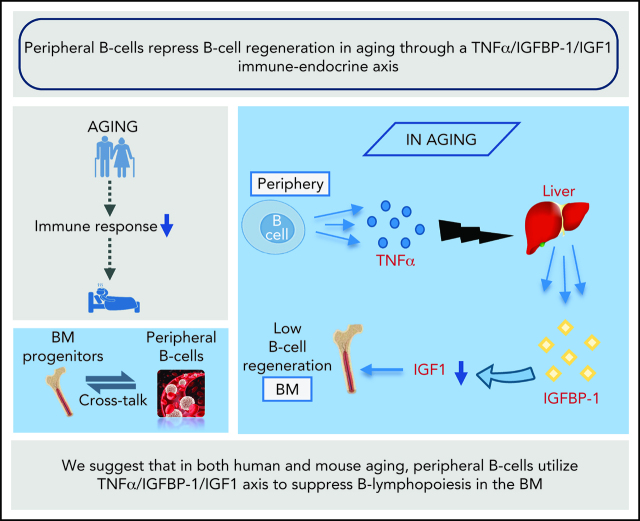
Loss of B lymphocyte regeneration in the bone marrow (BM) is an immunologic hallmark of advanced age, which impairs the replenishment of peripheral B-cell subsets and results in impaired humoral responses, thereby contributing to immune system dysfunction associated with aging. A better understanding of the mechanism behind this loss may suggest ways to restore immune competence and promote healthy aging. In this study, we uncover an immune-endocrine regulatory circuit that mediates cross-talk between peripheral B cells and progenitors in the BM, to balance B-cell lymphopoiesis in both human and mouse aging. We found that tumor necrosis factor α (TNF-α), which is increasingly produced by peripheral B cells during aging, stimulates the production of insulin-like growth factor-binding protein 1 (IGFBP-1), which binds and sequesters insulin-like growth factor 1 (IGF-1) in the circulation, thereby restraining its activity in promoting B-cell lymphopoiesis in the BM. Upon B-cell depletion in aging humans and mice, circulatory TNF-α decreases, resulting in increased IGF-1 and reactivation of B-cell lymphopoiesis. Perturbation of this circuit by administration of IGF-1 to old mice or anti-TNF-α antibodies to human patients restored B-cell lymphopoiesis in the BM. Thus, we suggest that in both human and mouse aging, peripheral B cells use the TNF-α/IGFBP-1/IGF-1 axis to repress B-cell lymphopoiesis. This trial was registered at www.clinicaltrials.govas#NCT00863187.
骨髓(BM)中 B 淋巴细胞再生的丧失是衰老的免疫学标志,它损害了外周 B 细胞亚群的补充,导致体液免疫反应受损,从而导致与衰老相关的免疫系统功能障碍。更好地了解这种丧失背后的机制可能会提示恢复免疫能力和促进健康衰老的方法。在这项研究中,我们揭示了一种免疫内分泌调节回路,该回路介导外周 B 细胞与 BM 中的祖细胞之间的串扰,以平衡人类和小鼠衰老过程中的 B 细胞淋巴生成。我们发现,肿瘤坏死因子 α(TNF-α)在衰老过程中越来越多地由外周 B 细胞产生,刺激胰岛素样生长因子结合蛋白 1(IGFBP-1)的产生,IGFBP-1 在循环中结合并隔离胰岛素样生长因子 1(IGF-1),从而抑制其促进 BM 中 B 细胞淋巴生成的活性。在衰老的人类和小鼠中耗尽 B 细胞后,循环 TNF-α 减少,导致 IGF-1 增加和 B 细胞淋巴生成重新激活。通过给老年小鼠施用 IGF-1 或给人类患者施用抗 TNF-α 抗体来扰乱该回路,恢复了 BM 中的 B 细胞淋巴生成。因此,我们认为在人类和小鼠衰老过程中,外周 B 细胞使用 TNF-α/IGFBP-1/IGF-1 轴来抑制 B 细胞淋巴生成。该试验在 www.clinicaltrials.govas#NCT00863187 进行了注册。