Chokshi Chirayu R, Brakel Benjamin A, Tatari Nazanin, Savage Neil, Salim Sabra K, Venugopal Chitra, Singh Sheila K
Department of Biochemistry and Biomedical Sciences, McMaster University, Hamilton, ON L8N 3Z5, Canada.
Department of Surgery, Faculty of Health Sciences, McMaster University, Hamilton, ON L8N 3Z5, Canada.
Cancers (Basel). 2021 Jul 7;13(14):3400. doi: 10.3390/cancers13143400.
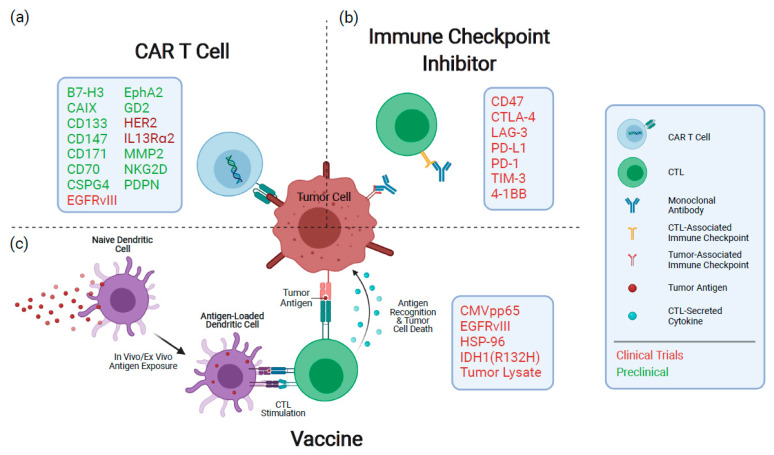
Despite aggressive multimodal therapy, glioblastoma (GBM) remains the most common malignant primary brain tumor in adults. With the advent of therapies that revitalize the anti-tumor immune response, several immunotherapeutic modalities have been developed for treatment of GBM. In this review, we summarize recent clinical and preclinical efforts to evaluate vaccination strategies, immune checkpoint inhibitors (ICIs) and chimeric antigen receptor (CAR) T cells. Although these modalities have shown long-term tumor regression in subsets of treated patients, the underlying biology that may predict efficacy and inform therapy development is being actively investigated. Common to all therapeutic modalities are fundamental mechanisms of therapy evasion by tumor cells, including immense intratumoral heterogeneity, suppression of the tumor immune microenvironment and low mutational burden. These insights have led efforts to design rational combinatorial therapies that can reignite the anti-tumor immune response, effectively and specifically target tumor cells and reliably decrease tumor burden for GBM patients.
尽管采用了积极的多模态治疗,但胶质母细胞瘤(GBM)仍是成人中最常见的原发性恶性脑肿瘤。随着能够重振抗肿瘤免疫反应的疗法的出现,已经开发了几种免疫治疗方法来治疗GBM。在本综述中,我们总结了近期评估疫苗接种策略、免疫检查点抑制剂(ICI)和嵌合抗原受体(CAR)T细胞的临床和临床前研究成果。尽管这些方法在部分接受治疗的患者中显示出长期肿瘤消退,但可能预测疗效并为治疗发展提供信息的潜在生物学机制正在积极研究中。所有治疗方法的共同之处在于肿瘤细胞逃避治疗的基本机制,包括巨大的肿瘤内异质性、肿瘤免疫微环境的抑制和低突变负荷。这些见解促使人们努力设计合理的联合疗法,以重新激发抗肿瘤免疫反应,有效且特异性地靶向肿瘤细胞,并可靠地减轻GBM患者的肿瘤负担。