Department of Chemical Pathology, The Chinese University of Hong Kong, Prince of Wales Hospital, Hong Kong, China.
State Key Laboratory of Research on Bioactivities and Clinical Applications of Medicinal Plants, Institute of Chinese Medicine, The Chinese University of Hong Kong, Hong Kong, China.
Int J Mol Sci. 2021 Jul 9;22(14):7393. doi: 10.3390/ijms22147393.
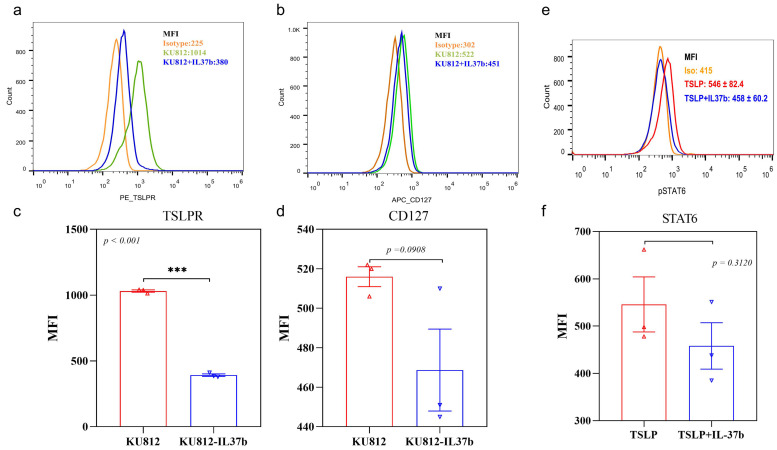
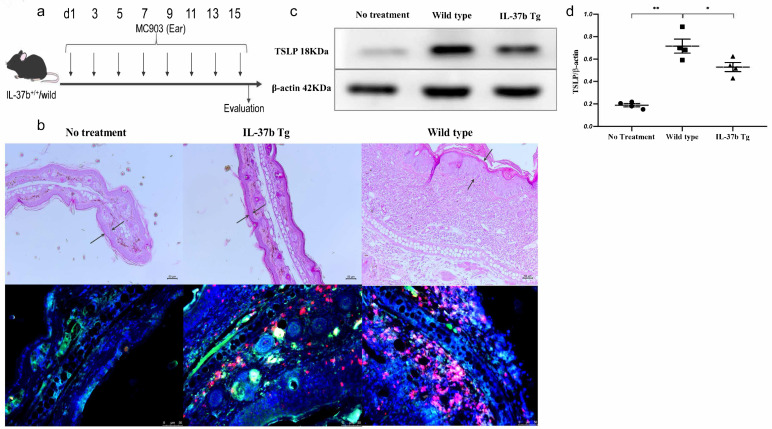
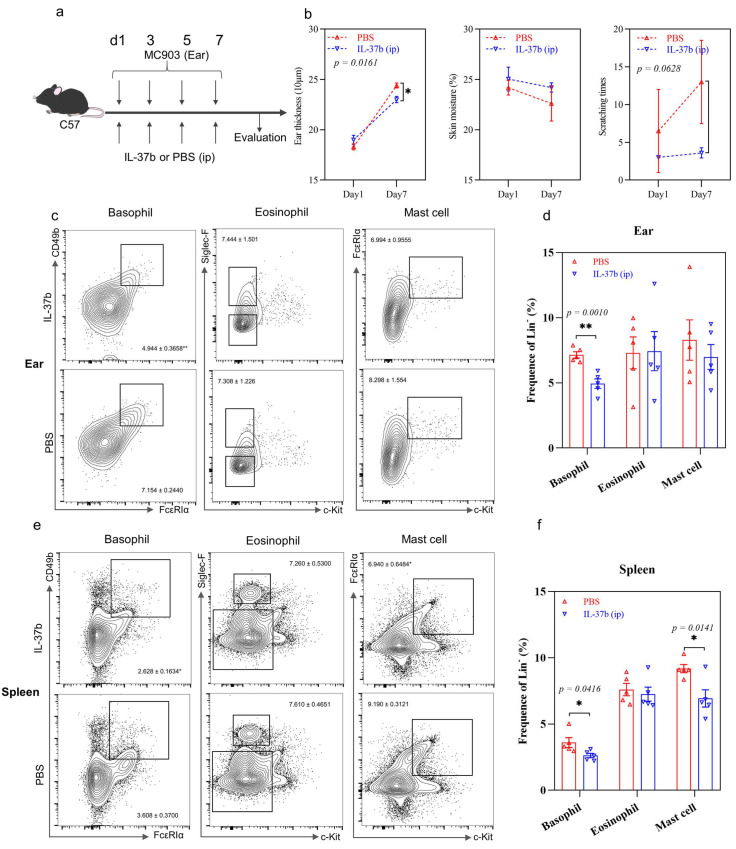
Atopic dermatitis (AD) represents a severe global burden on physical, physiological and mental health. Innate immune cell basophils are essential for provoking allergic inflammation in AD. However, the roles of novel immunoregulatory cytokine IL-37 in basophils remain elusive. We employed in vitro co-culture of human basophils and human keratinocyte HaCaT cells and an in vivo MC903-induced AD murine model to investigate the anti-inflammatory mechanism of IL-37. In the in vitro model, IL-37b significantly decreased Der p1-induced thymic stromal lymphopoietin (TSLP) overexpression in HaCaT cells and decreased the expression of TSLP receptor as well as basophil activation marker CD203c on basophils. IL-37 could also reduce Th2 cytokine IL-4 release from TSLP-primed basophils ex vivo. In the in vivo model, alternative depletion of basophils ameliorated AD symptoms and significantly lowered the Th2 cell and eosinophil populations in the ear and spleen of the mice. Blocking TSLP alleviated the AD-like symptoms and reduced the infiltration of basophils in the spleen. In CRISPR/Cas9 human IL-37b knock-in mice or mice with direct treatment by human IL-37b antibody, AD symptoms including ear swelling and itching were significantly alleviated upon MC903 challenge. Notably, IL-37b presence significantly reduced the basophil infiltration in ear lesions. In summary, IL-37b could regulate the TSLP-mediated activation of basophils and reduce the release of IL-4. The results, therefore, suggest that IL-37 may target TSLP-primed basophils to alleviate AD.
特应性皮炎(AD)对身体、生理和心理健康造成严重的全球性负担。先天免疫细胞嗜碱性粒细胞对于引发 AD 中的过敏炎症至关重要。然而,新型免疫调节细胞因子 IL-37 在嗜碱性粒细胞中的作用仍不清楚。我们采用人嗜碱性粒细胞与角质形成细胞 HaCaT 的体外共培养和 MC903 诱导的 AD 小鼠模型,研究了 IL-37 的抗炎机制。在体外模型中,IL-37b 显著降低 Der p1 诱导的 HaCaT 细胞中胸腺基质淋巴细胞生成素(TSLP)的过表达,并降低 TSLP 受体以及嗜碱性粒细胞激活标志物 CD203c 的表达。IL-37b 还可以减少 TSLP 预激活的嗜碱性粒细胞体外释放 Th2 细胞因子 IL-4。在体内模型中,嗜碱性粒细胞的替代耗竭改善 AD 症状,并显著降低小鼠耳部和脾脏中的 Th2 细胞和嗜酸性粒细胞群体。阻断 TSLP 可减轻 AD 样症状,并减少脾脏中嗜碱性粒细胞的浸润。在 CRISPR/Cas9 人 IL-37b 敲入小鼠或直接用人 IL-37b 抗体治疗的小鼠中,MC903 攻击后,包括耳部肿胀和瘙痒在内的 AD 症状明显缓解。值得注意的是,IL-37b 的存在显著减少了耳部病变中的嗜碱性粒细胞浸润。总之,IL-37b 可以调节 TSLP 介导的嗜碱性粒细胞激活,并减少 IL-4 的释放。因此,结果表明 IL-37 可能靶向 TSLP 预激活的嗜碱性粒细胞来缓解 AD。