Department of Automated Biological Diagnostic, Cochin Hospital, APHP-Centre Université de Paris, 75014 Paris, France.
Department of Virology, Cochin Hospital, APHP-Centre Université de Paris, 75014 Paris, France.
Int J Mol Sci. 2021 Jul 12;22(14):7462. doi: 10.3390/ijms22147462.
We aimed to investigate the prognostic performances of oxidative stress (OS), inflammatory and cell activation biomarkers measured at admission in COVID-19 patients.
retrospective monocentric study.
patients with suspected SARS-CoV-2 infection (COVID-19) admitted to the hospital.
One hundred and sixty documented and unselected COVID-19-patients. Disease severity (from mild to critical) was scored according to NIH's classification.
none.
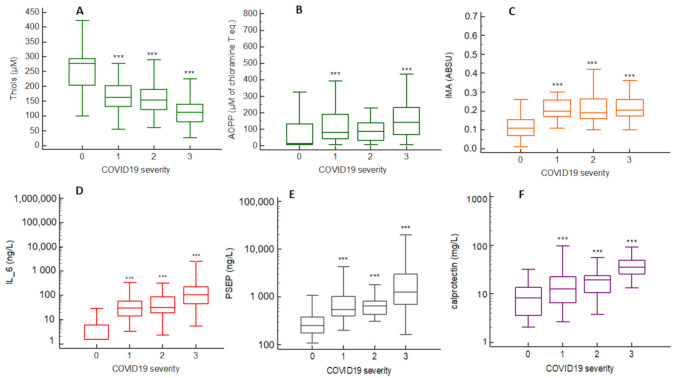
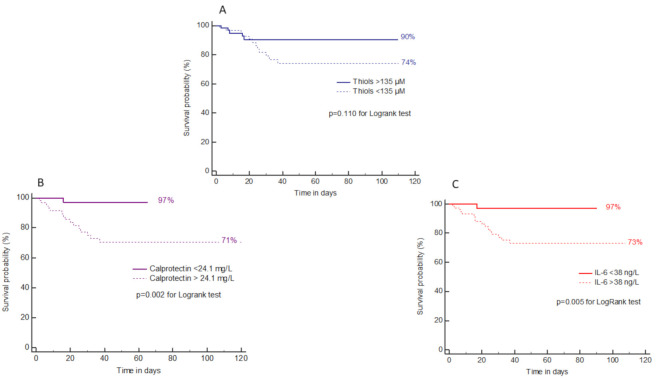
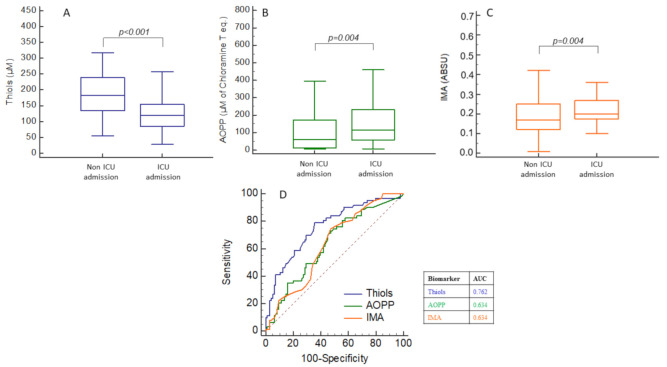
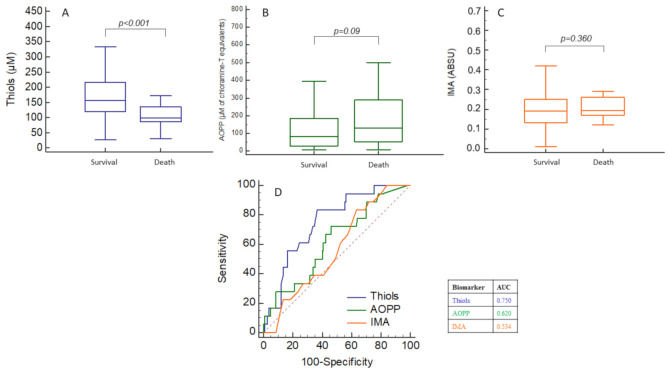
We measured OS biomarkers (thiol, advanced oxidation protein products (AOPP), ischemia-modified albumin (IMA)), inflammation biomarkers (interleukin-6 (IL-6), presepsin) and cellular activation biomarkers (calprotectin) in plasma at admission. Thiol concentrations decreased while IMA, IL-6, calprotectin and PSEP increased with disease severity in COVID-19 patients and were associated with increased O needs and ICU admission. The best area under the receiver-operating-characteristics curve (AUC) for the prediction of ICU admission was for thiol (AUC = 0.762). A thiol concentration <154 µmol/L was predictive for ICU admission (79.7% sensitivity, 64.6% specificity, 58.8% positive predictive value, 78.9% negative predictive value). In a stepwise logistic regression, we found that being overweight, having dyspnoea, and thiol and IL-6 plasmatic concentrations were independently associated with ICU admission. In contrast, calprotectin was the best biomarker to predict mortality (AUC = 0.792), with an optimal threshold at 24.1 mg/L (94.1% sensitivity, 64.9% specificity, 97.1% positive predictive value and 98.9% negative predictive value), and survival curves indicated that high IL-6 and calprotectin concentrations were associated with a significantly increased risk of mortality.
Thiol measurement at admission is a promising tool to predict ICU admission in COVID-19-patients, whereas IL-6 and calprotectin measurements effectively predict mortality.
我们旨在研究入院时测定的氧化应激(OS)、炎症和细胞激活生物标志物在 COVID-19 患者中的预后表现。
回顾性单中心研究。
疑似 SARS-CoV-2 感染(COVID-19)的患者住院。
160 例确诊和未经选择的 COVID-19 患者。根据 NIH 分类对疾病严重程度(从轻到重)进行评分。
无。
我们在入院时测量了血浆中的 OS 生物标志物(硫醇、高级氧化蛋白产物(AOPP)、缺血修饰白蛋白(IMA))、炎症生物标志物(白细胞介素 6(IL-6)、前降钙素)和细胞激活生物标志物(钙卫蛋白)。在 COVID-19 患者中,随着疾病严重程度的增加,硫醇浓度降低,而 IMA、IL-6、钙卫蛋白和 PSEP 增加,并与增加的 O 需求和 ICU 入院相关。预测 ICU 入院的最佳受试者工作特征曲线(ROC)下面积(AUC)为硫醇(AUC=0.762)。硫醇浓度<154μmol/L 可预测 ICU 入院(79.7%敏感性,64.6%特异性,58.8%阳性预测值,78.9%阴性预测值)。在逐步逻辑回归中,我们发现超重、呼吸困难以及硫醇和 IL-6 血浆浓度与 ICU 入院独立相关。相反,钙卫蛋白是预测死亡率的最佳生物标志物(AUC=0.792),最佳阈值为 24.1mg/L(94.1%敏感性,64.9%特异性,97.1%阳性预测值和 98.9%阴性预测值),生存曲线表明高 IL-6 和钙卫蛋白浓度与死亡率显著增加相关。
入院时的硫醇测量是预测 COVID-19 患者 ICU 入院的有前途的工具,而 IL-6 和钙卫蛋白测量可有效预测死亡率。